PM offers new freeze for recognition of Jewish state
PA publicly rejects proposal that had been discussed quietly; US exploring other solutions to "ensure talks take place."
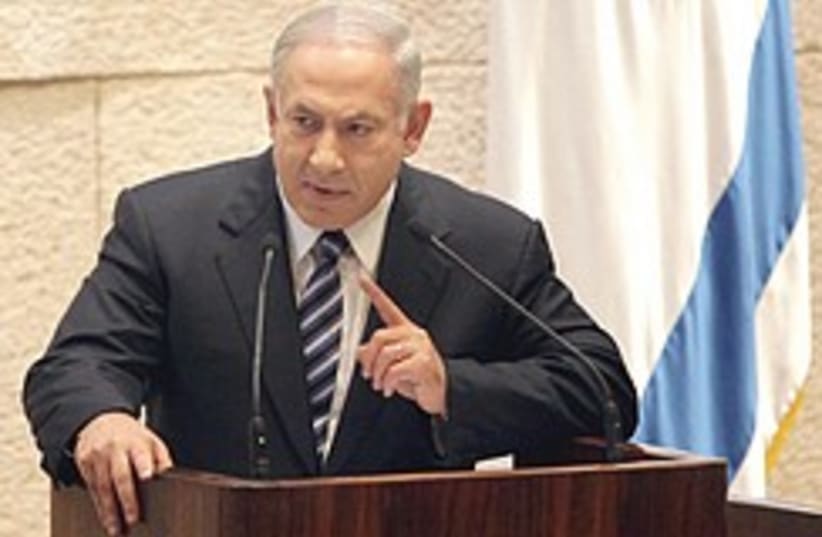
By HERB KEINONNetanyahu speaks at Knesset 248.88(photo credit: Ariel Jerozolimski)
The Palestinian Authority has rejected Israel’s suggestion that it recognize Israel as a Jewish state in exchange for a renewal of the settlement construction moratorium, officials in the Prime Minister’s Office said on Monday.“The idea was simple,” one official said. “If they could move on an issue important to us, then the prime minister would feel confident and ask the cabinet for a moratorium extension.”RELATED:Barak says land referendum bill obstructs peace process'In the ME, the weak do not survive, only the strong'The official’s comments, revealing the focus of intensive US-Israeli discussions over the past few weeks to keep the direct talks alive, came after Prime Minister Binyamin Netanyahu announced at the opening of the Knesset’s winter session on Monday that he would ask for a settlement moratorium extension if the PA would unequivocally recognize Israel as the nation-state of the Jewish people.The Palestinians quickly rebuffed the idea, with chief negotiator Saeb Erekat saying the PA “forcefully rejects all these Israeli games. The racist demands of Netanyahu cannot be tied to the request to cease building in the settlements for the purpose of establishing a state.”Nabil Abu Rudaineh, a spokesman for PA President Mahmoud Abbas, was not much more forthcoming, saying that for the Palestinians all the settlements were illegal, and their construction should be frozen so peace talks could continue.“As for the issue of Israel’s Jewishness, we have nothing to do with this matter,” Abu Rudaineh said, adding that the Palestinians went to the peace talks with Israel on the basis of mutual recognition between Israel and the PLO.“This is the Palestinian position on the basis of which the peace process was launched,” he said.Netanyahu, in his Knesset speech, said that despite the negative Palestinian response, the US was “attempting other means to ensure that the talks take place. The United States has made various suggestions, and we are seriously and responsibly considering them, in accordance with Israel’s national interests, first and foremost security.”The Obama administration has reportedly offered Israel a basket of security and political “incentives” in exchange for a limited renewal of the moratorium.Earlier in the day, during a discussion on the settlement issue in the Likud’s Knesset faction, Netanyahu was quoted as saying that it was important to be “realistic.”“We also have other interests,” the prime minister said. “There are other things that are no less important to us than settlement.”During his Knesset speech, Netanyahu finally shined some light on the nature of the intensive discussions that have been taking place for nearly a month to overcome the settlement moratorium impasse. The 10-month moratorium ended on September 26.“During the past several weeks, I have explored every path to ensuring the continuation of the talks,” Netanyahu declared, saying he was looking for something to convince the government and the country that the Palestinians “are truly ready to live with us in peace.”“There is one thing,” he continued. “I transmitted the message through quiet channels during the past month, and I am now saying it here, publicly: If the Palestinian leadership will unequivocally say to its people that it recognizes Israel as the nation-state of the Jewish people, I will be ready to convene my government and ask for another suspension of construction for a fixed period.Because the Palestinians expect us to recognize the Palestinian state as their nationstate, we can expect them to recognize the Jewish state as our nation-state.”Netanyahu did not spell out how long a period he had in mind, nor the manner in which he expected the Palestinian leadership to offer their recognition. One idea that has been discussed was for Abbas to deliver a speech in Arabic recognizing Israel as the nation-state of the Jewish people, just as Netanyahu delivered his Bar-Ilan speech in Hebrew last year declaring acceptance of a two-state solution.“There is no doubt that such a move by the Palestinian Authority would serve as a confidence- building step, one that would open up a new horizon of hope and trust among broad sections of the Israel public who, in light of the events of the past decade, have lost their confidence in the Palestinians’ desire to end the conflict,” Netanyahu said.The prime minister said he hoped that the Palestinian decision not to renew the talks without a renewal of the moratorium was not taken to “avoid making the real decisions necessary for a peace agreement.”Netanyahu, who was interrupted by opposition MKs some 20 times during his roughly 30-minute speech, said that not only Israel, but also the Palestinians, will “have to make difficult decisions.” He said that for compromise to lead to peace, and not more war, it must be accompanied by two fundamental components: recognition and security arrangements.The demand for Palestinian recognition of Israel as a Jewish state, he said, was not just “stubbornness,” but rather the “root of the conflict and therefore a central foundation for resolving it. For 100 years, the Palestinians have taught entire generations to believe that there is no Jewish people, that this land is their homeland alone.”Netanyahu’s spokesman, Mark Regev, said in response to the Palestinian rebuff to Netanyahu’s proposal that eventually a peace agreement would require Palestinian acceptance of Israel’s legitimacy.“If they do it now, this would energize the process and move it ahead much more speedily to tackle the other issues,” Regev said. “This process will not succeed if the expectation is that the Palestinians make the demands, and Israel makes the concessions.It will only work if it is a two-way street where there is give and take, and flexibility is exercised on both sides.”Khaled Abu Toameh contributed to this report.
if(catID != 151){
var cont = `Take Israel home with the new Jerusalem Post Store