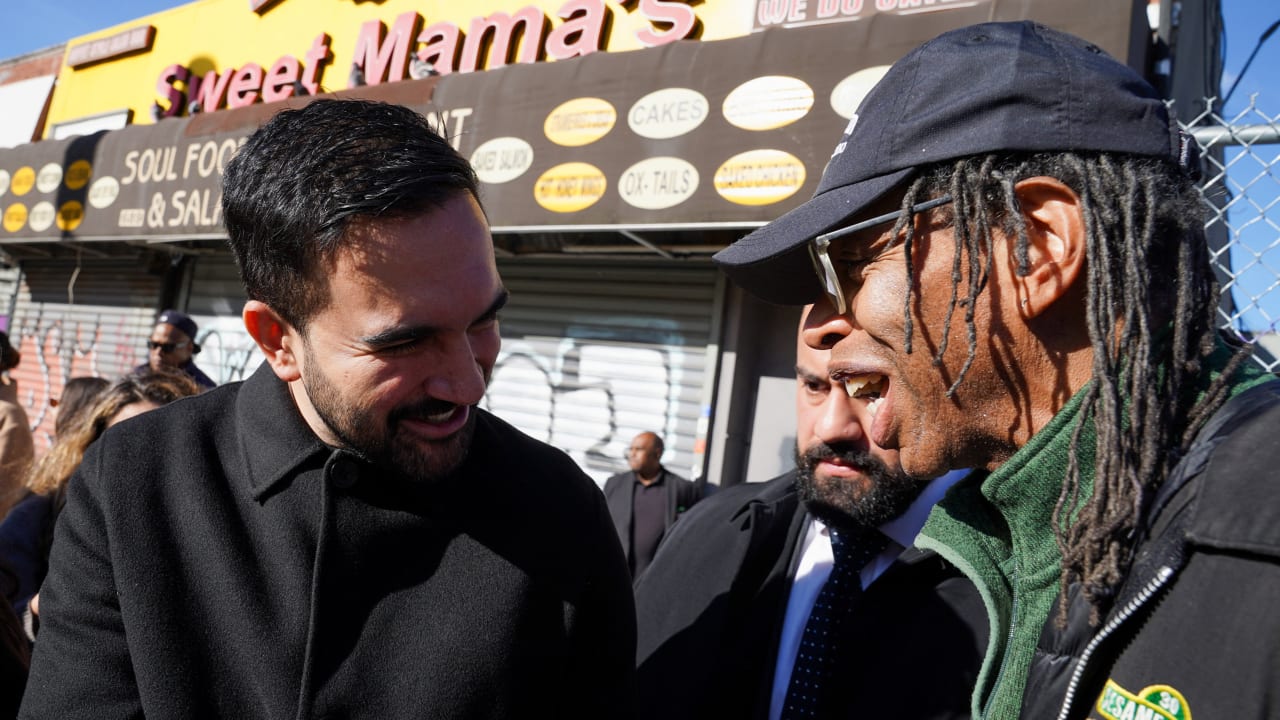
On the eve of election night in New York City, Zohran Mamdani posted a video showing his campaign for mayor over the past year. “A few days after the presidential election one year ago, we went to Fordham Road in the Bronx,” he wrote.
The video depicted him basically on his own as he stood out on a street corner speaking to New Yorkers. This approach has carried him to victory over the past year. He ran an energetic campaign, connecting with average people in New York.
While Mamdani was doing things like canvassing among taxi drivers at LaGuardia Airport, his opponents were calling him a “jihadist” and a “communist,” urging for his deportation.
In a last effort to defeat the rising young star, people then tried to push former New York State gov. Andrew Cuomo on voters. In addition, there was an attempt to get the Republican candidate, Curtis Sliwa, to drop out of the race, essentially haranguing Republicans that they “had” to vote for Cuomo.
This “lesser of two evils” strategy did not work. In the end, Sliwa got only seven percent of the vote, and the former governor got only 41%.

There should be lessons to be learned from this race. First of all, it was an off-year election; America is not even at the midterms yet.
That means it’s likely that Democrats will perform well, as they did in New Jersey and Virginia – Mikie Sherrill easily won the race for governor in New Jersey, as did Abigail Spanberger in Virginia.
Those looking at the Mamdani story could simply argue that he performed well in a predominantly Democratic city running against a controversial former governor and a Republican whose candidacy never caught on.
Many will search for the lessons in this. Is Mamdani’s more far Left brand of politics a curtain raiser on the future? There is no doubt that Bernie Sanders and others have sought to push the Democratic Party further to the Left, making it more populist and in touch with working-class people. Graham Platner’s campaign in Maine for US Senate has tapped into the same concepts.
Others may see in Mamdani’s victory a bad lesson for the rest of the US. New York City is not representative of most of America. It is more diverse than most of the rest of the US. New York has more immigrants or children of immigrants.
The Mamdani message may have resonated with New Yorkers, whereas it might not resonate in other places. As such, some say the real lessons about the future of US politics can be found in New Jersey and Virginia.
Mamdani shows that a good campaign has to inspire people
Notwithstanding this, there are still clear lessons to derive from the New York City race. For one, Mamdani showed that a campaign requires being on the street level, getting out the vote among average people. Parachuting in candidates like Cuomo and then trying to sell fear as a reason to vote for him was not an effective tactic.
Most people do not vote out of fear or a “lesser of two evils” question; they want to be inspired; they want to be met on the streets; they want a candidate who channels their views.
US President Donald Trump campaigned on many issues that unite people. At his base, there is a movement that believes he has America’s best interests at heart. Critics will say that this is just propaganda and that Trump does not have much in common with the average American.
However, what matters is not whether Trump’s experience in New York City for most of his life has much in common with people in most of America; what matters is that many voters think Trump speaks for them. When he talks about American workers and not wasting US lives on foreign wars, people tend to agree.
This is because they remember the Global War on Terror when Americans were sent abroad for wars and their lives were lost for nothing. What was the point of the 20-year war in Afghanistan? Was it to watch that country just being handed back to the Taliban?
One of the defining issues in the Mamdani campaign was the question about how Jewish voters would turn out and whether his campaign was “antisemitic” or anti-Israel.
In many cases, these two issues were conflated.
One article in The New York Times included a sentence that read, “The city that has long defined the Jewish experience for Americans – the land of Seinfeld and Katz’s Delicatessen and [famous 1950s to 1960s baseball player] Sandy Koufax – may be led by a man who is openly hostile to the government of Israel.”
This sentence seems to imply that Israel primarily defines Jewish Americans. However, historically, this has not been true. Katz’s Delicatessen has existed since 1888. Clearly, many Jewish New York institutions predate the modern State of Israel as well.
In many places in America, moreover, it is historically accurate to say that people can critique Israel without being antisemitic. In fact, many Jews in the US feel this way. So many of them felt this way that around a third of Jewish voters in New York City apparently voted for Mamdani.
There was an attempt during the campaign to try to make Israel a focal point. This is partly because the campaign took place during the Israel-Hamas War. Protests surrounding the war were common in NYC. People tore down hostage posters, and campuses became centers of pro-Palestinian rallies.
During the campaign, there was often the chicken-or-the-egg question about Mamdani. Was he focused on Israel, or was he being asked about Israel all the time?
Critics pointed to his statements, claiming he failed to condemn “globalize the intifada.” They also drew attention to his replies when asked about visiting Israel or its right to exist – Mamdani had said something to the extent of it having a right to exist with equal rights in it.
But Israel was not a central issue for Mamdani’s voters. However, many of them likely would agree with the view that Israel should have equal rights for its citizens and that Palestinians in the West Bank deserve equal rights as well.
Mamdani’s supporters were likely horrified by the destruction in Gaza. They are likely horrified by a recent video of a Palestinian woman in the West Bank being beaten over the head by a man holding a log. The fact is that most New Yorkers would not want their city to have the kind of daily violence that takes place in the West Bank.
It is possible that trying to make a US mayoral election partly about Israel has backfired. Many Americans have historically backed Israel. However, they do not support everything about Israel’s policies, and many are becoming more critical.
For instance, in Israel, government ministers celebrated the blowing up of civilian high-rise apartment buildings in Gaza in September, bragging about changing Gaza City’s “skyline” and vowing to destroy its civilian infrastructure.
This kind of rhetoric is not going to appeal to many American voters. Calling Mamdani a “jihadist” likely did not move the needle toward Cuomo either. Calling for Mamdani to be deported may have had the opposite effect among some voters who are immigrants or whose parents are immigrants.
It is important to remember that more and more Americans, in places like New York City, have names similar to Mamdani's and backgrounds comparable to his.
Calling for them to be deported because they do not share one’s politics may have been the wrong move. In contrast, going out into the streets to meet average people and asking them in person about their concerns might be an election winner.