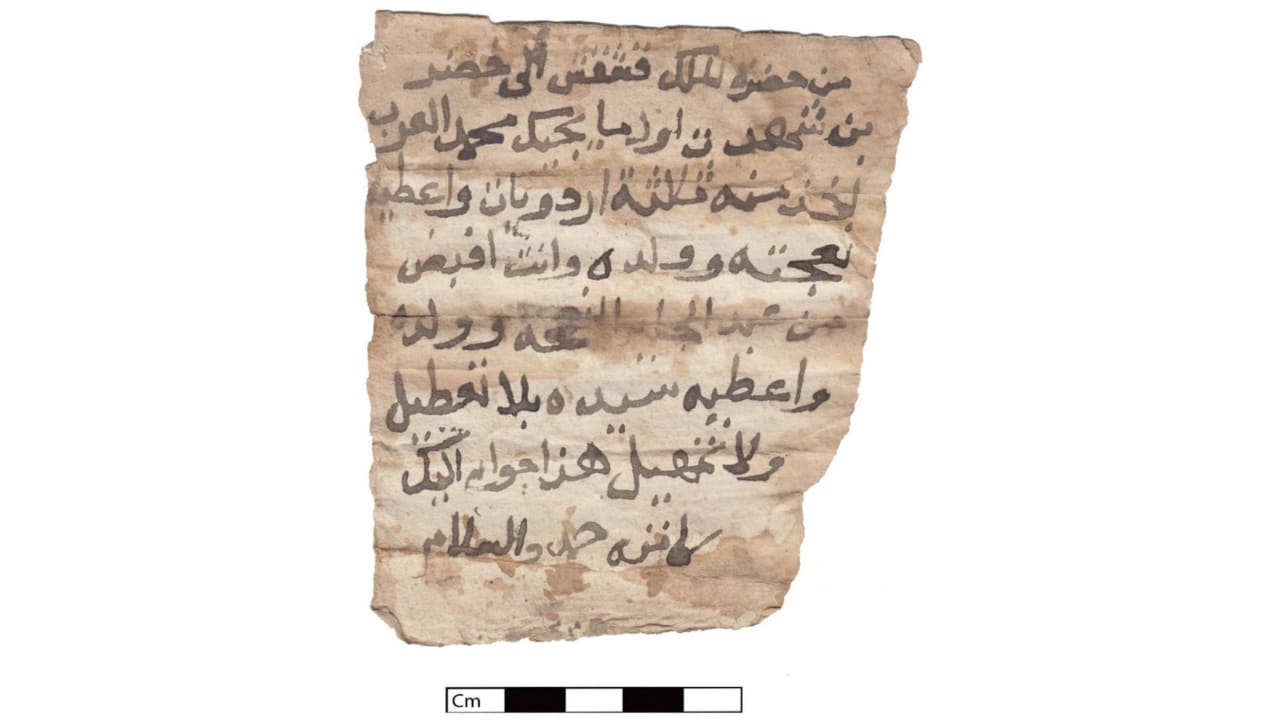
A royal decree written in Arabic, signed by King Qashqash, who had previously been dismissed as little more than legend, similar to Britain’s King Arthur, has been found by archaeologists from the University of Warsaw during excavations in northern Sudan.
The decree has been dated to the late 16th or early 17th centuries, making it the earliest archaeological evidence of Qashqash during the time, and offers a “rare glimpse into Sudanic kingship during one of the least-documented periods in Sudanese history," according to the study published by the researchers.
Prior, Qashqash had only been known in passing references in a biographical dictionary of Islamic holy men published after his death, titled Kitāb al-T abaqātfī Khusūs al-Awliyāʾ wa-l-S ālih īn wa-l-ʿUlamāʾ wa-l-Shuʿarāʾ fī al-Sūdān by Muhammad al-Nūr.
The page was found in an area located near the eastern bank of the Nile, known as the House of the Mekk (“House of the King”) within layers of medieval garbage in Sudan’s Old Dongola.
The city had once the capital of the Christian kingdom of Makuria, and later a trading hub between the Ottoman Empire to the north and the Funj Sultanate to the south.

Alongside the page, archaeologists found several other document fragments, bits of silk, linen, and blue-dyed cloth, as well as a gold ring, a dagger handle made of ivory or rhino horn, and what appear to be musket balls and a gunpowder flask.
At the time, firearms were primarily symbols of prestige rather than weapons of war, the study explained, marking their owners as members of a powerful circle.
Decree gives glance into micropolitics of the community
Despite its origin, the decree is seemingly ordinary. Written by a royal scribe named Hamad, it instructs an individual named Khidr to exchange textiles for livestock and to hand everything to its rightful owner without delay.
The note ends with a reminder of “do not hesitate!”
These transactions, archaeologists argued, may have been less about turning a profit and more about micropolitics and governence in these societies, as textiles acted as a form of currency in the region.
“Examining the king’s order alongside its archaeological context offers insights into rulership, social interactions, and literacy,” the study noted. “To borrow and modify Leo Africanus’ phrase, we want to present the King of Nubia at work, not at war, but in everyday management.”
The complete findings are detailed in a paper titled “The King of Nubia at work: archaeological context and text edition of a sixteenth/seventeenth-century Arabic document from Old Dongola” published in Azania: Archaeological Research in Africa in February.