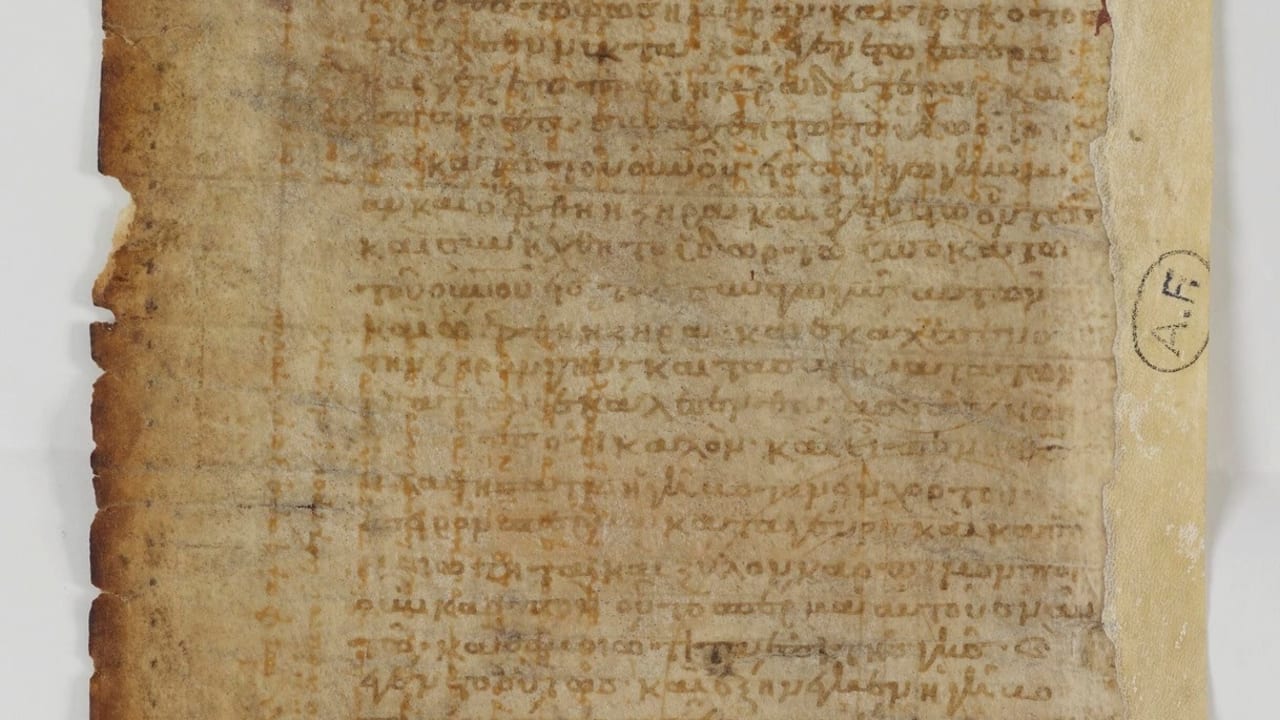
A page long thought missing from the Archimedes Palimpsest has been identified at the Musée des Beaux-Arts in Blois, France. Victor Gysembergh of the CNRS matched it to leaf number 123 documented in 1906 by Johan Ludvig Heiberg’s archival photographs. He came across the leaf in October 2025 while searching online for “palimpseste Blois.” The match was confirmed by comparing the Blois leaf with Heiberg’s images of three pages that later disappeared and were regarded as lost, according to CNRS France.
The recovered page preserves a fragment of Archimedes’ treatise On the Sphere and the Cylinder, specifically Book I, Propositions 39 to 41, accompanied by geometric diagrams. One side of the leaf remains difficult to study because it is covered by a twentieth-century illumination depicting the prophet Daniel with lions. Gysembergh intends to carry out imaging within a year using multispectral techniques and synchrotron-based X-ray fluorescence to reveal the text concealed beneath the later painting, according to Focus.pl.
The Archimedes Palimpsest
The Archimedes Palimpsest is a 10th-century Greek manuscript transmitting treatises by Archimedes of Syracuse, including parts of On the Sphere and the Cylinder. In the Middle Ages, parts of the manuscript were erased and the parchment was reused by a scribe to write a religious Greek text, a practice driven by the high cost of parchment. Over the centuries, the codex passed through various locations, including Jerusalem and Constantinople, and moved into private hands before being repurposed into a prayer book. The manuscript reappeared in the 1990s bearing added illustrations that concealed portions of Archimedes’ text, and it is now housed at the Walters Art Museum in Baltimore, USA.
After its reemergence, scholars in the 2000s applied advanced multispectral imaging that made previously invisible passages readable, bringing to light works such as Archimedes’ The Method and Stomachion.
On the Sphere and the Cylinder
he newly identified leaf at Blois contributes to filling a gap left by three leaves shown in Heiberg’s 1906 photographs that later vanished, and it preserves further evidence of Archimedes’ geometrical investigations recorded in On the Sphere and the Cylinder.
The Walters Art Museum continues to house the main body of the palimpsest, which bears the marks of erasure, reuse, and relocation that characterize its turbulent history from Byzantine-era scriptoria to modern collections.