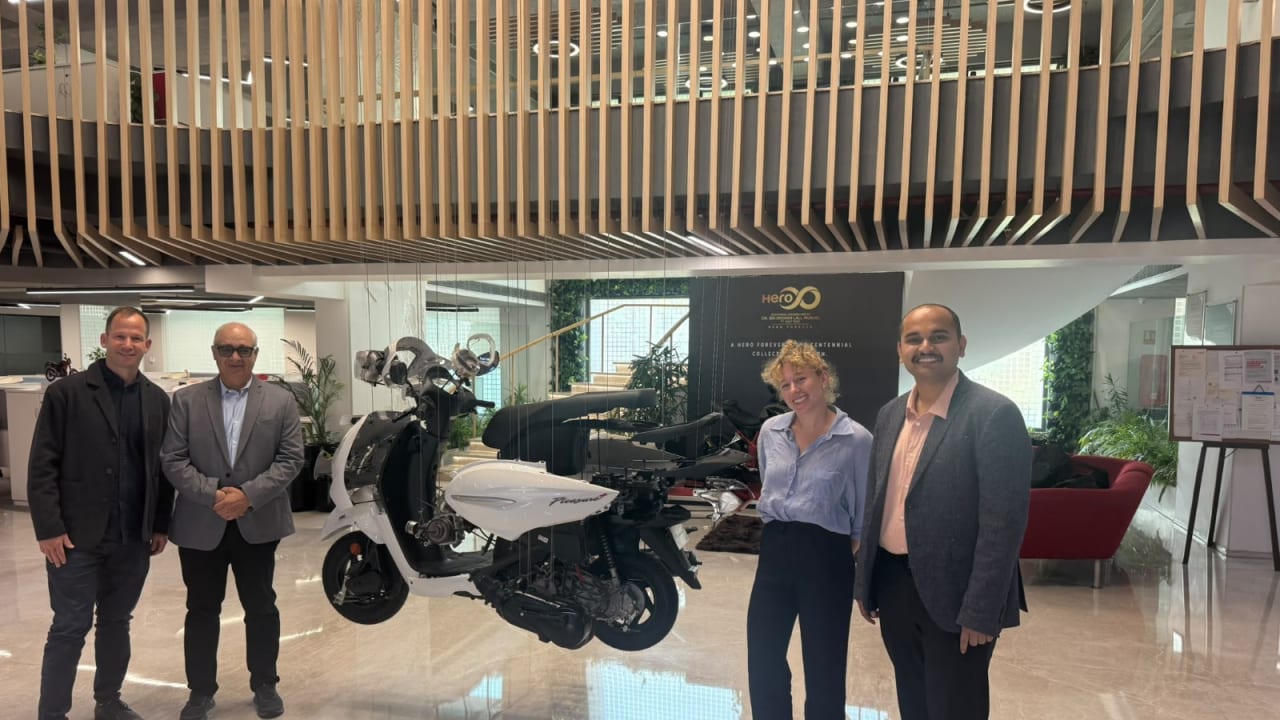
During a recent visit to India, I spent several days with business owners and industrial executives who decide what reaches production. I went to talk about Israeli innovation in the age of physical AI, when machines can decide and act. I came home with one question: when such a machine is wrong, whose name is on the incident report? Answering it convinced me that Israel should build with India rather than sell to it. The difference is technical.
Two shifts meet on the factory floor.
The first is India's rise as a deeper production base. Bloomberg reported that about a quarter of the world's iPhones were assembled there in 2025. The first C295 built on the Tata-Airbus line in Vadodara flew in June 2026. India is becoming a place where complex things are finished.
The second is the factory moving from programmed automation to machines that perceive, adapt and act. BMW says its Figure 02 humanoid pilot supported production of more than 30,000 vehicles at Spartanburg over ten months. It also named what integration required from the start: production IT, safety, process management and logistics. Physical AI has left the conference slide and entered the shift schedule.

Where the two shifts meet, the product is completed on the line. Software can ship before it is fully adapted. An industrial machine that acts becomes a production system only when it is integrated. Its sensing must be tuned to the plant. As its behavior changes, its operating limits and oversight must keep pace. Its cybersecurity must hold on the plant's network. Its authority to act must be defined by management, accepted by the people working alongside it, and defensible to safety assessors and insurers.
The old model, invent in Israel and export the finished thing, breaks where much of the value is created. In physical AI, the go-to-market is the go-to-line.
When the machine is wrong, someone's name goes on the report. A capable model is only the start. The machine also needs a defined job, limited authority, an override, and evidence of what it did. Permission must be earned locally, and that record cannot be created backwards. A right answer with no home is a demo.
Building that home is where Israel is unusually useful, and unusually dependent on a partner. Israeli engineers bring depth in the disciplines physical AI fuses: sensing, autonomy and cybersecurity under real operational pressure. A small domestic market forces companies to build for foreign customers from day one. I founded Drive TLV, and for nearly a decade I have watched global manufacturers work there with hundreds of Israeli startups. The strongest turn deep components, with partners, into systems a plant can run. Few can reach global industrial scale alone.
India offers the scale, and more: engineering depth, demanding operating environments, and the order books of a diversifying world. Co-develop the system with Indian engineers, prove it on Indian lines, and manufacture it in India. Let Indian partners own a real share of what they made work. Israel gains the volume to test and improve a system repeatedly. India gains capability it can adapt, validate and govern at home.
The governments have opened the way. India and Israel began free-trade talks in February 2026 and held a second round in July. What should follow is a physical AI corridor built around a few production lines and problems worth solving.
Start with joint teams of Israeli developers, Indian engineers and plant operators. Choose a specific job on an Indian line and agree on quality, cost and safety. Establish who can stop the machine. Preserve the operating record. Expand when the evidence supports it. Measure success by work accepted into production, and by whether the next plant can start with what the first learned.
Two countries rooted in ancient civilizations meet at one of technology's newest questions: when a machine acts, who answers, on what evidence, and under whose authority? Democracies run on evidence and consent. So should their machines. Build them together. The countries that can answer for their machines will be hard to beat.
Tal Cohen founded Drive TLV and Drive Europe, where global manufacturers work with deep-tech startups, and is a General Partner at NextGear Ventures, which invests in physical AI, automation and mobility. A former Georgia Tech faculty member, he is the author of The Case for Habitat, on how AI earns permission to act. He writes at talcohen.ai.