
'SOSA was established to solve a very acute challenge in the technology ecosystem, which is inefficiency in the way technologies reach the market and in the way the market reaches technologies,” says company CEO Uzi Scheffer. Since its founding in 2014 by Israeli innovation pioneers, SOSA has evolved into a multidimensional platform enabling global corporations, government organizations, and start-ups to execute and scale innovation.
“It’s obvious how impactful technology can be in traditional markets,” continues Scheffer, “and yet, it’s difficult to actually take advanced emerging technologies to the finish line and see them deployed in those markets and sectors that affect the lives of all of us. Every large organization in the world today needs to access technologies that will answer its operational needs and successfully integrate these solutions into its daily operations. Over time, we’ve developed a unique expertise in executing proprietary methodologies and innovation activities for governments and large organizations. And with time, we started building innovation centers.”
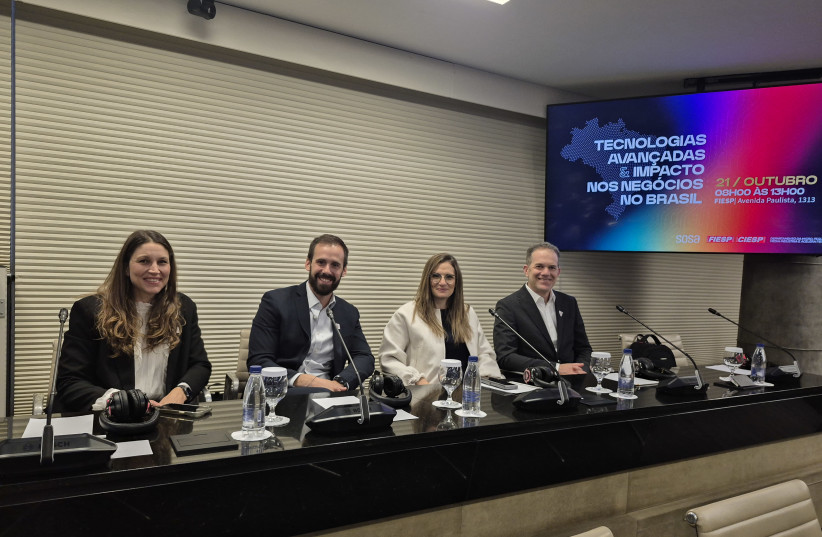
Over the past decade, SOSA has built innovation centers in New York, New Jersey, Brazil, and Israel. SOSA also helped build “the Hatch” in Singapore, established to enhance Singapore’s public safety. In its first year, the Hatch executed more than a dozen proof-of-concept projects, using cutting-edge technologies from around the world. Serving as an innovation hub for Singapore’s national resilience, the Hatch has successfully brought together the local and global ecosystems, fostering collaboration among start-ups, government agencies, corporates, and investors.
“Based on our methodologies, guidance, and support,” explains Scheffer, “we have helped build, together with our partners, one of the world’s leading innovation centers, designed specifically for public safety. It serves the country’s nine homeland security agencies and has become the epicenter of the local technology ecosystem. Today, nearly all technological activity in the region is connected to it, and it has emerged as a globally recognized case study.”
SOSA was recently selected to serve as the operator of the New Jersey Business Acceleration and Softlanding Ecosystem, also known as NJ BASE. The center is focused on attracting international companies in industries critical to New Jersey’s economy. NJ BASE supports businesses seeking to access the broader US market by assisting them in establishing a presence in New Jersey, enabling their expansion, facilitating investment opportunities, and contributing to the creation of high-quality, long-term jobs in the state.

Scheffer describes SOSA’s operational model as a proactive bridge between market demand and global tech solutions. The methodology involves a deep dive into client needs, ranging from corporate giants to national security agencies, followed by a rigorous global search for the most effective technologies.
According to Scheffer, the process goes far beyond a mere exhibition of products. SOSA’s team utilizes global benchmarking to help clients understand emerging possibilities, then curates and validates the best-fit solutions for immediate piloting. This collaborative approach allows the organization to work alongside governments and industry leaders to pinpoint the economic growth drivers of a specific region.
For global corporations and for government organizations, creating innovation centers today, he explains, is almost a necessity to keep up with new developments and technologies. “There is an understanding over the past 10 or 15 years that knowledge is distributed in the world and that you need to look to the outside and have effective operations and methodologies to stay up to date,” Scheffer states. “The cycles of innovation are very, very fast. When you look at software, AI, and Gen AI today, it’s measured in weeks. And with innovation cycles measured in weeks, whether in government or private companies, the strategy of vertical growth and scaling is becoming increasingly challenging.”

Scheffer adds that the creation of innovation centers helps turn the region where the innovation center is located into a hub for advanced technologies and, in effect, helps create a technology ecosystem for the area. “When we establish an innovation center and bring in global talent to collaborate with the local ecosystem, it elevates the entire environment – driving foreign direct investment, boosting GDP, strengthening education systems, creating jobs, and attracting venture capital.”
Companies, organizations, and governments seeking SOSA’s counsel benefit from a rigorous methodology that prioritizes the definition of concrete use cases. By utilizing its proprietary databases and global networks, SOSA identifies and matches the most effective technology solutions to these specific needs. “We always start the process with the actual end user at the table,” Scheffer explains. “By doing so, we secure engagement and commitment from day one. Most innovation projects fail precisely because they lack this level of involvement from the end user.”
Scheffer highlights an urgent and growing demand for innovation centers dedicated to national resilience, a sector undergoing a fundamental shift in how critical technology is developed. Historically, defense R&D was a closed loop, funded and managed almost exclusively by state defense budgets. Today, that landscape has been upended by venture capital, private grants, and commercial enterprises, leading to a vast, decentralized dissemination of specialized knowledge.
“The modern battlefield, and by extension, national security, now features an unprecedented mix of offensive and defensive tools sourced from a diverse array of sources – armies, prime manufacturers, and tech companies,” Scheffer explains. “To maintain national resilience, a state needs an agile operation capable of sourcing across every tier, from global defense giants to lean private start-ups.”
He concludes that the boundaries between public safety, internal security, and traditional defense are blurring into a single, critical vertical. “Establishing a national resilience innovation center is no longer a luxury; it is a strategic necessity. These hubs are the most effective way to ensure that a nation maintains both the up-to-the-minute knowledge and the rapid access required to secure these disparate, critical technologies.”
Scheffer says that sensors and autonomy are critical components of the current battlefield. “When we speak about the future, or actually, the current battlefield, we speak about autonomy, and autonomy starts with sensing. For example, one of the most important topics today is defense against drones, which starts with detection. There is a need for sensing very small objects from kilometers or miles away. This is where private companies and private start-ups get into the picture.” He cites Makalu Optics, a leading tech company that develops advanced lidar solutions for mission-critical industrial systems, delivering ultra-long object detection range, high 3D resolution, and hyper-fast real-time processing.
According to Scheffer, AI has become a crucial component of defense-tech, for example, in real-time generation and prioritization of targets and passing them to aircraft in the air. He attributes an additional layer of importance to communication. “There’s an entire battlefield, which is not the physical battlefield but a battlefield on the electromagnetic spectrum, such as spoofers [technology that disguises identity], anti-spoofers [systems designed to counter spoofers], and identifying them.”
Over nearly 15 years, SOSA has refined a methodology for identifying and validating thousands of start-ups to address complex industry challenges. This extensive research and matching process allows SOSA to integrate the most advanced technologies directly into its innovation hubs. These include Tenna Systems’ spectrum intelligence technology for real-time detection and mitigation of wireless signal interference. In select cases, SOSA’s investment arm also invests in companies sourced through this work, particularly in defense and national resilience. This investment activity is intended to support the most promising technology companies as they scale in their target markets. Tenna and Makalu Optics are two such examples.
Scheffer says that he entered the field driven by a desire to improve how technology is applied. “When I first entered this space, I recognized a significant gap between what technology is capable of achieving and the profound impact it can have on every aspect of our lives, and, on the other hand, the considerable inefficiencies in how it is actually implemented. The fact that more than 90% of start-ups fail is not due to a lack of strong products or advanced technologies. Rather, they fail because they do not reach the market, and the market, in turn, fails to reach them.
“Over the past 12 years, we have completed more than 1,000 innovation projects, each addressing a specific use case through advanced technologies. This work has a meaningful impact, and it is a privilege to help bring these efforts together. By operating at the intersection of governments, corporations, and start-ups, we leverage insights from one side to de-risk the other, enabling faster execution and stronger strategic outcomes.”
Looking toward the next decade, Scheffer envisions these centers powering a global economy of self-sustaining, scalable ecosystems driven by validated market demand. He emphasizes that for regions to remain competitive, governments and local leaders must integrate into a global network to secure access to the latest knowledge, top talent, and advanced technologies necessary to support their most critical sectors. “This is a must,” he concludes.
This article was written in cooperation with SOSA.