- Price (base / test vehicle): NIS 230,000 / 280,000
- Competitors: Tesla Model Y, XPeng G6, Zeekr 7X
- We liked: Interior, driving range, refinement and ride comfort, road manners
- We didn’t like: Price, urban ride comfort
- Score: 8.5/10
During the test days, I was surprised to discover just how deeply the two-seat Smart Fortwo is etched into the memory of car enthusiasts. Everyone remembers the cute little car that, despite being able to park perpendicular to the curb, ended its life as a commercial failure. Mercedes put the brand on the shelf, and in 2019 gave it new life in a 50:50 partnership with China’s Geely. The new Smart models are designed by Mercedes-Benz, while the cars themselves are manufactured in China. Judging by the test vehicle, this connection is clearly successful, and the tiny Smart will also be making a comeback soon.
From a pricing perspective as well, the Smart #5 sits between Mercedes’ premium pricing and Geely’s more accessible price lists. The #5 is offered in four powertrain and trim versions. The test vehicle in “Premium” trim costs NIS 280,000, but there is also an entry version at 230,000, and a sporty “Brabus” version that will cost you NIS 300,000.
In this price range you get two battery options (76 or 100 kWh) and motor outputs ranging from 340 to 646 hp. It should be noted that despite significant differences in trim and equipment levels, even the base models enjoy the same charisma as the test car. Common sense may point toward the “Pro” and “Pro+” versions at NIS 230,000 and NIS 260,000, but in the showroom there is a clear preference for the more luxurious Premium and Brabus models.

Design
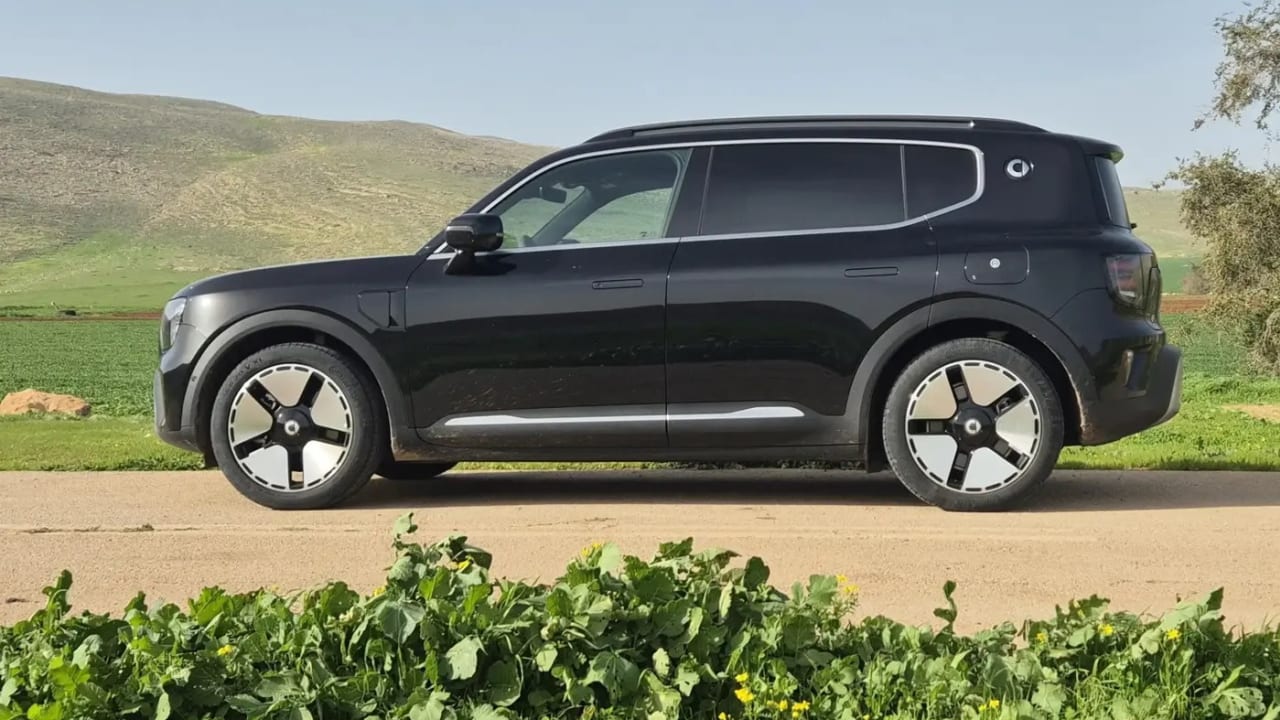
Mercedes’ designers shaped the Smart #5 with bold, assertive lines. For a moment, one could think it’s an SUV or a raised station wagon. Smart’s functional approach is very different from today’s fashionable sporty styling or elegant “coupe” crossovers. I’m not sure every design purist will appreciate this functional look, although the boxy structure is softened by an abundance of refined and sophisticated details. These include unique wheels, a chrome frame surrounding the side windows, and lighting units based on a rounded-rectangle motif. This motif appears repeatedly at the front and rear of the Smart and is also a central element inside the cabin. The off-road wink is reinforced by brushed-aluminum skid-plate elements at the front and rear. As an off-road enthusiast, I liked the exterior appearance.

Interior
The main show takes place inside the cabin, where the rounded-rectangle motif greets you from every direction. Most prominent are two 13-inch OLED screens, one in front of the driver and the other facing the front passenger. The right-hand screen allows the passenger to control the audio system and other functions. When parked, it can also display videos or connect to a gaming console. The screens are housed within a rounded-rectangle element, as is the dashboard that spans the width of the car. To top it off, the driver gets a 10.25-inch instrument cluster.
The rounded rectangle returns in the doors, where electric switches replace conventional handles, in the seat upholstery, in the cupholders, and at this point we’ll stop talking about this motif. Ambient lighting is projected from everywhere, including beneath a central speaker that emerges from the shelf below the windshield.
Everything looks sophisticated and well executed, with a selection of materials that feel and look high quality. These include natural leather, brushed aluminum, slim wood trims, and mostly high-grade plastics. What I liked about the interior is that despite the heavy investment in design, it remains functional and intuitive to use. There are very few physical buttons, and still no physical volume knob for the audio system, but the electronic climate controls are always accessible, and the steering-wheel switches are large and easy to use. It’s clear the designers didn’t get carried away prioritizing gimmicks over usability and clarity. The air vents are large and easy to adjust, the power seats are heated and ventilated, and they’re operated via physical switches on the doors.

There is an abundance of storage compartments, including a huge one beneath the center console, wireless charging for two phones, and additional charging ports front and rear. In the Premium models we received a Sennheiser sound system with 20 speakers that makes long journeys pleasant. It’s easy to find a good driving position, although rearward visibility is somewhat limited. The rear bench comfortably seats three, with generous legroom and headroom. Above it all stretches a panoramic glass roof. It doesn’t open, but it does include a sun-filtering blind. A 630-liter trunk will accommodate all the gear for a trip. Up front there is a useful 72-liter frunk. The overall impression is of a high-quality, practical cabin that successfully combines thoughtful design with solid build quality.

Equipment
The Pro and Pro+ versions come with 19-inch wheels, a 13-inch multimedia screen with Android Auto and Apple CarPlay, a panoramic roof with electric operation, synthetic leather upholstery, and power-adjustable seats. The Premium level upgrades to 20-inch wheels, Matrix LED lighting, an additional 13-inch passenger display, genuine leather upholstery, seat ventilation, and a head-up display. The Brabus adds sporty elements, artificial engine sound, and off-road driving modes.

Performance
Premium models are equipped with a 100 kWh battery and a rear motor producing 363 hp, with a declared electric range of up to 590 kilometers. At the top of the pyramid sits the Brabus with dual motors delivering 646 hp and accelerating from zero to 100 km/h in 3.8 seconds. With 6.5 seconds from zero to 100, the test vehicle doesn’t exactly wrinkle asphalt, but it is very strong and quick. In the first few meters it may hesitate slightly. It lacks the violent launch of some sporty EVs, but the hesitation quickly fades and the Smart accelerates decisively. Beyond the meaty acceleration, a sense of refinement and quiet stands out. Good acoustic insulation and double-glazed windows keep road noise outside.

Electric range and charging
In relaxed highway driving we achieved a range of about 540 kilometers, close to the declared maximum. In more spirited driving the range dropped to 430 km. One of the unique capabilities of the Smart #5 Premium is extremely fast DC charging of up to 400 kW. However, there are no such fast chargers in Israel. The fastest rate we reached at 180 kW stations was 117 kW. It should be emphasized that this limitation lies not with the car, but with the poor state of Israel’s charging infrastructure.
Ride comfort and handling
Despite 20-inch tires, the Smart #5 delivers very good ride comfort. The suspension tuning is relatively firm, but it isolates you well from road imperfections on highways. In the city, those imperfections are more noticeable.
We liked the road manners. The #5 is very well balanced, the steering weight is good, and the suspension effectively damps asphalt undulations. Despite rear-wheel drive and a weight of over 2.3 tons, the handling is neutral and very predictable. It suits calm family use, yet can still deliver a touch of adrenaline on a winding mountain road.

Bottom line
Smart has come a long way from its primordial microcar to the #5. This is a mature and cohesive crossover that clearly bears Mercedes’ skilled fingerprint. It is distinctive, practical, avoids gimmicks, and delivers a strong sense of quality.
At a price of NIS 280,000, I’m not sure I would choose the Premium version. For an urban customer not seeking huge driving ranges, the Pro at NIS 230,000 may be a more sensible choice, while the Pro+ at NIS 260,000 offers the 100 kWh battery and the impressive range.

Smart #5: Technical data
Motor: Rear electric motor, maximum output 363 hp, torque 37.3 kg-m
Transmission: Automatic, rear-wheel drive
Electric system:
- Battery (kWh): 100
- Maximum AC charging rate (kW): 22
- Maximum DC fast-charging rate (kW): 400
Performance:
- 0–100 km/h (sec): 6.5
- Top speed (km/h): 200
- Combined range (manufacturer, km): 590
- Test range (km): 430–540
Dimensions:
- Length (m): 4.70
- Width (m): 1.92
- Wheelbase (m): 2.90
- Rear trunk (liters): 630
- Front trunk (liters): 72
- Weight (kg): 2,335
Safety:
- Euro NCAP crash test rating: 5 out of 5 stars
- Active safety: Autonomous emergency braking forward, reverse cross-traffic and pedestrian detection. Lane keeping and lane correction, blind-spot monitoring, driver distraction alert, adaptive cruise control, 7 airbags
Warranty:
- 3 years with no mileage limit for the vehicle, 8 years or 200,000 km for the battery