Even though I don’t like to rely on clichés, the Beit She’an Valley in winter is the closest thing we have to a European landscape. The springs flow, the fields are lush, and the migratory birds arrive in waves. With the Gilboa mountains in the background, the scenery alone is worth the trip. But what’s surprising are the attractions in the area within a relatively short distance - from a vegetable section that turns into a breakfast menu to a goat pen that became a dairy, a winery with a view of an ancient fortress, and a ceramics studio in a renovated chicken coop. I arrived for 24 hours and left feeling that I barely scratched the surface of what’s here.
Breakfast Between the Rows
I started at Meshek Eliyahu in Beit Yosef, a coffee cart that opened four months ago. Eliran, 31, originally from Ma’ale Adumim, built the cart on his late grandfather’s farm after a long period of military reserve duty. Instead of returning to the kitchens of Tel Aviv, where he had worked for ten years as a chef at West Side Royal Beach, he decided to build something different - a small farm-to-table menu with fresh vegetables. The idea is to rely only on vegetables he grows himself - and he even has a plot where he grows broccoli, cauliflower, lettuce, chard, cherry tomatoes, and herbs. For now, since he maintains Mehadrin kosher certification, he buys vegetables from a local supplier. However, his dream is that once he has enough produce, he will use only what he grows on his farm.
Eliran’s menu combines vegetables he grows with Jacob’s cheeses in various interesting combinations that complement both the vegetables and the cheeses. The menu is not yet fixed, but currently you can find: Sheep feta with honey and sesame, eggplant brûlée, scrambled bruschetta, focaccia with tahini from Har Bracha and grated tomatoes, salads, and more. It’s a meal that gives a different feeling - not planned, not industrial, simply fresh.

The Way to Koach Hayarden (Star of the Jordan)
To digest the food and also enjoy the open spaces, I went on a tour with Eshed Nevo, a local guide who knows every corner of the area. The tour was to the Koach Hayarden National Park, where a Crusader fortress stands on the edge of a basalt plateau overlooking the Jordan Valley. The site rises 312 meters above sea level, but because it sits on a cliff edge, the elevation difference from the Jordan Valley below is about 550 meters. From the viewpoint, you can see the entire valley and understand why the Crusaders chose to position themselves here.
The Crusaders called the fortress Belvoir - meaning “beautiful view” in French - and they were not exaggerating. The fortress was built in the 12th century by the Knights Hospitaller and was one of the last three fortresses held by the Crusaders after the Battle of Hattin in 1187. Saladin decided to conquer it and besieged it for a year and a half. Even after he managed to collapse a tower in the outer wall, the defenders continued to hold the other sections. In the end, both sides were so exhausted that the Crusaders agreed to hand over the fortress on the condition that they could relocate to Tyre.
Eshed explains the history in a way that brings the site to life. He points to stones taken from an ancient Jewish synagogue that stood here from the 2nd to the 6th centuries and even showed how the Crusaders used those stones to build the fortress.

Wine with a View of a Fortress
After the open-air tour in the cool wind, I warmed up a bit at Even Harosha Winery in Beit She’an. Behind the winery is Shimon Edri, a former military officer who grew up in Beit She’an, served as an attaché in South Korea, and returned to live in Beit Shita. During his time abroad, he was exposed to wines from all over the world.
When he returned to Israel, just before the pandemic, he already knew exactly what he wanted to do. After serving as CEO of Golan Heights Basalt Winery and studying at Surik Winery, he now heads his own boutique winery, producing about 5,500 bottles a year from grapes grown in the Upper Galilee. He produces the white and rosé wines at the Camisa Winery in the Dalton industrial area, and the red wines at Avivim. Later, he plans to produce everything at his own winery. Currently, Even Harosha Winery is located in a stone building overlooking an ancient fortress, with a view of Tel Beit She’an from the window.

Evening in a Tent (Sort Of)
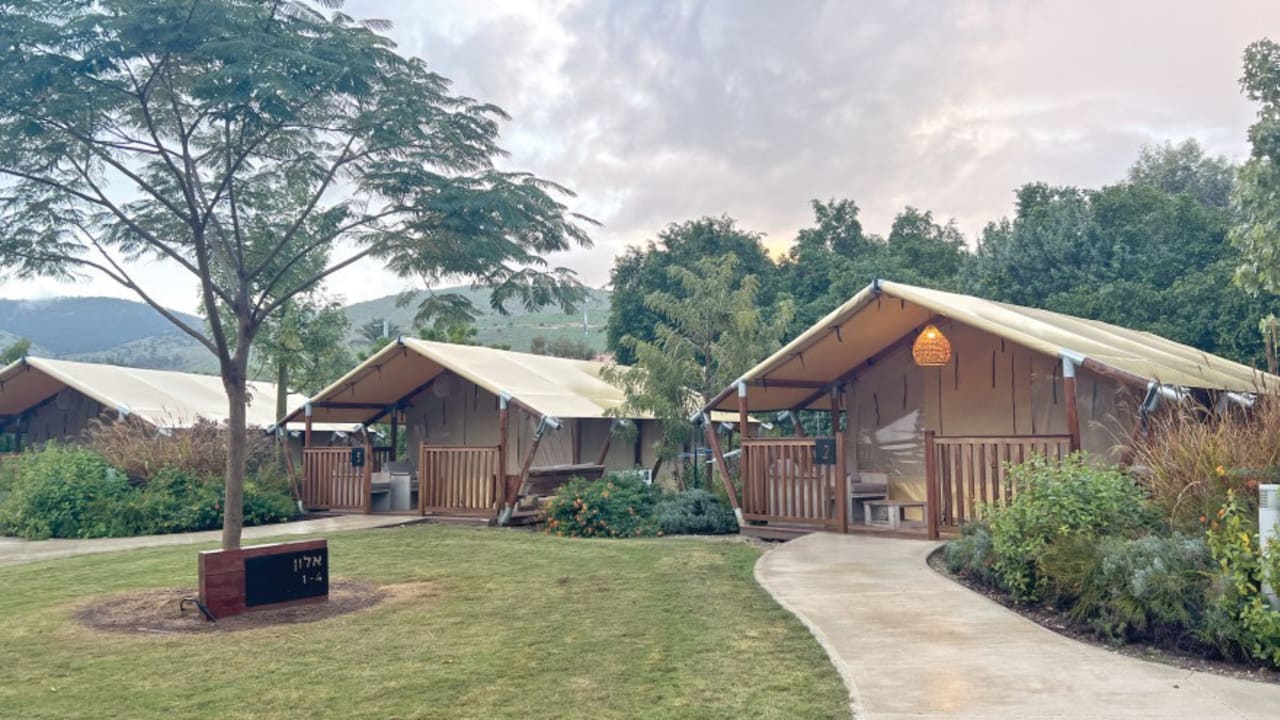
In the evening, I arrived at Laila, the glamping site near Kibbutz Nir David, and it’s one of those places that’s hard to believe is in Israel. Four years ago, it was a cornfield, and now it’s one of the most sought-after accommodations in the north. The white tents are arranged in an open field with the Gilboa mountains in the background, and each tent is equipped almost like a hotel room - a real bed with white linens, air conditioning and heating, and restrooms and showers a short walk away. This is not camping that requires extreme nature lovers - it’s glamping that allows you to feel in nature without giving up comfort.
The site includes a shared kitchen equipped with a coffee machine, electric stoves, personal refrigerators, freezer, and microwave, large lawns to lie down and watch the sky, and a fruit orchard for self-picking in season. In the evening, a bonfire is lit - it’s not a planned activity, it just happens, and anyone who wants to join can. The atmosphere is of a place built with the understanding that people want to be in nature but not necessarily suffer, and the quiet here is worth more than any organized entertainment. A minute’s drive from the site, there is also a heated indoor pool, convenient in winter when you want to refresh without freezing.
Glamping Laila belongs to the Nir David Tourism network, which operates several other vacation sites in the area - rural lodging at Kibbutz Nir David, rural lodging and glamping at Kibbutz Ortal in the Golan Heights, and recently Nofei Bashan at Kibbutz Lehavot Habashan. During the winter season, weekends combine accommodation with activities - for example, the “Winter Trek of Israel,” which begins Thursday evening with a bonfire activity and in the morning goes on a two- to four-hour guided hike with guides from the Gilboa-Springs Visitor Center. It’s suitable for families who want to combine a nature stay with a real hike, without organizing everything themselves.

A Morning of Goats and Birds
The next morning I woke up early and arrived at Ruppin Village. The first stop on the list: “Dir Balak, Nokdei Ruppin Farm” run by Ayala and Tzahi Shevach. They established the pen in 2017 as a small educational-volunteer project for the kibbutz children. What started with a few goats grew and by 2023, the herd numbered more than 70 goats. The children of the kibbutz actively participate in raising the herd - feeding, milking, and taking them out to graze. Ile recognized the therapeutic power of working with animals when her son, a Golani fighter, was injured on October 7th and returned home for rehabilitation.
Today, the pen also serves as a therapeutic center for families and groups. There is a food truck serving fresh dishes based on the farm’s milk and cheeses, and workshops lasting one to three hours - arrive early in the morning, drink coffee and tea, go out to the pasture with the herd, and return for a cheese platter or a cheese-making workshop. It’s a real connection to the process, not just a visit.
From the pen, I went on a birdwatching tour with Chen Ravon Shari, who lives in Ruppin Village and knows every corner. The tour went along the trail around Ruppin Village, through the Bird Park and Amud Reservoir. Winter is the season of migratory birds, and the area becomes a busy stopover. Chen explains what to look for, points out birds I wouldn’t notice on my own, and gives a sense that life here exists that we usually don’t pay attention to. The tour costs 1,200 NIS per group (not per person) and lasts up to three hours.

From Clay to the Old Dining Hall
After the nature tour, you can visit the Yom Yom Ceramica studio, also in Ruppin Village. Yossi Malka Yakir, a Bezalel graduate who worked in the fashion world (including with Alexander McQueen), left everything six years ago and moved to the kibbutz. The studio is located in an old chicken coop, renovated by hand, and turned into a boutique shop with tableware and serving pieces made entirely on-site. There are designed pieces sold online to 37 countries, along with special items and export surplus at good prices. The place also hosts creative workshops for groups, providing a true “secret spot in the valley” experience that combines art, personal story, and a bit of quiet.

Ending at the Old Dining Hall
The final stop - the Center for Health Leadership in Neve Eitan - is a place that’s hard to explain until you get there. Dr. Uri Meir-Chizik, who leads the center, is a historian of local food traditions. Meir-Chizik researches how communities in the past knew what to eat, how to preserve food, and how responsibility for health was part of daily life, not a medical prescription.
Here, no health promises or methods are sold - people simply learn - wild plant foraging, fermentation, sourdough bread making, Rambam’s nutrition, and debunking nutritional myths that surround us. There is also a weekly online class called “Local Pantry” focusing on familiarizing with local and seasonal ingredients. The workshops combine knowledge with hands-on experience - not just listening, but doing.

The center is located in what used to be the old kibbutz dining hall kitchen, surrounded by planted herbs and edible wild plants among the vegetables. We drank an infusion based on Rambam’s nutrition principles with no less than seven herbs.
This is not a place people usually visit on a weekend trip, but anyone interested in the connection between food, culture, and health can find something here that’s hard to find elsewhere - knowledge that doesn’t depend on the next trend.