
The US should select Israel Aerospace Industries (IAI) to develop its Golden Dome missile defense shield because they built the Arrow defense system together, IAI CEO Boaz Levy told the Magazine in a recent interview.
Levy said, “One of the lessons from the war [with Iran], Operation Rising Lion, is that collaboration is the name of the game. There is no doubt that you cannot win big wars without partnerships, which also go operational.”
The IAI CEO stated, “There is a lot of initiative in US-Israel cooperation, which especially manifested itself during this war. The active Israeli defense apparatus has multiple layers against ballistic missiles.
“A lot of the materials are made in the US, but the brain is in Israel. It would be natural for the US to use it because it’s an entirely American system,” he explained.
Further, he stated, “The Golden Dome initiative of President Trump has components where we are already cooperating. There are two pieces: land-based and sea-based defenses; and defenses from space.
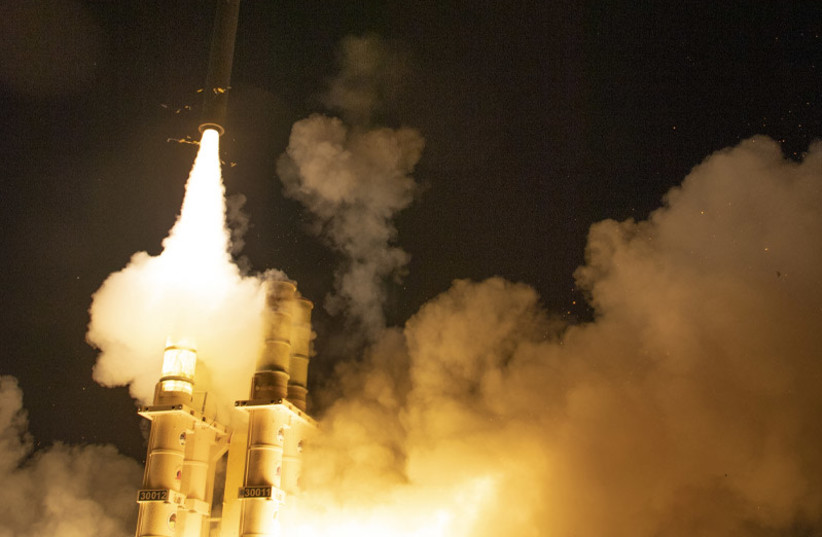
“Space has two pieces: identification and tracking of the threat; and shooting down the threat,” remarked Levy.
Next, Levy noted that the Arrow 3 brings all the pieces and purposes of the relevant missile defense functions and goals together for use by the distinct branches of the military.
In addition, he said, “US Space Force General Michael Guetlein was appointed [to run the Golden Dome program]. He has the capability to lead the missile defense and space components. They need to bring a vision” and decide the details and the price tag that they want to help companies like IAI, which will bid for the project, to frame their proposals.
“But the technology is all very possible.”
Golden Dome’s conceptual architecture is still very much a work in progress.
For example, although US President Donald Trump presented a price tag of $175 billion on May 20, the Congressional Budget Office put out a price tag of $831 billion over two decades.
However, IAI officials have said in recent briefings that once the program’s architecture and management are clear, if they want to move rapidly Israel has another edge, as it could potentially provide systems for the dome in a mere two to three years, faster than some competitors, which likely means completion during Trump’s term.
Pointing toward Europe, Levy noted that the Arrow system, along with the Barak, “can serve as a strong defensive shield against all types of threats” as part of the continent’s Sky Shield initiative. “We can intercept at the right height and at the right distance.”
While Levy stressed that he is not aware of all aspects of the program, “IAI would be honored to take part.” And, he stressed, “If we are chosen, then it would not be on the back of Israel’s security. Instead, this would be a win-win for both sides.”
Price for Arrow drops
Levy noted, “The price for the Arrow has gone down a lot in the marketplace. When the volume of orders goes up, there are new market efficiencies” for producing it, which help lower the price.
“There are different prices to propose, depending on what they [clients] decide they want. The technology is proven.”
On July 17, the Defense Ministry issued a statement that it had signed a production contract to significantly accelerate the serial production of Arrow interceptors at IAI.
As part of the deal, IAI is due to supply the ministry with “a significant additional number of Arrow interceptors,” while the actual number is kept classified for national security reasons.
The Arrow 3 development program is one of the joint programs between Israel and the United States and is co-managed by the US Missile Defense Agency and IMDO, a division of the Defense Ministry.
The Arrow 3 forms the uppermost layer of Israel’s multi-layered defense system, along with the Arrow 2, David’s Sling, and the Iron Dome system. Together, the systems provide Israel with a protective umbrella able to counter threats posed by both short- and mid-range missiles used by terror groups in Gaza and Hezbollah, as well as the threat posed by long-range Houthi and Iranian missiles.
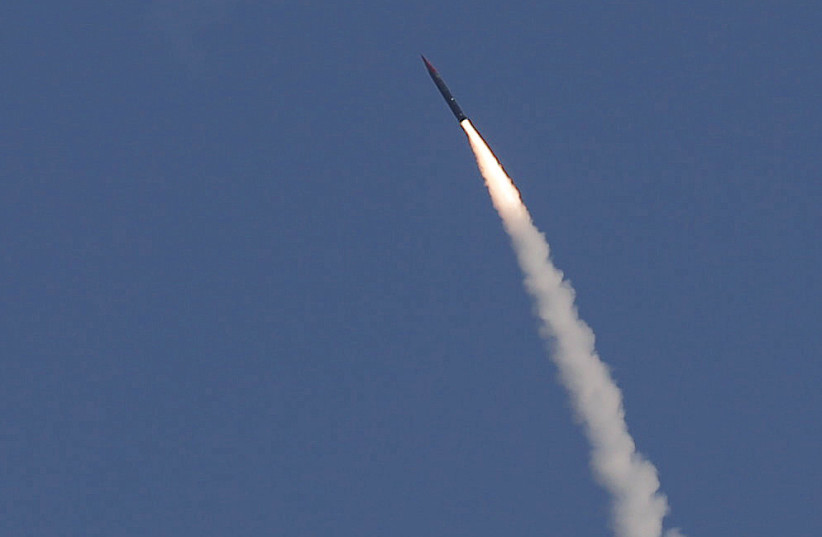
The Arrow 3 is a highly maneuverable system designed to provide ultimate air defense by intercepting ballistic missiles when they are still outside the Earth’s atmosphere. It is considered one of the world’s best interceptors due to its breakthrough technological capabilities.
Shortage of Arrow missiles
There have been a slew of reports in late 2024 and 2025 about Israel reaching some problematic lows in terms of how much of its Arrow supply has been exhausted after attacks by Iran and Yemen’s Houthis.
Iran attacked Israel with more than 100 ballistic missiles in April 2024, close to 200 in October 2024, and around 550 during the war in June of this year.
The Houthis have fired hundreds of ballistic missiles on Israel over the course of the current war, though Israel has not given an exact number, stating usually that the number of aerial threats, including drones, has been in the 400 to 500 range.
Addressing the reports of shortages and how quickly IAI can supply sufficient replacements to defend Israel against potential future ballistic missile attacks, Levy said, “I completely trust the Defense Ministry to make the right calculations. IAI has contracts, and whatever is agreed to, we will produce what they want from us.”
The impression is that IAI is moving fast, and Israel will not reach a point where it cannot shoot down most ballistic missiles, though defense officials have admitted that all areas of missile defense, over time, involve some economic calculations about when to shoot something down or let it land in an open area.
Defense officials have also said that using robots can speed up the process and reduce costs.
IAI employees working hard
Levy placed an emphasis on the hard work of IAI’s human resources, saying, “On Oct. 7, we started to [really] work, including calling in our ‘reservists’ [select, highly trained retirees], and we built up our production lines. We even brought back retired workers for some lines.
“We have an obligation to the State of Israel and all of our foreign and Israeli customers. We have three rotations to keep things running all day, seven days a week. And we activated a humongous volume of workers,” he said.
Levy said that IAI has a 15,000-strong direct workforce, with around 50,000 jobs connected to its operations and ecosystem.

Space and satellites
Honing in on IAI’s and Israel’s space activities, Levy said, “Actions in space multiply your power. So many products are coming out of Israel and IAI, whether for surveillance or communications.
“We are seeing the first sparks of space moving from being a domain to being a full front and battle zone. We already destroy ballistic missiles in space, with the benefit of this happening far away” from the civilian population.
More specifically, he discussed the success of the Ofek 13 surveillance satellite and other such satellites during the Israel-Iran war.
The Defense Ministry disclosed last month that Israeli satellites took tens of millions of pictures of critical items in the Islamic Republic’s territory leading up to and during the war.
Levy said, “Surveillance satellites orbit the world every 90 minutes, but the world spins. You need to have enough satellites and coordinate so you can see an almost continuous developing picture.
“We saw points of interest, including, but not limited to, Iran,” he stated.
Like the Israel Air Force, the satellite industry is a key component of the Jewish state’s strategic military capabilities. Active since the late 1980s, satellites are the real eye in the sky, keeping a close look on Israel’s enemies 24/7 from afar.
While the exact number of Israeli satellites in orbit remains classified, it is reported to be in the double digits. When it comes to their use, the IDF’s Unit 9900 is responsible, not IAI.
Next, Levy added, “The pictures come in very rapidly. You can observe what the change is, and then translate that into targeting. Producing the satellite data then uses a lot of AI capabilities. You quickly identify threats and send communications about them to all the different arms of the military,” including straight to fighter jets, like the F-35.
Radar and future threats
On the eve of the war with Iran, IAI celebrated the sale of its 250th multi-mission radar system worldwide.
The system worked remarkably well throughout the war, though each Israeli enemy did achieve hits on Israel at different points, and no defense is hermetic.
Levy was pressed about how Iran has now learned a lot about Israel’s defenses and can adjust to use new tactics and threats against it in the future.
“We need to look ahead at what will come next from the enemy. We need to review [threats and counterpoints], and then prepare for battle. No doubt, every day during the war we learned new things. We also learned from the reservists. They come up with solutions and provide added value, helping to design the solution to the next upcoming threat.”
Looking at future threats is not limited to the region. Given Iran’s increasing alliance with Russia and China, Levy was asked whether IAI will address potential new threats that those countries could provide to Tehran.
He responded that Israel and IAI are always looking beyond the region for threats that might make their way into the area.
“We see a reflection of the threats that we see in Israel in theaters around the world. And it’s not about the technology being used; it’s about the threats posed,” he said, explaining that in conflicts around the globe, there is an increasing use of ballistic missiles, rockets, drones, and UAVs.
“If India has similar threats and Thailand has similar threats, they are looking for proven defense systems to do the work. If a country thought it through ahead of time and bought the proper tools from a country that thought of how to answer such threats, then they will buy from that country,” and IAI is often the top player to provide solutions. This also applies to Israeli defenses against such threats from outside the region that could enter it.
“We are always trying to look two generations ahead. We don’t have the luxury to wake up one morning and have something ready the next day; we look for the answers decades ahead of time,” he said.
This article is part of a series on Israeli defense companies.