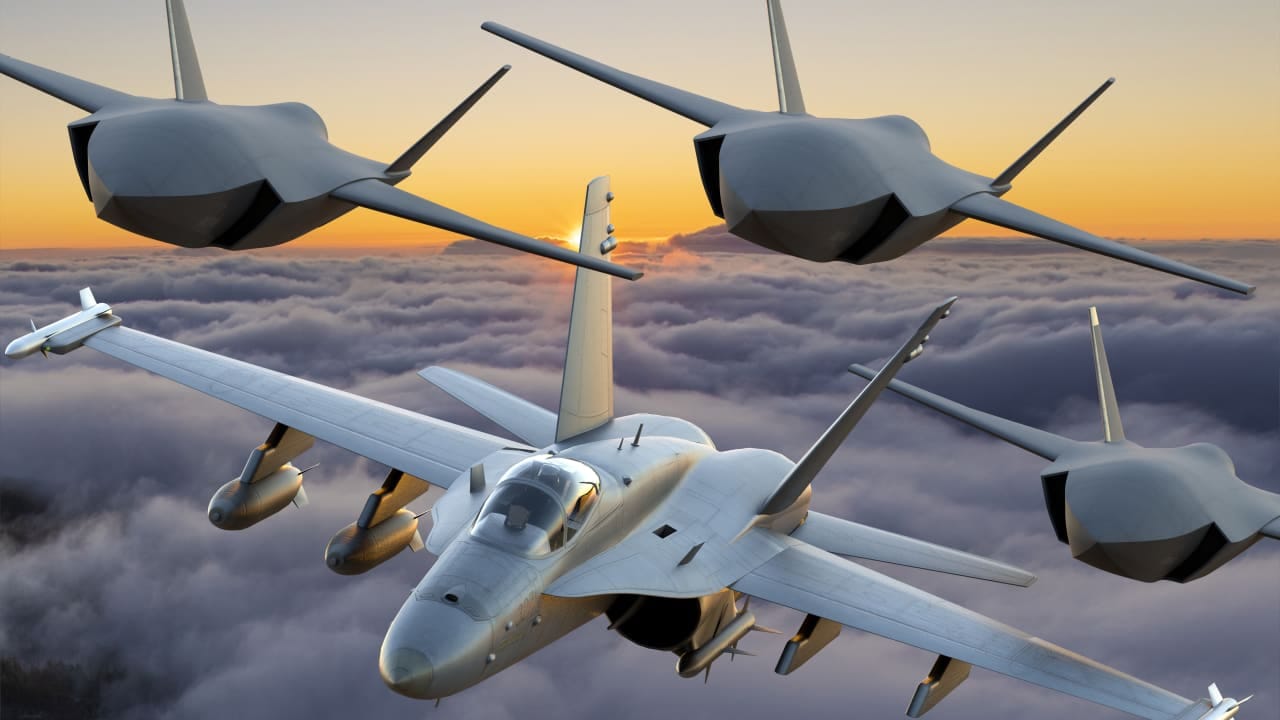
In recent years, the landscape of military aviation has been undergoing a transformation with the emergence of the Loyal Wingman and Collaborative Combat Aircraft (CCA) concepts. These global innovations are representing a shift toward integrating autonomous systems flying alongside traditional manned platforms to enhance combat effectiveness while reducing operational risks.
Loyal Wingman are unmanned combat aerial vehicles (UCAV) designed to operate in close coordination with manned fighter jets. Unlike conventional drones, these aircraft are equipped with advanced artificial intelligence, enabling them to fly autonomously or semi-autonomously, execute complex missions, and respond dynamically to evolving battlefield conditions. Their roles range from intelligence surveillance and reconnaissance (ISR) to electronic warfare and direct combat engagement. Crucially, Loyal Wingmen are intended to serve as force multipliers, extending the reach, survivability, and lethality of manned aircraft without requiring additional pilots.
The United States Air Force has embraced this concept through its Collaborative Combat Aircraft program. This initiative aims to develop a fleet of AI-enabled drones that can team with next-generation fighters such as the F-35 and the forthcoming Boeing’s F-47 fighter jet for the Next Generation Air Dominance (NGAD) platform that will replace the F-22 raptor.
According to the US Air Force, NGAD is a "family of systems" that includes the F-47 as well as the CCA program to develop variants of uncrewed, semi-autonomous Loyal Wingmen aircraft that would “enable air superiority, defined as the ability to operate without threat of attack, even in highly contested environments.” The Trump Administration has requested $2.58 billion for system development and demonstration of the F-47 and $111.37 million for CCA in 2026.

The Kratos XQ-58A Valkyrie has been in development since 2016 and aims to fly alongside manned aircraft like the F-35. It flew for the first time in 2019 and successfully flew in 2023 under the Penetrating Affordable Autonomous Collaborative Killer Portfolio (PAACK-P) program that evaluated the drone’s manned-unmanned teaming scenarios.
The CCA program emphasizes human-machine teaming, allowing pilots to command multiple autonomous aircraft that can scout ahead, engage targets, or absorb enemy fire. Two prototypes, designated YFQ-42A developed by General Atomics and YFQ-44A developed by Anduril, were given fighter drones designations in March marking a first in USAF history.
Global efforts
From the UK to Japan, China and Australia, international efforts are also advancing rapidly. Japan and the United Kingdom are collaborating under the Global Combat Air Programme (GCAP), which seeks to develop sixth-generation fighter capabilities alongside autonomous systems.
The UK has been actively developing its loyal wingman capabilities. The UK delivered StormShroud Mk1 into service in May 2025, the first autonomous collaborative platform (ACP) in the RAF. The UK Royal Air Force’s StormShroud autonomous collaborative platform has been designed to increase the survivability and effectiveness of F-35B Lightning and Typhoon pilots by blinding enemy radars.
According to the RAF, StormShroud “has been developed using lessons from the ongoing conflict in Ukraine, as well as other operational theaters around the world” including the Middle East. In a May 2025 press release, the RAF said that the “ACP Strategy is clear that the best way to optimise our strength against increasingly sophisticated adversaries is through a blend of crewed and un-crewed autonomous platforms operating together. It’s a more agile, adaptable and cost-effective model that significantly reduces the risks faced by pilots in conventional aircraft when flying and fighting in hostile environments.”
Japan first unveiled its plan to produce a drone that would support the Japanese Self-Defense Forces’ combat aircraft in 2022 and in 2024 the United States announced that it would include Tokyo in the CCA program. In January 2025 the Japanese Ministry of Defense awarded Boeing a contract to test aerial drones for the country’s manned-unmanned teaming research and development.
Japan’s Mitsubishi Heavy Industries has also unveiled two distinct CCA concepts: a missile-like drone for tactical combat support that can take off from land, attack a target and return. The second concept is a 6 meter-long ISR and combat support drone. According to a report in Defense Post news site, both drones are conceptualized with stealth capabilities, open architecture and updatable AI to adapt quickly to various missions.
Australia has also made significant progress with the Boeing MQ-28 Ghost Bat, Australia’s first domestically produced combat aircraft in more than 50 years, developed in collaboration with the Royal Australian Air Force (RAAF).
The Ghost Bat measures 12 meters long and has a wingspan of 7 meters. Powered by a turbofan engine for subsonic speeds,it has a reported range of over 2,000 nautical miles and can be equipped with advanced radars, electro-optical sensors, and other components for electronic warfare applications.
In March 2025, Boeing announced that the MQ-28 had completed 100 test flights and in June Boeing and the RAAF announced that they have successfully validated interoperability using two uncrewed MQ-28s controlled from a E-7A Wedgetail at Woomera Test Range.
These developments reflect a shared recognition among allied nations that manned-unmanned teaming will be central to maintaining air superiority in increasingly contested environments.
In China meanwhile, the People’s Liberation Army (PLA) is actively developing multiple loyal wingman drones, including those who can lead swarms of smaller drones. Last week, images out of China showed several different loyal wingman drones rehearsing for an upcoming parade to mark the 80th anniversary of the country’s victory over Japan in World War II that is set to be held on September 3rd.
China’s Feihong FH-97 and FH-97A, developed by the Aerospace Times Feihong Technology Corporation, a subsidiary of the China Aerospace Science and Technology Corporation (CASC), are said to be the leading drones that would fly alongside Beijing’s most advanced fighter jet, the stealth-capable J-20. According to a report in Interesting Engineering, the FH-97A has an integrated weapons bay that can carry air-to-air and air-to-ground munitions.
Strategic implications
Loyal Wingmen and CCAs offer a cost-effective means of expanding airpower, allowing militaries to deploy large numbers of capable aircraft without the logistical and human constraints of traditional fleets.
Their AI-driven autonomy enables rapid decision-making and mission adaptability, particularly in scenarios where communication may be degraded or denied. Moreover, by placing unmanned systems in high-risk roles, commanders can reduce the exposure of human pilots to hostile fire, thereby enhancing survivability and operational resilience.
As defense priorities evolve and technological capabilities mature, the Loyal Wingman and Collaborative Combat Aircraft concepts are poised to redefine the future of aerial warfare. They represent not merely an incremental improvement but a paradigm shift—one that blends human judgment with machine precision to achieve superior outcomes in the battlespace of tomorrow.