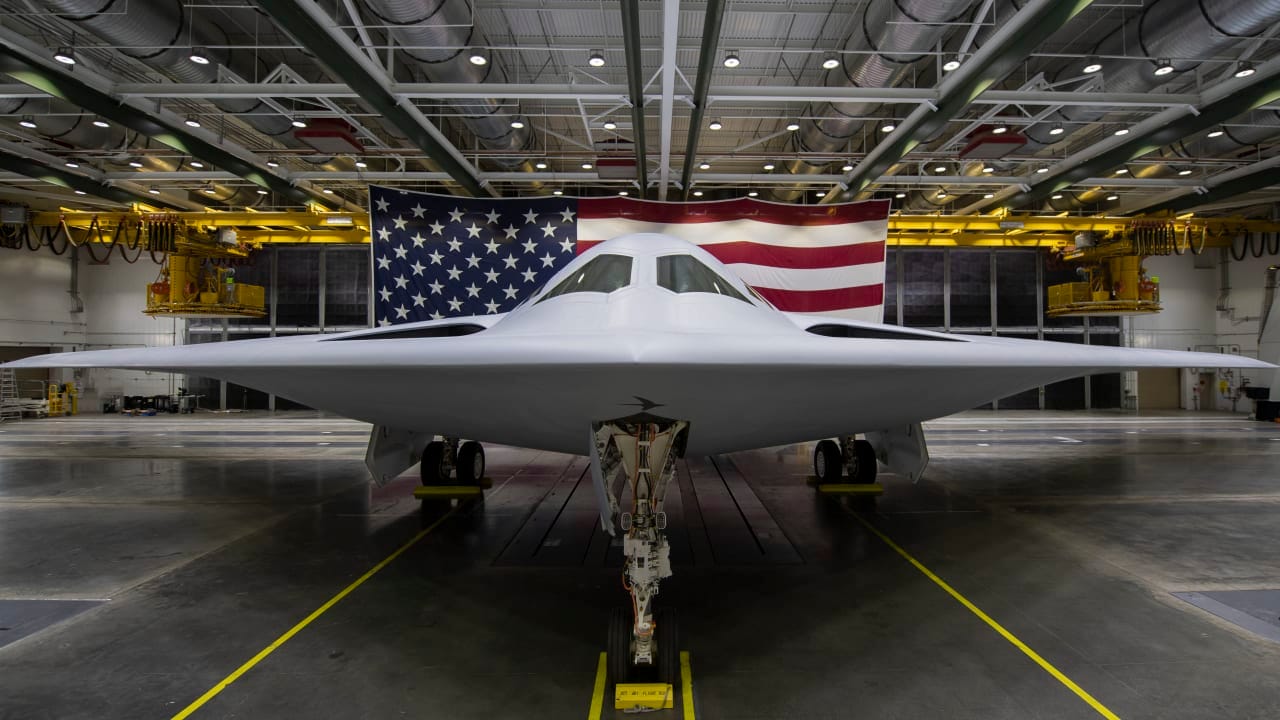
As the war with Iran rages, the US Department of the Air Force (DAF) has reached a new agreement with Northrop Grumman Corp to expand production capacity for the B‑21 Raider, a move officials say will speed delivery of the nation’s next‑generation stealth bomber fleet.
The arrangement utilizes $4.5 billion already authorized under the fiscal year 2025 reconciliation legislation, informally known as the “One Big Beautiful Bill.”
According to the Air Force, the funding boost will increase annual production capacity by 25 percent, allowing the service to compress delivery timelines without compromising cost controls or performance standards.
“This is what disciplined acquisition delivers,” said Critical Major Weapon Systems director Gen. Dale R. White – direct reporting portfolio manager to the Deputy Secretary of War.
“This decision reflects our confidence in the program’s performance and the stability of the industrial base. By increasing production capacity now, we are responsibly accelerating delivery of a critical, combat-effective capability to the warfighter.”

The B-21 is intended for long-range strategic strikes and is designed to operate in highly contested airspace. The aircraft is capable of delivering both conventional and nuclear payloads while penetrating advanced enemy air defenses. It incorporates advanced stealth features, resilient networking, and modern, data‑driven command‑and‑control architecture.
The first aircraft, currently in flight testing, was delivered on schedule in 2025, and the Air Force says it remains on track to field operational aircraft at Ellsworth Air Force Base in South Dakota by 2027.
A report on the website The War Zone (TWZ) said that while the additional production capacity could increase the fleet size in the future, United States Air Force officials say the aim remains a fleet of at least 100 bombers. The report also noted that while the agreement comes as the USAF continues to strike deep inside Iran, the increase in production capacity had been in discussions for over a year.
US Secretary of the Air Force Troy Meink defined the strategic importance of the bomber as “foundational.”
“The B-21 is foundational to our long-range strike capability and to credible deterrence,” he said. “Accelerating production capacity now ensures we deliver operational capability to combatant commanders faster – strengthening our ability to outpace, deter, and, if necessary, defeat emerging threats. This is disciplined execution at the speed the security environment demands.”
B-21 supports ISR, electronic attack, and long-range strikes
The B-21 Raider will be a component of a larger family of systems for conventional Long Range Strike, including Intelligence, Surveillance and Reconnaissance (ISR), electronic attack, communication, and other capabilities. It will be able to carry a variety of stand-off and direct-attack munitions.
The new aircraft is designed to replace the aging B-1 Lancer and B-2 Spirit, and eventually complement or succeed the B-52 Stratofortress. The stealth bomber also supports manned or unmanned operations, offering flexibility for future mission profiles
The USAF Factsheet states that “The B-21 will form the backbone of the future Air Force bomber force consisting of B-21s and B-52s. Designed to operate in tomorrow’s high-end threat environment, the B-21 will play a critical role in ensuring America’s enduring airpower capability.”