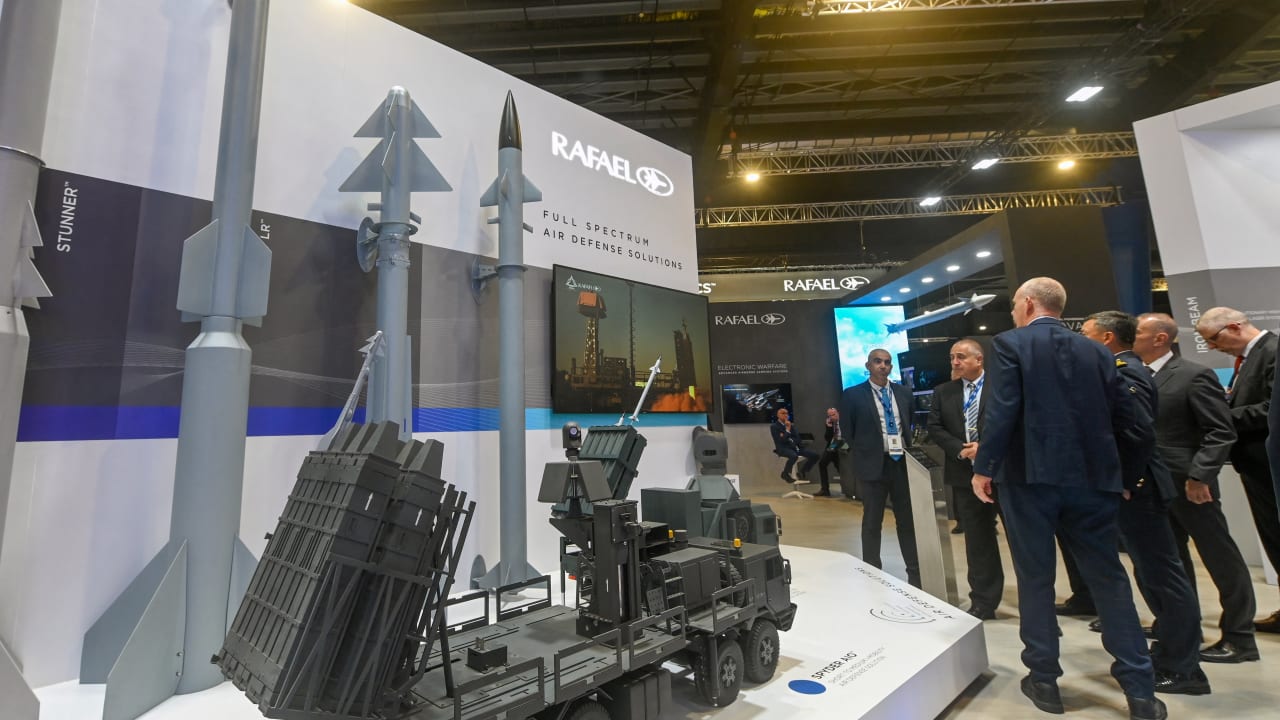
The Singapore Airshow came to a close on Sunday, with Israeli platforms having played a central role in the show. The exhibition showcased how Israel’s defense industry is rewiring its export map, and starting to look towards Asia as a strategic anchor.
Though the shift is not absolute, with Europe still Israel’s main market, there are more Asian customers, more joint research and development (R&D), and more long‑term industrial partnerships, especially as traditional Western markets become more politically constrained after the Israel-Hamas War.
Several European states have paused – or have started scrutinizing – arms deals over concerns over their use in Gaza, leading Israeli firms and officials to lean harder into Asian markets where political conditionality is often lower and demand for battle‑proven systems is high.
The Israeli delegation, led by SIBAT, included 11 Israeli defense companies showcasing a wide range of advanced, operationally proven technologies, including unmanned aerial systems (UAVs), missile defense systems, electro-optical systems, cyber systems, and AI-based robotics, counter-UAV systems, and more.
Israeli companies that participated were Israel Aerospace Industries (IAI), Elbit Systems, Rafael Advanced Defense Systems, Aeronautics, BIRD Aerosystems, CONTROP, Orbit Communication Systems, Skylock Systems, TOMER, UVision Air, and XTEND Systems.

IMOD Director General, Maj.-Gen. (res.) Amir Baram said that Israel's participation in the Air Show was part of the Defense Ministry's strategy to increase defense exports and support Israeli defense manufacturing.
Despite its reputation for cutting-edge military technology and battlefield-tested systems, Israel’s defense industry has been facing a paradox of record-breaking sales amid rising international backlash. While the two-year-long war in Gaza triggered diplomatic fallout that threatened many deals, it also fueled demand for Israeli weapons proven on the battlefield.
The Israeli national pavilion served as a platform to promote the country’s defense cooperation and strengthen Israel's presence in Asian and Pacific markets.
Baram said that during the exhibition, the Israeli delegation met with representatives from various countries “who expressed great interest in Israeli technology that has been operationally proven over the past two years in complex warfare across seven fronts.”
He added that “alongside developing the next generation of defense and offensive systems, we continue to build strategic partnerships with countries in the region. The Defense Ministry is committed to advancing the Israeli defense industry on the international stage and strengthening Israel’s position as a global leader.”
Israel’s strong showing at the Singapore Airshow marks a pivot into a market that is ripe for battle-proven technology. With threats from China continuing to rise, many Asian countries are strengthening and modernizing their militaries.
Battle-proven vs activism
While Asian governments are generally less activist than European ones on human‑rights conditionality, public opinion and parliamentary scrutiny in the region are not static. Ahead of the Singapore exhibition, an online petition called on the government to ban Israeli state-owned arms manufacturers and other suppliers of military technology to Israel from taking part.
“The State of Israel has deliberately created one of the most abominable humanitarian crises of our time. It has committed and continues to commit appalling war crimes,” wrote the author of the petition. “By continuing its association with such entities, the Singapore Airshow becomes complicit in their actions. We, the people of Singapore, urge you to take a stand against these injustices.”
Nevertheless, while the defense ties between Israel and Singapore remain below the radar, Singapore is a major customer of Israeli defense technology, signing deals worth hundreds of millions of dollars.
According to the Database of Israeli Military and Security Export (DIMSE), Israel has sold Singapore tanks, Barak missiles, Spike and Spice missiles, Python 5 and Derby missiles, UAV and drone systems (including Heron, Hermes 450 and 900, Orbiter 4), a surveillance satellite, air defense systems, cyber tools (including spyware such as Fleming and Pegasus), riot control vehicles, and EL/M radars, among other defense technology.
In 2024, Israel’s defense exports surged to an unprecedented $14.8 billion, marking the fourth consecutive year of growth.
During that year, European nations accounted for 54% of deals, up from 35% the previous year, with missiles, rockets, and air defense systems making up the largest tiers of defense exports. The Asia-Pacific region accounted for 23% of exports, with India remaining the largest customer alongside significant deals with Singapore, the Philippines, and Vietnam. Like Europe, air defense systems, missiles, and drones were the most significant platforms exported.
According to a Defense News report on the airshow, Singapore’s Air Force will boost the capabilities of its drone fleet with Israeli-made platforms already operating over the nation, such as Aeronautic’s Orbiter 4 and Elbit Systems’ Hermes 900s.
“We’re no strangers to drones, having used them for almost 40 years, but they will play a much bigger role in the Republic of Singapore Air Force in terms of scale,” Maj.-Gen. Kelvin Fan, the chief of Singapore’s Air Force, was quoted as telling Defense News.
Fan added that “just as we harness the potential of drones, we are also developing the counter-drone shield, especially against low-cost and swarm attacks.”
The Republic of Singapore’s Air Force (SAF) announced last year that it had selected Elbit Systems’ Hermes 900 UAV to replace the fleet’s Hermes 450 UAVs, which have been in service for 20 years and are “becoming obsolete,” as part of “the SAF2040 transformation.”
The announcement, made on Facebook, explained that the Defense Ministry (MINDEF) and SAF would progressively take delivery of the Hermes 900 (H900) UAVs.
“Through robust and thorough evaluations, the H900 UAV was assessed to best meet the SAF’s operational needs. Singapore joins a list of countries around the world that operate this advanced system for military and civil uses,” the post added.
Research and development
But the real pivot is not just where Israel ships weapons, it’s where it designs the next generation.
Asian nations, increasingly looking to be self-reliant, are investing in indigenous defense capabilities. Israeli firms are therefore increasingly structuring big Asian deals around co‑development and tech transfer, such as shared IPs, local assembly, and joint labs in areas like air defense, loitering munitions (suicide drone), electronic warfare (EW), and cyber.
Though India is the clearest example, similar patterns are emerging, albeit on a smaller scale, in Vietnam, Thailand, and South Korea.
Just recently, Rafael was rumored to have signed a deal with Vietnam to locally manufacture the newest version of the Spike missile, the L-SPIKE 1x, a tactical loitering munition designed to provide maneuvering forces at the company level, with independent precision-strike capability.
Though Rafael wouldn’t confirm the report, several reports said that the $250 million deal would see a local facility receive a production license from the Israel-state-owned company to manufacture the missile, with the necessary knowledge transferred from Israel.
Thailand joined the Spike family after a November 2023 deal that saw Thailand’s Defence Technology Institute (DTI) and Rafael sign a joint-production agreement to domestically manufacture two variants of the Israeli-made guided missile system: Spike Non-Line-of-Sight (NLOS) and Spike Extended Range (ER).
Rafael has three missiles in the SPIKE family: SPIKE NLOS (non-line of sight), SPIKE ER (extended range), SPIKE MR/LR (medium/long-range), and SPIKE SR (short range).
The SPIKE has been sold in various versions to 45 countries, including 20 NATO forces. The munition has been produced, supplied, and integrated onto as many as 45 platforms, including 10 types of helicopters, ground vehicles, marine vessels, and more.
At the Singapore Airshow, Israeli company AiR signed a strategic partnership with Singapore engineering and defense firm ST Engineering. The DrN-600, a sub-600 kg MTOW (Maximum Takeoff Weight) uncrewed eVTOL aircraft, is a fully electric platform that supports payloads of up to 100 kg. and is designed for short to mid-range uncrewed operation in remote and infrastructure-limited environments.
The platform has a maximum take-off weight of 600 kg, a wing span of 8 meters, and a range of 70-120 km.
Chua Jin Kiat, executive vice president and head of international defense business at ST Engineering, was quoted by CNBC as saying that nations must be able to look after their own defense, using US President Donald Trump’s combative stance toward allied nations as an example of why “we may not be able to depend on others.”
As Europe re-arms amid concerns about Russian aggression, Asian nations are increasingly worried about Chinese expansionism. They are turning to Israel for knowledge and know-how in order to get ahead of any war that might break out with China. So while Europe might be today’s volume story, Asia is tomorrow’s resilience story.