
Since the end of World War II, Vienna has functioned as an Ellis Island for Jewish refugees from Europe and the Middle East, a place where survivors, dissidents, and religious minorities arrived with little more than documents and hope, and departed toward new lives.
That role has come to an end: HIAS is shutting down its Vienna operations and laying off dozens of employees who worked there, following the Trump administration’s decision to halt the US refugee program and terminate the federal grant that funded the Resettlement Support Center in Austria, which HIAS had operated for more than 25 years.
HIAS said the move has left more than 14,000 Iranian religious minorities - including hundreds of Jews and thousands of Baha’i, Christians, Zoroastrians, and Sabean Mandaeans - stranded in Iran after having already been vetted and approved for resettlement in the United States. Several hundred Eritrean and other asylum seekers in Israel have also lost their pathway to resettlement following the closure.
“This decision leaves thousands of families in danger, with no pathway to safety,” Beth Oppenheim, HIAS’s chief executive officer, said in a statement.
The Trump administration has said the suspension of the refugee program is necessary because local communities lack the capacity to absorb additional arrivals, citing concerns about assimilation. In an executive order, the White House said refugee admissions should resume only if they align with US national interests and do not compromise public safety, national security, or taxpayer resources.
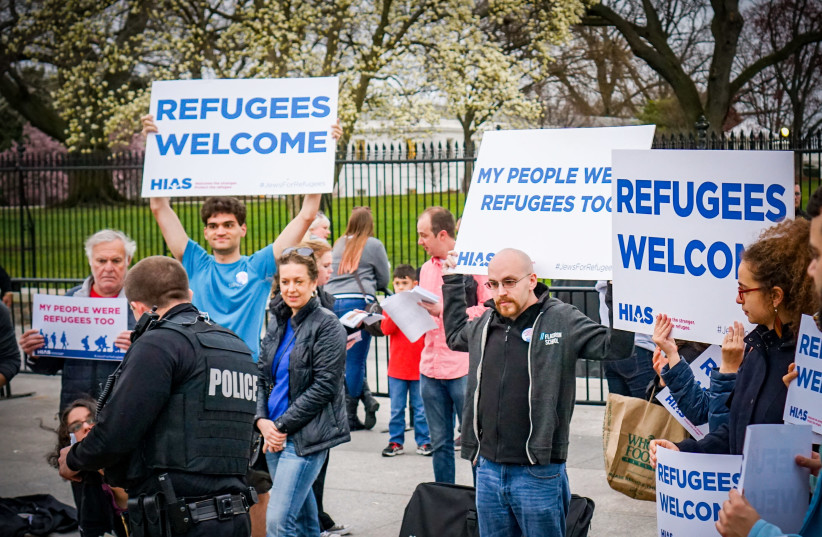
Oppenheim said HIAS continues to advocate for the restoration of refugee admissions and the reopening of lawful pathways for people fleeing religious persecution, and continues to provide services to thousands of refugees and asylum seekers around the world.
“For generations, the United States has stood as a beacon for those fleeing religious oppression, and we will fight to preserve that legacy,” Oppenheim said.
HIAS's history echoes history of Jewish displacement
The closure of the Vienna office marks the end of an institution whose history closely mirrors the modern history of Jewish displacement.
Known then as the Hebrew Immigrant Aid Society, HIAS began operating in Vienna in the aftermath of World War II, when Austria became a central transit country for Jewish survivors leaving displaced persons camps across Europe. During that period, the organization helped resettle roughly 150,000 Holocaust survivors to communities in the United States, Canada, Australia, South America, and later Israel.
Vienna again emerged as a refugee crossroads after the 1956 Hungarian Revolution, when thousands of Jews fled Soviet-backed repression and passed through Austria on their way to new homes overseas. In later decades, the city became a key waypoint for Jews leaving the Soviet Union, particularly from the late 1970s through the late 1980s.
During that period, Vienna served as the first stop in what became known as the “Vienna-Rome pipeline,” the migration route used by more than 400,000 Jews from the former Soviet Union as they resettled in the United States and other countries. For US-bound refugees, the Vienna office coordinated case preparation, documentation, and interviews with American authorities.
Singer-songwriter Regina Spektor and Google co-founder Sergey Brin are among the many prominent Jews who passed through Austria on their journey from the Soviet Union to the United States.
“If your family arrived in the postwar period, or through the Soviet Jewry movement, HIAS’s office in Vienna may have been their gateway to the United States,” Oppenheim said.
In its modern form, HIAS’s operations in Austria became a US-funded Resettlement Support Center in 2000, operating under contract with the State Department’s Bureau of Population, Refugees, and Migration. One of nine such centers worldwide, the Vienna-based operation focused primarily on Iranian religious minorities and vulnerable asylum seekers in Israel.
Between 2001 and 2025, HIAS said it resettled more than 33,000 people from Iranian religious minority communities to the United States through the Austria center and its suboffices. The work was conducted under the Lautenberg Amendment, a US law first enacted in 1990 to facilitate the resettlement of Jews from the former Soviet Union and later expanded to include persecuted religious minorities from Iran.
Since Trump paused refugee resettlement on his first day in office, no one has entered the United States through the Lautenberg program.