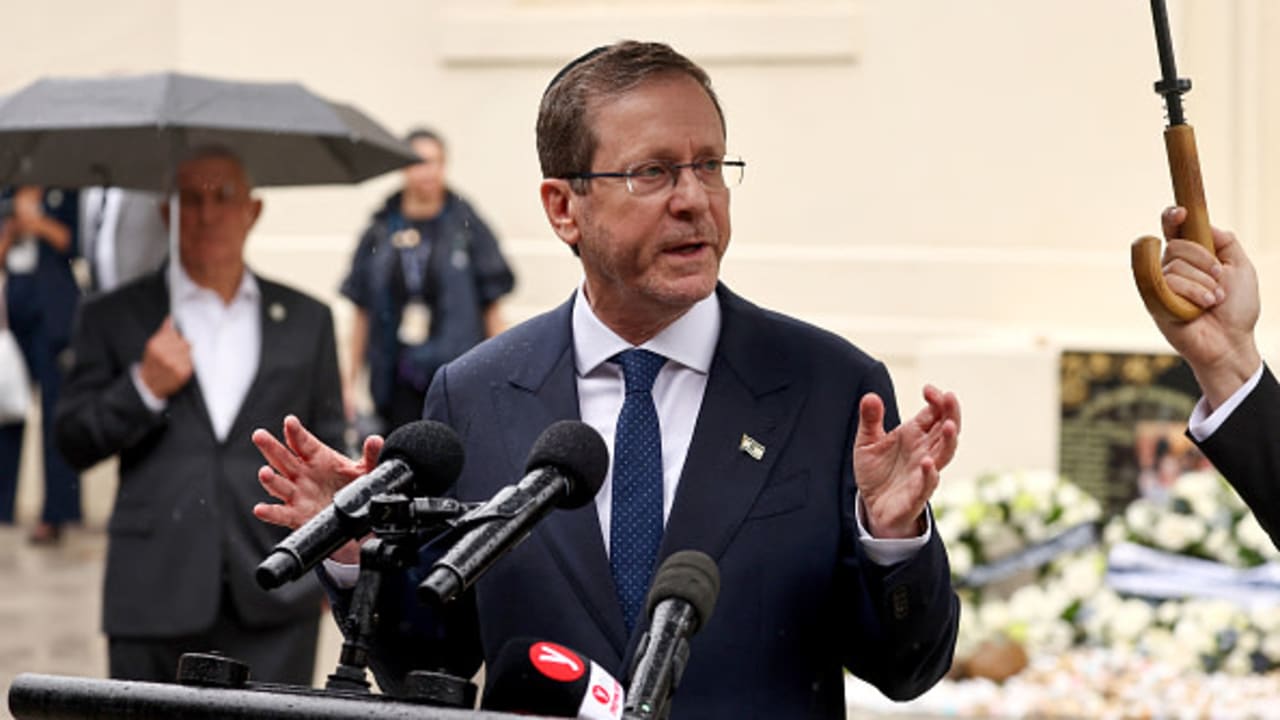
As President Isaac Herzog drew a straight line in the capital of New South Wales on Monday night connecting the antisemitism embodied in the chant “Globalize the Intifada” and the attack on Bondi Beach, police just a few kilometers away were battling anti-Israel protesters chanting that very slogan.
“The hatred that triggered the shooting at Bondi is the very same age-old plague of antisemitism endured by our parents and grandparents,” Herzog told an estimated crowd of 4,000 people at the TikTok Entertainment Center during a remembrance ceremony for the Bondi victims and solidarity with the Australian Jewish community.
Referring to the attack that killed 15 people in December, Herzog said, “The horrors in Israel, empowered by jihadi extremism, reared their ugly head here as well… This is what it means to ‘Globalize the Intifada.’”
Meanwhile, a few kilometers away at Town Hall, a crowd that local media put at “thousands” defied a court order and marched against Herzog’s visit. The News.com.au website reported that Grace Tame, a former “Australian of the Year,” led protesters in a “Globalize the Intifada” chant.
“We have to continue to mobilize, and we have to continue to globalize,” she said. “Say it with me, from Gadigal [Aboriginal land in Sydney] to Gaza, globalize the Intifada.”

Despite clashes between police and protestors, Herzog was shielded from the demonstrations, with participants kept well away from both his downtown hotel and the motorcade route he traveled. Some 3,500 police officers were deployed to protect the Israeli president.
Herzog had arrived in Australia earlier in the day for a four-day visit at the invitation of Governor-General Sam Mostyn, Prime Minister Anthony Albanese, and the Australian Jewish community. On Monday morning, he attended a wreath-laying ceremony at the site of the Bondi Beach massacre, where he said he had come to embrace and console the bereaved families following the “horrific antisemitic terror attack.”
“We are one big family, and when one Jew is hurt, all Jews feel their pain,” Herzog said at the site.
He welcomed what he described as “positive steps already taken by the Australian government to tackle antisemitism since the Bondi attack,” but stressed that he, along with others, had warned leaders in Australia, the United Kingdom, Canada, and the United States for years about the rising tide of antisemitism in their societies, long before the massacre.
Among the speakers at Sunday night’s solidarity event was Chris Minns, the governor of New South Wales and a member of the Labor Party, whose head – Albanese – has come under harsh criticism from Prime Minister Benjamin Netanyahu and many within the Australian Jewish community for steering a pro-Palestinian stance that included recognition of a Palestinian state over the summer.
Minns, who received a warm reception, began his remarks by quoting the famous speech made by Herzog’s father – Chaim Herzog – at the United Nations, denouncing the resolution equating Zionism with racism. A nation’s level of humanity, Herzog said at the time, could invariably be judged by its behavior toward its Jews.
“The murderous ideology of antisemitism is a test of every society, and it’s one that weighs heavily on me,” Minns said.
“We have to be able to say, openly and clearly and without excuse or reservation, that we failed that national test of human decency on December 14 at Bondi. And things must change in our state and our country.”
Herzog visit triggers massive Sydney security operation
Herzog is scheduled to meet Albanese on Wednesday, in a meeting seen as part of an effort to put bilateral relations back on firmer footing after a period of strain in the bilateral ties.
Following the Bondi attack, Netanyahu said that Australia’s recognition of a Palestinian state had “poured fuel on an antisemitic fire.”
After Australia denied a visa in August to Religious Zionist Party MK Simcha Rothman, Netanyahu wrote on X/Twitter: “History will remember Albanese for what he is: a weak politician who betrayed Israel and abandoned Australia’s Jews.”
Herzog said at the large community event that, in addition to wanting to underscore to the Australian Jewish community just how important it is to Israel, he also hoped to use his visit to reinvigorate ties between the two countries.
Nevertheless, much of the local media coverage surrounding the visit has focused less on its symbolic significance and more on the controversy it has sparked – including the protests, court challenges, and accusations that authorities are using excessive measures to keep demonstrators away from the president – often overshadowing the broader context of Israeli-Australian relations.
That strain surfaced even at the ceremony itself, during one of the questions posed by an Australian reporter.
“Standing here at this solemn site where 15 people were killed indiscriminately, there are protests planned today by people mourning 70,000 killed in Gaza, including 20,000 children. Can you reflect on what message you have, if any, for those protesters?” he asked.
Herzog, no stranger to hostile anti-Israel protests during visits abroad, responded that Israel and Australia have been close allies for decades and that support for Israel has traditionally been bipartisan in Australia.
In many cases, he said, what is heard at such demonstrations comes from people who seek nothing less than “to undermine and delegitimize” Israel’s right to exist.