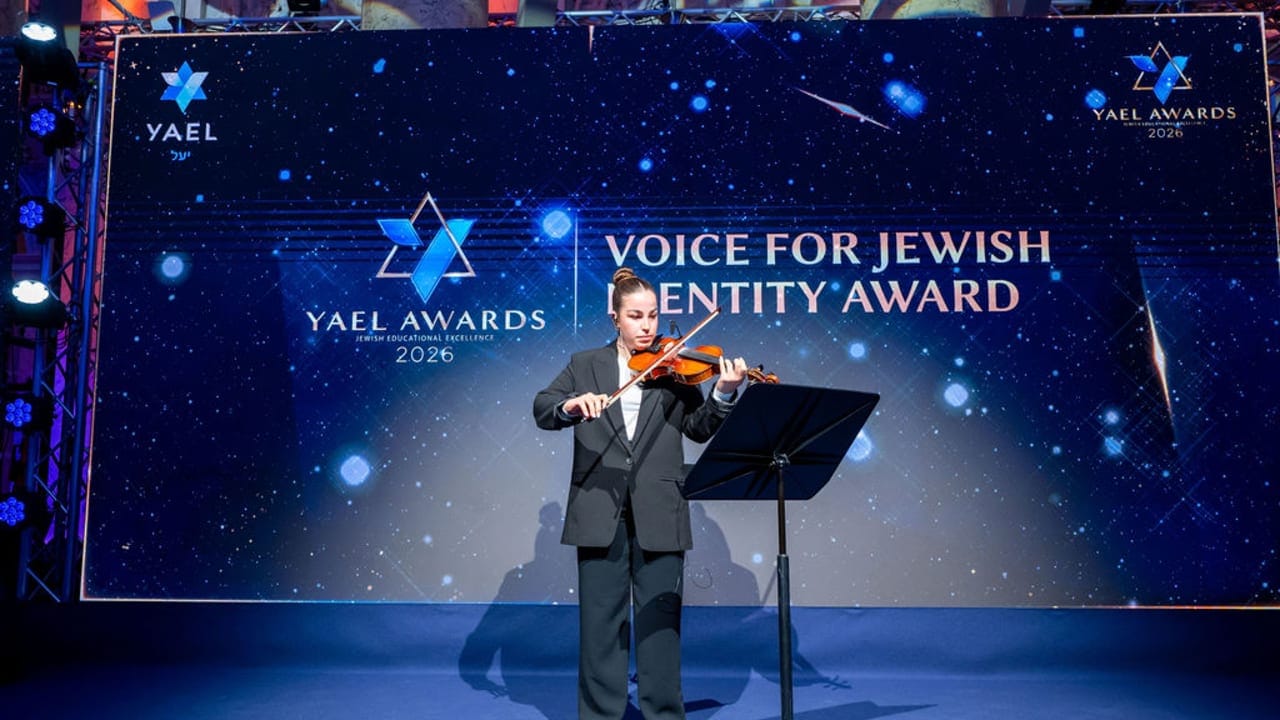
Educators from across the Jewish world gathered last week at Vienna’s Hofburg Palace for the 2026 Yael Awards. The setting was formal and the message energizing, yet grounded in the day-to-day realities faced by more than 200 educators, administrators, and community leaders from around the world. The conference created space to think seriously about Jewish education and how to further raise standards. The Yael Awards are the only global awards program focused exclusively on Jewish education.
This year’s ceremony recognized excellence across 11 categories, with winners representing ten countries. The gathering took place as antisemitism continues to rise across many regions, prompting Jewish leaders to question whether current responses are sufficient or properly aimed. In Vienna, the Yael Foundation advanced a different argument, one centered on long-term strength through sustained investment in Jewish education and identity.
Speakers emphasized that strong schools and a confident identity are long-term assets. Jewish education, they argued, should be understood as community infrastructure. Rabbi Shlomo Farhi opened the gathering with urgency. He reminded the audience that a student spends roughly 13,000 hours in school – just over two years in total – and that this limited time shapes identity, values, and belonging.
The clock, he warned, is always running. His message was direct. Excellence is not optional. Jewish tradition, he argued, does not settle for “tov” [good enough], but always pushes us to go beyond, to “tov me’od” as written in the creation story in Bereishit. That motivation to raise standards shaped the days that followed. The awards ceremony marked the culmination of several days of programming and discussion. Educators moved among plenaries, workshops, and keynotes focused on leadership, resilience, and responsibility, maintaining a collaborative, open, and solutions-oriented tone throughout.

Cybersecurity expert Keren Elazari discussed ethics, trust, and decision-making under pressure, with a focus on responsibility in complex environments. Psychologist Tal Ben-Shahar addressed resilience and recovery, arguing that recovery from stress enables post-traumatic growth, a framework he described as resilience 2.0. By the time participants arrived at the Hofburg Palace, the setting itself carried meaning.
Long a seat of power and decision-making, the palace conveyed authority through its scale and formality. The choice of venue was deliberate. The Yael Foundation placed Jewish educators in a space historically reserved for ambition and influence, sending an implicit message: education that shapes the future should be treated with the same seriousness and standard of excellence. The surroundings were striking and intentional. Jewish education was being positioned as work worthy of the highest investment and attention.
That standard was reflected in the models of excellence recognized throughout the evening. Madrid’s Ibn Gabirol School won the Academic Excellence Award, with judges citing academic rigor and its ability to serve a diverse Jewish population within a single framework. Beth Habad Canton Vert in France received Jewish Experience of the Year for providing stability and connection for teens under pressure.
Maimónides School in Tucumán, Argentina, won the Community Impact Award for rebuilding Jewish life in a small but growing community. Simcha School in Kyiv received the Innovator of the Year award, recognized for adaptive educational models developed under extreme conditions. Each award includes a cash prize, and for recipients, the recognition carries both practical and symbolic weight. Several leaders spoke about returning home with greater validation and visibility within their communities.
More than 13,300 parents participated in voting this year. Winners were selected based on parent input and evaluation by an international judging panel that included Natan Sharansky, Avital Chizhik Goldschmidt, Robert Singer, Max Neuberger, and Chaya Yosovich. Chaya Yosovich, CEO of the Yael Foundation, said the event reflected values through action. “This week in Vienna, we chose to invest in educators in the most visible and intentional way possible,” Yosovich said. “Jewish education is worth investing in at the highest level.” Yael Foundation co-founder Uri Poliavich spoke about growth and structure, with a focus on sustainability. “What matters to us is building strong, self-sustaining Jewish schools with the right leadership, structure, and educational talent in place,” Poliavich said.
Poliavich noted that the foundation has significantly increased its investment compared to last year, describing an approach shaped by long-term planning and operational discipline. Conference sessions addressed antisemitism directly, with speakers describing pressure felt across communities. The discussion repeatedly returned to capacity building and institutional strength.
Participants emphasized that reactive funding alone is insufficient. Strong schools build confidence early, and an identity formed early proves more durable. One quiet moment during the ceremony punctuated that point. Agam Berger received the Voice for Jewish Identity Award. She did not speak. She played Hallelujah on the violin, bringing the hall to silence in a performance that filled the room with a palpable sense of meaning and purpose. By the end of the evening, the message was clear. The Yael Awards articulated a set of priorities, placing investment in education, leadership, and standards at the center of efforts to strengthen Jewish identity worldwide.
Written in collaboration with the Yael Foundation