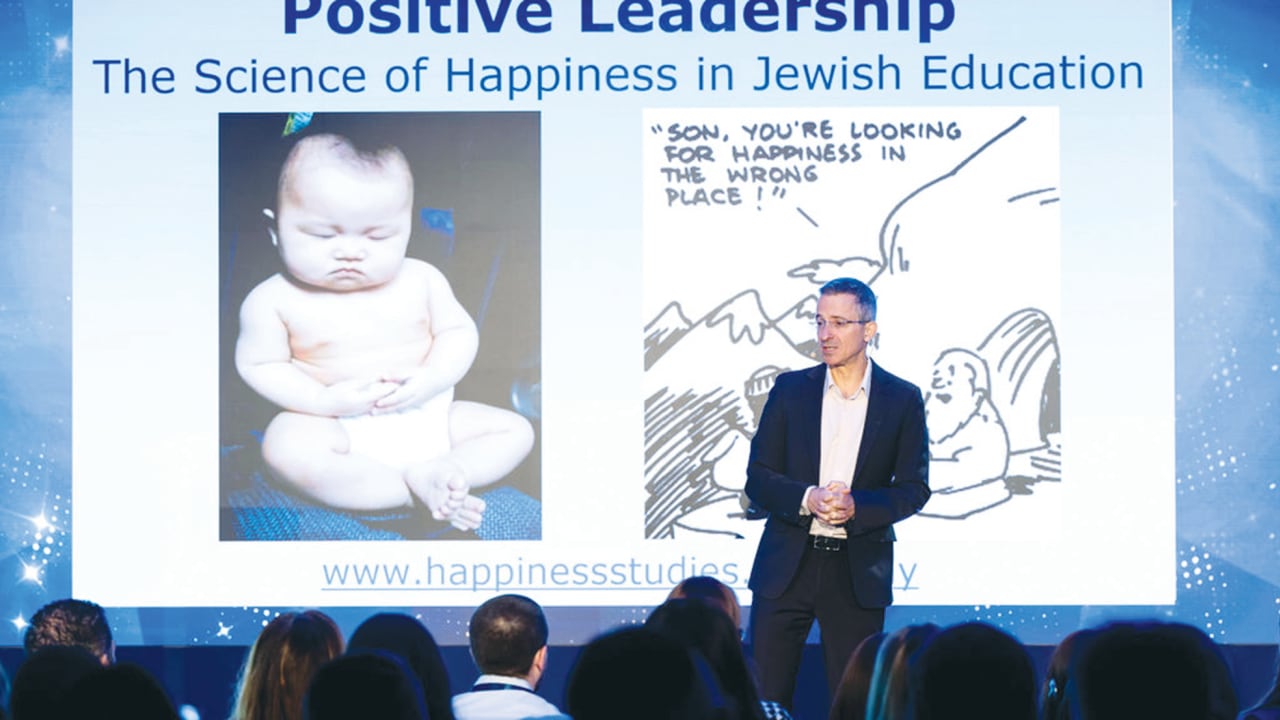
VIENNA – How can we teach happiness in a post-October 7 world? And how can we focus Jewish education on pride, success, and victory, rather than trauma and oppression?
These are some of the key questions facing Jewish leaders, educators, and parents today.
Research suggests post-traumatic stress disorder has risen sharply since the October 7 attack, with a significant number of adult and adolescent Israelis showing symptoms of post-trauma. Though figures in the Diaspora are less precise, the rise in antisemitism and the increasing isolation of Jewish communities have led many Diaspora Jews to experience similar trauma.
However, some experts believe focusing on positivity and happiness may be the most effective approach to trauma and Jewish growth.
One of these experts is Dr. Tal Ben-Shahar, an Israeli professor and writer in the areas of positive psychology and leadership. Ben-Shahar has taught happiness studies at Columbia University, and now runs fully accredited MA and PhD programs in happiness studies with Centenary University.

'The first secret to happiness'
“My answer is that there are three secrets to happiness,” Ben-Shahar told The Jerusalem Post at the Yael Foundation conference in Vienna. “The first secret to happiness is reality. The second secret to happiness is reality. Third secret, reality.”
This, he explained, means focusing on our successes. “That’s part of reality that has largely been ignored, whether it’s by the Jewish community or whether it’s by the psychology tradition, the 20th-century psychology that mostly focuses on psychopathology. And positive psychology says let’s focus on what works, let’s focus on the positive.”
Within the Jewish community, and especially within Jewish education, there is often a focus on the traumatic past – the Holocaust, pogroms, expulsions. While Ben-Shahar said it is important to learn about past suffering, he stressed it is also important to learn about the amazing history that we have and the accomplishments.
“Just focusing on the suffering is unhealthy. It’s as unhealthy as, within a relationship, a couple only talking about their problems. Again, with good intentions, because we want to fix them. But if you only talk about problems, you live your problems. And you become them.”
Take Israel, for example. Israel is a country that faces threats from multiple fronts and has a deeply traumatic past, but it is also the Start-Up Nation. And it is also consistently ranked as one of the happiest countries in the world.
“Why is Israel one of the happiest countries in the world? Despite all of our challenges? The main reason is because of relationships. It’s a real focus in Israel, whether it’s on Shabbat, dinner with your family. And that explains why Israel is among the happiest countries in the world. And that also explains why Israelis are so resilient.
“And secondly: giving, generosity. Whether it’s charity, whether it’s helping someone in need, whether it’s just listening to someone. Of course, when we help other people, we are also helping ourselves. We become happier and we become more resilient and more likely to experience post-traumatic growth.”
Researchers estimate that roughly half to two-thirds of people who experience a traumatic event also experience post-traumatic growth. Post-traumatic growth is a positive psychological transformation that can occur after struggling with highly challenging, traumatic life experiences. It involves profound shifts in perspective such as deeper appreciation for life, enhanced relationships, and increased personal strength.
Ben-Shahar referenced a favorite phrase of his by Eknath Easwaran, an Indian-born meditation teacher and professor of English.
“He says we become what we meditate on. We become what we talk about. We become what we repeatedly say. So, again, I’m not saying ignore the Holocaust, just like we shouldn’t ignore October 7. But there are also amazing things that are happening.
Jewish pride
“They say about Gandhi that the most important thing he did for India was that he made India proud of itself. We need to learn Jewish pride, Israeli pride, because we do have a lot to be proud of.”
Jewish pride and how to spark it in the next generations were at the heart of Ben-Shahar’s discussion with the Post. He explained that part of invoking pride comes from making Judaism relevant for Jewish children.
“If I tell children Shabbat is important and it’s also in the Torah, it’s one thing; many kids will be persuaded by that. However, if you say: listen to this research showing that if you take a day off during the week you’ll not just be happier, you’ll be healthier and more successful overall, more children may be encouraged to keep the Sabbath.
“Or if you tell them you should say Modeh Ani in the morning, that’s one thing. If you tell them that if you express gratitude in a regular way you’ll be happier, healthier, and more successful, that’s another layer.”
He provided the example of the research of Martin Seligman, the founder of the field of positive psychology and a professor at the University of Pennsylvania in Philadelphia.
He said Seligman asks teachers and parents two questions. “‘What would you most want for your children?’ The parents tell him they want their child to be happy, or they want their child to have good relationships, or they want their child to be resilient or healthy. And Seligman adds these to a list. Then he asks them a second question: ‘What are children learning in school?’ And he makes a list of math, language, geography, history, biology, and so on.”
What becomes clear is that there is almost no overlap between the two lists.
“It’s unfortunate, especially today given the fact that we have a science of happiness. So we know how to teach happiness. We know how to help children and adults be more resilient, have better relationships, and become happier. Why aren’t schools focusing on that as well? Why aren’t schools in Israel or Jewish schools around the world connecting between our tradition and what the science of happiness has to offer?”
Ben-Shahar also advocates for more physical exercise, something which he says is essential for emotional well-being.
“It’s important for physical well-being and for psychological well-being. I absolutely think it’s lacking in schools. Schools teach math, but they don’t have enough funding for PE. Children who exercise regularly will also sit down to do science better. They’ll be less distracted. One of the best ways to deal with ADHD is through movement. One of the best ways to enhance creativity and innovation is by cultivating healthy relationships. They’re connected.
“Children now spend unprecedented amounts of time on smartphones, a trend increasingly linked to anxiety and depression. One of the dangers of the phone generation is that children have more exposure to hatred, antisemitism, and potentially traumatic content. While antisemitism isn’t new, it’s taken a different form in the digital age.”
Do children have the tools and facilities to be able to deal with that?
“I don’t think so,” said Ben-Shahar. “One of the reasons why we founded The David Project [his public diplomacy organization] all those years ago was because Jewish schools or Jewish children and adults were not receiving the tools to be able to deal with attacks against Israel. When I was teaching, I used to say we need to learn to go on the offensive without being offensive.
“So we shouldn’t just passively receive all the lies and distortions that are being promoted in the media worldwide and certainly in social media worldwide. We need to stand up for Israel and fight.”
Ben-Shahar lamented how some Jewish students – predominantly those who do not go to Jewish schools – not only do not care about Israel, but some are opposed to the very existence of a Jewish state.
“We need to teach our children to not just stand up for Israel, not just understand why we have a right to this land, but why this is also a moral and righteous cause. To stand for Israel and to put Israel at the epicenter of good versus evil. It’s our goal to be that candle in a dark room.”
Ben-Shahar thinks that, both Israel and in the Diaspora, there has to be much more focus on the “Jewish” in “Jewish education.” He noted that, in Israel, children who do not go to Jewish religious school, get “very, very little” Jewish education. “In fact, there is also antagonism towards it.
“In the Diaspora we need to continue with Jewish education, to connect it to their daily life, so [we continue] this bridge between modern research and ancient wisdom.
“We need to learn Jewish pride, Israeli pride,” he said, “because we have a lot to be proud of.”