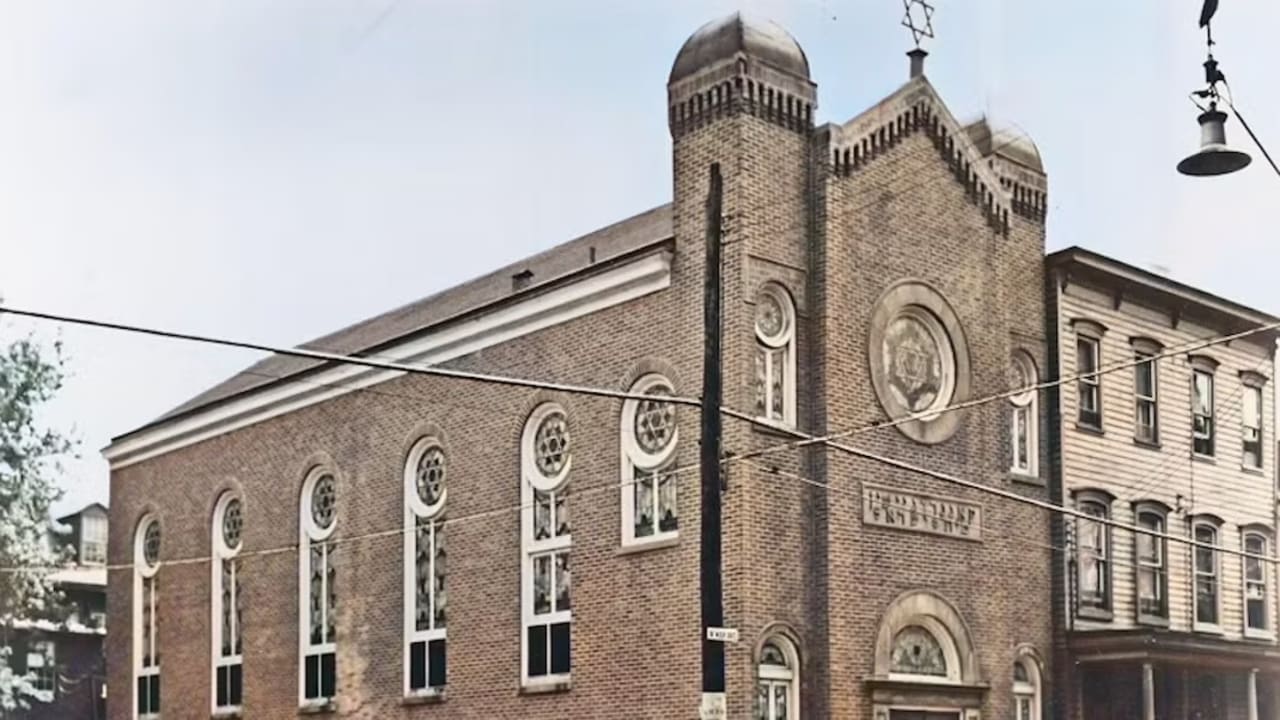
An abandoned synagogue in Pennsylvania’s coal region, which until the early 2000s had served Jewish residents of Mahanoy City for more than 80 years, collapsed late Thursday night, officials and neighbors told the local media.
Emergency crews responded to reports of falling walls and scattered debris at the former Beth Israel Synagogue, a brick building whose cornerstone was laid in 1923.
No injuries were reported, according to Skook News, a news site serving Schuylkill County. Crews began demolishing what was left of the building and carted away the debris.

“It’s sad to see the buildings go, I lived in Mahanoy City, or I worked here my whole life, and one by one these historic buildings seem to be going,” Paul Coombe, president and historian of the Mahanoy Area Historical Society, told television station WFMZ.
According to local histories, Mahanoy City’s first organized Jewish congregation dated to 1888. Jewish merchants and families had settled in the area - about an hour and a half northeast of Harrisburg - at the turn of the century, opening shops and businesses serving the booming coal economy.
History of the building and the local Jewish community
“When we talk about the Jewish communities and the Rust Belt, the Jews didn’t come to be part of that particular industry or that particular labor. They came to support it,” said Alanna Cooper, chair of Jewish Studies at Case-Western University and an authority on synagogues past their prime.
“They understood that it was important for that economic niche to be there in order to support the people who were working the mines or doing the industrial labor,” Cooper said.
At its peak, the Jewish population in the borough rose to around 50 families, who established the synagogue and, in the 1930s, a Jewish cemetery. Like many small-town Jewish communities in the Rust Belt, the congregation at Beth Israel dwindled as industry and the local economy declined in the decades after World War II.
The synagogue ceased formal religious services in 2003, and its doors were locked, and the building boarded up, according to Rabbi Akiva Males, a Harrisburg rabbi who wrote in a 2012 article about his interest in Beth Israel’s history. In the process of closing the house of worship, congregation leaders sold its Torah scrolls and offered ritual items to synagogues in other regions.
In 2015, author Ted Merwin reported in the New York Jewish Week that Beth Israel’s stained-glass windows had ended up at Eitz Chayim of Dogwood Park, an Orthodox synagogue on Long Island’s South Shore, under unclear circumstances. Eitz Chayim leaders said they had been given permission by unnamed local leaders to remove the windows.
The same article reported that descendants of Beth Israel families were seeking the return of the windows or payment at “fair market value,” which they hoped to use to maintain the cemetery. The case ended up in state court in 2017, although there is no record of how it was resolved.
Merwin said this week that how the eight windows ended up on Long Island remains a mystery, but perhaps one with a satisfying ending.
“The windows are beautiful,” said Merwin. “What is the legacy of these communities that faded out and are forgotten? At least this is some sort of a lasting legacy.”
Cooper, who is writing a book on preserving and disposing of the assets of fading congregations, said any synagogue’s demise touches on Jewish feelings of historical loss.
“American Jews crave community, and we’re losing it now because of our mobility and digital technology,” she said. “The disappearance of community is not just a Jewish story, but it resonates with people. What does it mean to be in a tight-knit community where all of the members were aunts and uncles to all of the kids? That’s kind of getting lost.”