Only four ingredients are needed to make modern beer: water, malted grain (in most cases, barley), hops, and yeast. Just by manipulating these four elements, a skilled brewer can produce any of the more than 100 recognized styles of beer.
Until recently for Israeli brewers, the malt, the hops, and the yeast had to be imported. For the past few years, however, the Alexander Brewery in Emek Hefer has been using Israeli-grown wheat (from the Gaza border communities) for its Wheat Beer. The Shikma Brewery in Ashkelon has been shipping Israeli-grown barley to Germany, where it is malted and then sent back to Shikma for use in some of its beers.
As far as hops go, Israeli brewers have always imported them from the main areas where they are grown: Europe, Australia, New Zealand, and the west coast of North America.
Hops are green, flowering plants that grow on vines. They are an essential ingredient in beer, adding bitterness, aroma, and flavor. They also are mild preservatives. There are hundreds of different hop varieties, each one with its own characteristics.
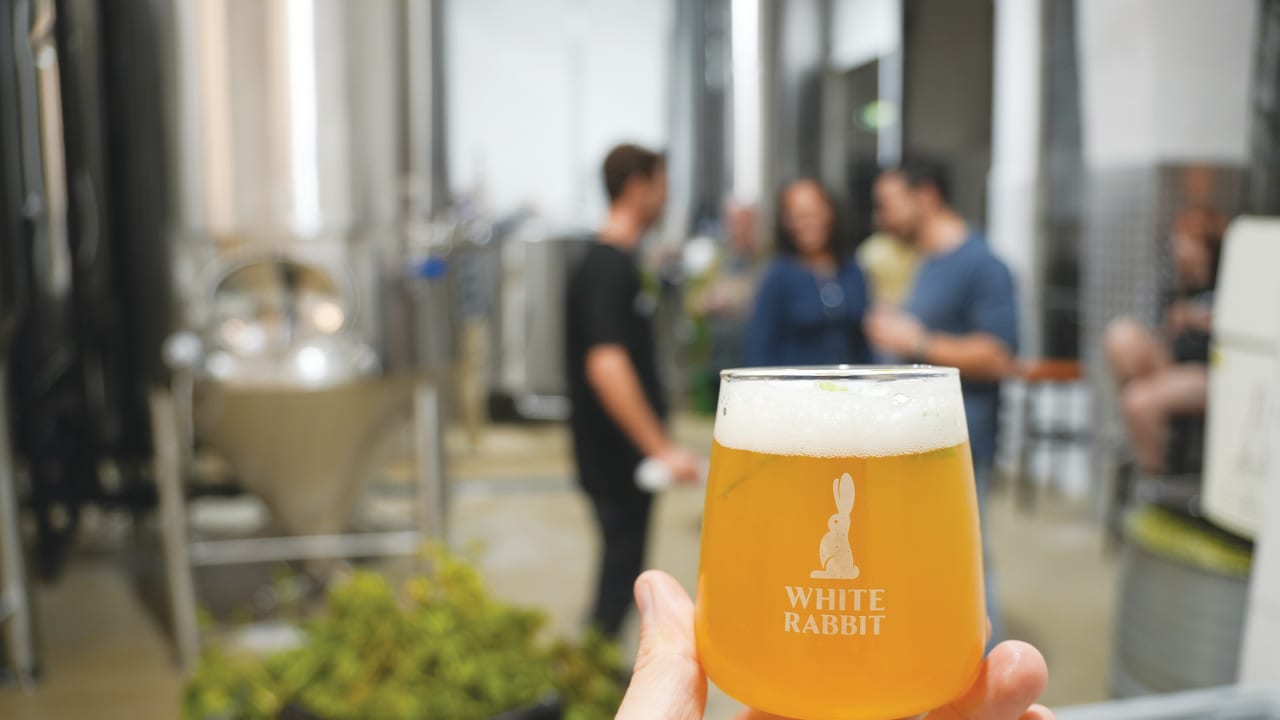
And now, for the first time (drum roll), Israeli-grown hops have been used commercially for making beer. The White Rabbit Brewery in Tel Aviv brewed and unveiled one of the beers at a recent public event. It called the celebration Beerjolai’s, inspired by the Beaujolais wines in France, made from the first grape harvests.

The beer itself was nameless and was served from the tap. No bottles were available. But how the hops were grown and what they did to the beer is what makes the whole story so interesting.
It begins when Noam Amar, whose family owns a vineyard on Moshav Odem on the Golan Heights, traveled to New Zealand after his army service.
“I spent some time on a farm where they were growing hops,” he says, “and I noticed they were also growing the same crops that we do on the Golan.”
After Amar returned to Israel, he was offered a stipend by the Golan Regional Council to grow “something different.”
He remembered the hops from New Zealand and suggested that crop, believing it would have a market with Israeli beer brewers. The council agreed, and Amar and his brother Ido began growing hops experimentally in the family vineyard.
Ido was killed in a tragic work accident three years ago, but Noam Amar continued with the project.
“We got the first seedlings from Israeli beer lovers,” he explains. “We were able to produce several hundred plants from tissue cultures. They grew well under our climate conditions and temperature.”

Amar grew five hop varieties on his farm: Cascade, Chinook, Comet, Centennial, and Zeus. He approached the White Rabbit Brewery, proposing that it use his hops for brewing a beer. Head brewer Avi Shalev liked the idea and agreed immediately.
Cascade was chosen for the first beer. It is one of the most popular hops grown in the US, contributing both bittering and aromatic qualities.
Around 1,200 liters of beer brewed
The hops were dried right on the moshav, vacuum packed, and shipped directly to the White Rabbit Brewery. About 1,200 liters of the new beer were brewed.

“We’re very excited about using Israeli-grown hops,” says Shalev. “I’ve always thought that if we want to develop our own Israeli beer culture, we should be producing our own raw ingredients. Shortly after the hops were planted, I went to work together with Noam Amar to ensure that they were being cared for properly and were harvested at just the right time.”
Shalev was curious to learn whether the hops grown in the volcanic soil of the Golan gave aromas and flavors that were different from the same hops grown abroad. In short, what effects did the terroir of the Golan have on the final beer?
A short taste test by yours truly and other members of the Israel Brews and Views (IBAV) Tasting Team revealed that the Israeli Cascade hops were more restrained (less bitter, less flavorful) than their North American relatives.

The White Rabbit nameless beer was indeed gentle in aroma and clean in taste. The Cascade hops brought it to what we felt was the border of an India Pale Ale (IPA). The spice and citrus characters weren’t there, but we did taste some melon, strawberry, and vegetal. Alcohol was present in the mouthfeel, even though alcohol by volume was a moderate 5.2%.
The White Rabbit brews three core beers, all India Pale Ales. (They can be ordered from the brewery website, Hebrew only: www.white-rabbit.co.il/beer-about.)
But the Golan hops story doesn’t end with the White Rabbit.
At about the same time the people from White Rabbit decided to use the hops from Odem, two other people paid a visit to Amar.
Itzik Levy, the owner of the Isis Desert Brewery on Moshav Dekel (close to the Egyptian and Gaza borders), and Yedidya Revach, the new brewmaster, knew about Amar and his experimental hops.
“We wanted to use these Israeli hops in our beer,” Revach says, “so we went to the Golan to examine them. We ended up buying a quantity and bringing it back with us to the brewery.”
The Isis Desert Brewery was founded in 2007 and today brews 12 core beers. Since they are marketed mostly in Israel’s southern region, the beers are not very well known in the rest of the country. Levy takes pains to explain that the name Isis comes from the Egyptian goddess of fertility and health, and not from the more recent Islamic terrorist movement! “We were here first!” he declares.
Isis recently moved to new facilities on the moshav. Revach had previously worked at the Shapiro and Srigim breweries, and he earned a brewmaster’s degree in Germany.
The beer he brewed with the Golan hops is called Brut Beer, echoing the name of Brut Champagne, known for its extra dryness and low sweetness level.
“We achieved this,” he explains, “by using red wine yeast to ferment the beer. The result is a dry, clean, and refreshing drink.”
To emphasize the beer’s distinctiveness, the brewers decided to market Brut Beer under a different brand name: not Isis but ISAAC, and named the brewery Western Negev Brewery. Another difference is that it is sold in bottles of 750 milliliters. Alcohol by volume of 8%.
Revach confirms that the aromas and flavors of the Israeli-grown hops were more muted than similar foreign imports. “To get the flavor and bitterness I wanted for the 3,000 liters of Brut we brewed, I had to add imported Cascade and Nelson hops,” he says.
The IBAV Tasting Team was suitably impressed by Brut, enjoying the diverse aromas and flavors of green apples, cucumber, pine, melon, and white wine. Two members of the team, however, thought that the bitterness level was too high, even going so far as to overshadow the other flavors. The finish was dry and refreshing, as we expected from the Brut name.
ISAAC Brut Beer from the Western Negev Brewery is not available in any stores at the moment, but it can be ordered for home delivery by calling 054-642-8598. Other Isis beers can be purchased from the online store: isisbeer.co.il/.
The writer is the owner of MediawiSe, an agency for advertising and direct marketing in Jerusalem. He writes a weblog on Israeli craft beers called “Israel Brews and Views,” which can be found on Facebook.