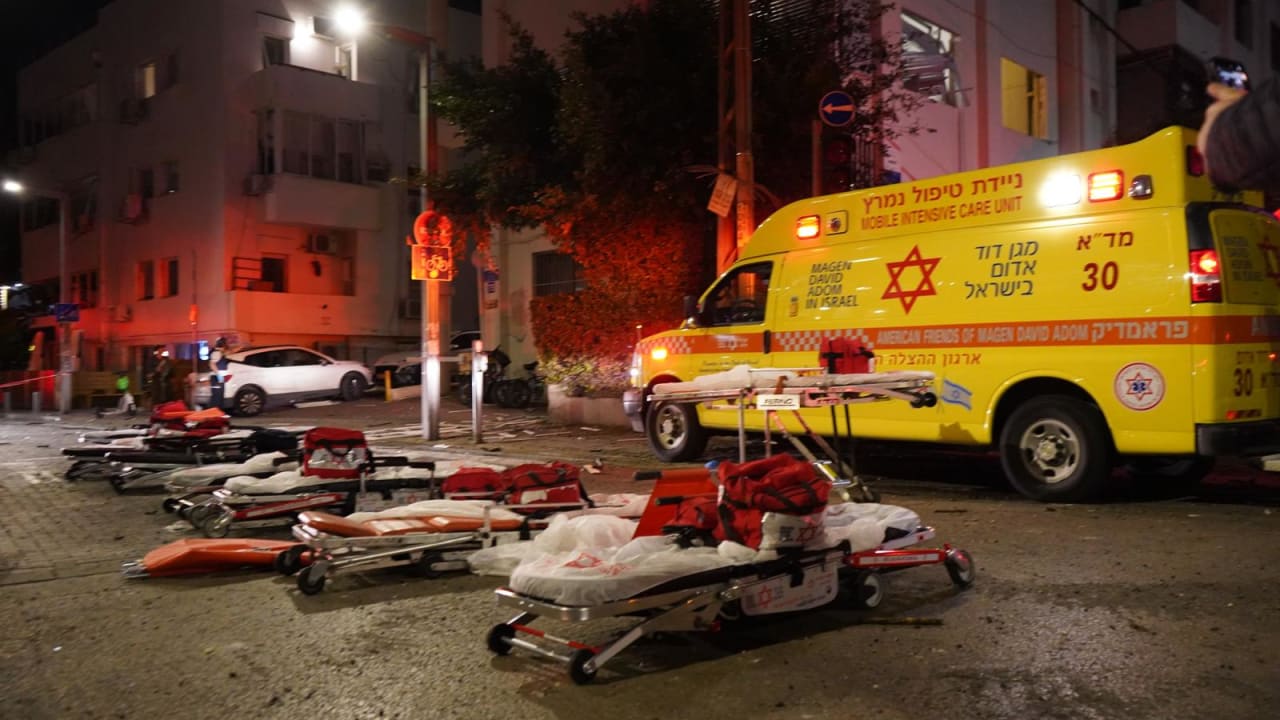
While missiles continue to threaten the home front during Operation Roaring Lion, Magen David Adom (MDA) stands as the first line of defense of the State of Israel. With 39,000 staff members and a fleet of rescue vehicles, the organization is conducting a logistical and operational campaign unlike any other in the world. Here is an inside look at the heroism in the field and the unimaginable cost of saving lives.
>> MDA teams are working under fire and they need your support. Donate Now.
On days when Israel’s home front becomes the frontline, Magen David Adom is far more than an organization that provides ambulance services, it is the state’s “national nerve center.” Behind every siren piercing the silence stands a well-oiled machine of approximately 39,000 women and men, the vast majority - over 90% - volunteers who staff approximately 2,800 ambulances and mobile intensive care units, specialized rescue vehicles, helicopters, emergency motorcycles, and more, alongside an advanced technological network that ensures a team is dispatched to any scene within seconds. Yet this strength is not self-evident. It is built first and foremost on the total human dedication of MDA’s teams, who run into the fire while everyone else flees from it.
Heroism Among the Ruins: “The Girl Asked Where She Would Live”
'Operation Roaring Lion' began on the morning of Saturday, 28.2.26. By the end of that same Saturday, a direct missile strike hit a building in Tel Aviv. Yonatan Shem Tov, a 21-year-old MDA volunteer, arrived at the smoke-filled, devastated scene riding his emergency motorcycle. While treating the wounded under the threat of additional missile fire, he experienced a heartbreaking moment: a five-year-old girl, clutching a book in her hands, was carried out of the destroyed building.

“She looked at me and innocently asked where she and her family were going to live,” Yonatan recalls. “I didn’t know what to say. I took a deep breath and told her that the most important thing is that they are together, and that they would have an even more beautiful home.”
The following day, a missile struck in Beit Shemesh, claiming the lives of nine people. Dror Eini, a veteran paramedic who has served in the organization since 1988, was among the first to arrive. He found himself facing difficult scenes: a synagogue turned into a pile of rubble and a massive crater at the heart of the neighborhood.

“Even for me, this is not a routine incident,” Dror shares. “But when you’re in the middle of it, you place a barrier between what you see and what you feel and focus on the job.”
Alongside Dror was Eli Eisenbach, who was responsible for ongoing reporting to the 101 dispatch center. “My role was to translate what we were seeing into words for the dispatchers, so the right resources would be sent to the scene,” he explains, adding, “Thanks to the precise reporting, approximately 40 ambulances and more than one hundred MDA personnel flowed to the location, managing triage and effective treatment of the wounded under fire.”
The Brain Behind the Operation: Life-Saving Technology
The ability to take control of such a devastating scene stems from an enormous investment in internal technology. MDA’s 101 dispatch center uses automated systems it shares with the police and with Fire and Rescue services, saving precious and critical minutes in transferring information by phone, minutes that translate into faster life-saving response.

In addition, dispatchers can receive live video transmissions from the field and guide civilians on how to stop bleeding even before the ambulance and emergency medical team arrive.
“A picture is worth more than a thousand words,” says Omri Levy, National Dispatch Supervisor. “That’s what enables us to have complete versatility and a rapid response.”
National Resilience Requires Resources
Despite its critical role, Magen David Adom is not a government organization in budgetary terms. The state funds only approximately 12% of its annual budget, while the rest relies on the generosity of donors in Israel and around the world. During wartime, the costs become staggering: each day of fighting costs the organization approximately 3 million shekels.
The numbers speak for themselves:
- 180,000₪ is the cost of the medical equipment in a single mobile intensive care unit;
- 48,000₪ is the cost of a kit to test 1,000 blood units alone at the National Blood Bank;
- 30,000₪ is the cost of a life-saving trauma kit for a mobile intensive care unit;
- and 11,000₪ is required for a professional kit for a paramedic on a motorcycle.
“This infrastructure was built largely from donations by people who understand the importance of the organization to national resilience,” clarifies Alon Friedman, MDA’s Deputy Director General of Finance. Orly Ariel, CEO of Friends of MDA, adds that during war, supplies are depleted at an accelerated pace. “Without immediate reinforcement of inventory, it is impossible to maintain the level of preparedness the public expects.”
“Our Spirit Is Strong”
At the most difficult scenes, such as the one in Beit Shemesh, Israel’s true strength is revealed. Reuven Haro, the volunteer coordinator in the city, recounts seeing, amid the destruction, the granddaughters of an elderly woman who had been rescued, hugging one another and singing, “Everything will be okay.”
“To see the power of dozens of ambulances and mobile intensive care units operating shoulder to shoulder under missile threat; that is strength, Israeli strength,” he concludes. “Yes, this is a complex period, but our spirit is strong.”
Magen David Adom will continue to be there for every citizen, at every point in Israel and at any hour of the day. But to ensure that the next ambulance and emergency medical team set out fully equipped with everything required, MDA now needs your partnership. Donation link
>> MDA teams are working under fire and they need your support. Donate Now.
This article was written in collaboration with Magen David Adom (MDA).