
There is a line in Spanish-Jewish philosopher Hasdai Crescas’s letter to the Jews of Avignon, France, that stops you cold. He is describing the 1391 massacres in Spain, community by community, chronicling who died and who converted and who escaped.
Then he reaches Barcelona, his birthplace, and writes: “Among the many who sanctified the Name of the Lord was my only son, who was a bridegroom and whom I have offered as a faultless lamb for sacrifice. I submit to God’s justice and take comfort in the thought of his excellent portion and his delightful lot.”
That sentence captures something essential about Crescas. His son was murdered, his community decimated, the yeshiva where he studied destroyed, the scholars he knew slaughtered. And through it all, he kept writing philosophy.
Hasdai Crescas: Collected Writings, edited by Roslyn Weiss and published by The Library of the Jewish People, an imprint of Koren Publishers Jerusalem (korenpub.com), brings together all of Crescas’s surviving writings. It is the first time that all his works have appeared in English in a single collection.
At 1,500 pages, it is not light reading, but it is necessary reading for anyone who wants to understand a crucial period in Jewish thought and a crucial response to catastrophe.
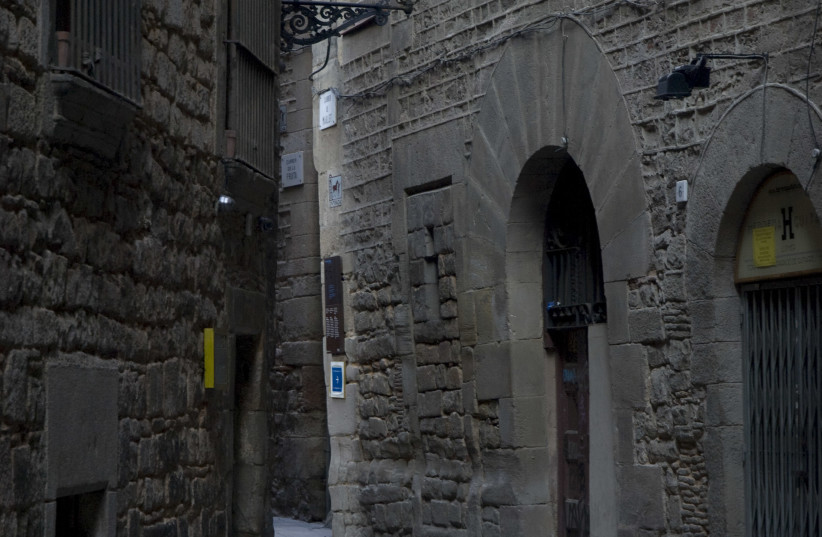
Born in Barcelona
Crescas was born in 1340 in Barcelona. He studied under Rabbi Nissim ben Reuben Gerondi, known as the Ran.
He became crown rabbi of Aragon under King John I and Queen Violant de Bar. He counted among his friends Rabbi Isaac ben Sheshet and Rabbi Simeon ben Tzemah Duran. His student was Rabbi Joseph Albo, author of Sefer Ha’ikkarim. He was, in short, part of the elite circle of Spanish rabbinic leadership in the 14th century.
Then, in a matter of months, that world ended.
The massacres of Jews in Spain began in Seville on the first of Tamuz. They spread to Cordoba. On the 17th of Tamuz, they reached Toledo.
Valencia fell on the seventh of Av. On the first of Elul, Mallorca was struck. On the following Shabbat, Barcelona.
Crescas’s epistle to Avignon, written on October 19, 1391, reads like a war dispatch. Two hundred and fifty were killed in Valencia. Three hundred in Mallorca. Two hundred and fifty in Barcelona. In every city, thousands were converted. In Valencia, the entire Jewish community disappeared except for one town, Murviedro. In Barcelona, Crescas writes, “There is none left today who still bears the name of Jew.”

The second work in this volume is The Refutation of the Christian Principles, translated by Daniel Lasker. Crescas likely wrote it in Catalan, not Hebrew, so that both Jews and Christians could read it.
The work systematically dismantles Christian theological claims: original sin, the Trinity, incarnation, the virgin birth, transubstantiation, baptism, and the messiahship of Jesus. Crescas was writing for Jews under pressure to convert, who needed intellectual ammunition. The arguments are sharp, logical, and unapologetic. They assume a reader who is familiar with both Jewish and Christian texts and can follow a sustained philosophical argument.
The third work is the Passover Sermon. In it, Crescas explores how human will and miracles affect faith in God and Torah. The first part is philosophical. The second part is a concise summary of the laws of Passover. It is the only halachic work of his that survives, though we know from other sources that he was a respected authority on Halacha.
The sermon gives us a glimpse of what his planned work, "Lamp of the Commandment," might have looked like. He intended it as an alternative to Maimonides’s Mishneh Torah, one that would correct what he saw as deficiencies in Maimonides’s approach. That work was never written. Only the philosophical volume, Light of the Lord, was completed.
That philosophical volume is the major work in this collection. Crescas wrote it to challenge Maimonides’s Guide of the Perplexed. He believed Maimonides had gotten fundamental things wrong about Jewish belief, and he wanted to set the record straight. The work is dense, systematic, and ambitious. Crescas was not trying to simplify Maimonides or make him more accessible. He was trying to replace him.
Historical context
Weiss, who translated both the Passover Sermon and Light of the Lord, has written introductions to each work that make the material accessible without dumbing it down. She explains the historical context, the philosophical stakes, and the structure of Crescas’s arguments.
She does not hide the difficulty. She helps the reader see why it matters.
What makes Crescas important is not just that he challenged Maimonides. Others did that. What makes him important is that he wrote from within a community that was being destroyed, and he tried to give that community something to stand on.
He was not writing philosophy in the abstract. He was writing to Jews who had watched their neighbors convert, who had buried their children, who were trying to figure out whether there was any reason to stay Jewish.
Crescas’s answer was not sentimental. It was philosophical. Where Maimonides had placed intellectual perfection at the center of religious life, Crescas argued that love of God was the highest purpose. Maimonides had insisted that we can know nothing positive about God. Crescas built a theology around divine love.
For Maimonides, knowledge was the goal. For Crescas, it was devotion. Crescas wanted a Judaism that could survive catastrophe because it was rooted in something deeper than intellectual assent.
Despite the power of these ideas, Crescas’s influence was limited. Spinoza read him. Some later thinkers engaged with him. But he never had the following that Maimonides did. Part of the reason is that his work is hard. Part of the reason is that the audience for whom he wrote was scattered, converted, or expelled.
This volume gives him a second chance. Weiss brought together texts that were scattered, got permissions from multiple publishers, and coordinated translators. The book is bilingual, with Hebrew on one side and English on the other. Readers who can navigate the Hebrew can check the translation and see how Crescas’s arguments work in the original.
There are moments in reading Crescas when you feel the weight of what he was carrying. He is writing Light of the Lord in his 60s, after everything has fallen apart, and he is still trying to get the philosophy right.
He is still arguing about whether will precedes intellect, whether love of God is a commandment or a consequence, whether miracles undermine or confirm faith. These are not idle questions. They are questions about what holds a community together when everything else is gone.
Crescas never says, “Look at what I’ve been through.” The epistle mentions his son’s death in a single sentence and moves on. The philosophical works do not reference the massacres at all. Yet you feel them underneath. This is philosophy written by someone who knows what it costs to stay Jewish.
The book is not for casual readers. It is dense and technical. It assumes familiarity with medieval Jewish and Christian thought. But for readers willing to engage with serious scholarship, it is worth it.
Crescas is sharp, original, and brave. He took on Maimonides at a time when most scholars were still treating the Guide as untouchable. He defended Judaism against Christian arguments when most Jewish intellectuals were converting. He tried to rebuild a community that had been shattered.
Weiss calls Crescas “unjustly less well known today than he deserves to be.” This volume is a step toward correcting that. It gives English readers access to a thinker who mattered in his time and should matter now. Not because he provides easy answers but because he shows what it looks like to think clearly in the midst of catastrophe.
The final paragraph of the epistle reads: “I am the man that hath seen affliction by the rod of His wrath, Hasdai son of Abraham son of Hasdai son of Judah Crescas, who writes here in Saragossa, on the 20th day of the month Marheshvan in the year 5152 of the creation.” He signs his name. He gives the date. He does not ask for pity. He just reports what happened and gets back to work.
That is the voice that runs through this entire volume. Clear-eyed, unflinching, and still engaged with the questions that matter. Crescas does not offer consolation. He offers clarity.
And clarity, in moments of fracture, may be the most faithful response of all.■
Hasdai Crescas
Collected Writings
Edited by Roslyn Weiss
The Library of the Jewish People/Koren Publishers Jerusalem
1,500 pages; $45