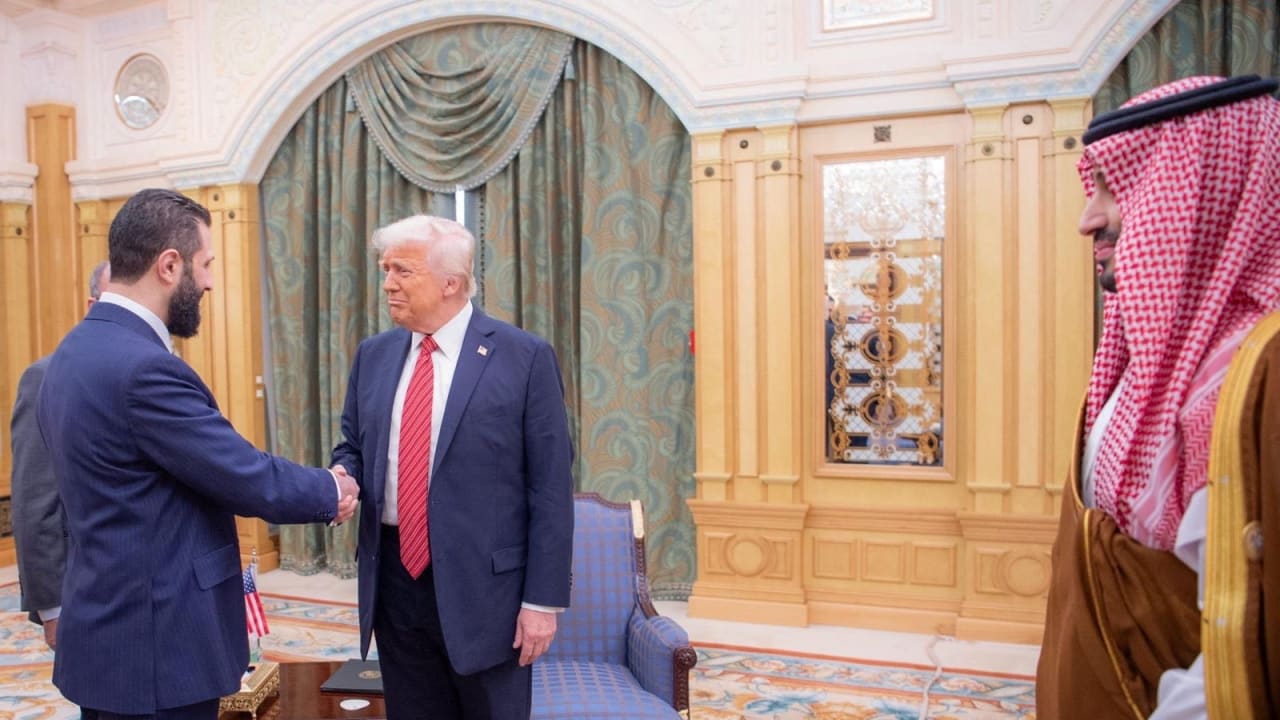
US President Donald Trump issued an executive order on Monday terminating the Syrian Sanctions Program and the national emergency with respect to Syria, a US State Department statement said in a statement.
Assets held by previously sanctioned persons that are in the United States or controlled by US nationals will now be unblocked, the notice said.
The executive order, which will take effect on Tuesday, will also relax restrictions on specific exports to Syria.
The order marks "the beginning of a new chapter for the people of Syria as they work to shape a future that is safe, stable, and successful," US Secretary of State Marco Rubio said in the statement.

Further examination of sanctions, terrorist designations planned
Sanctions will remain in effect for individuals and entities connected to former Syrian president Bashar al-Assad and his followers, as well as "human rights abusers, captagon traffickers, persons linked to Syria's past proliferation activities, ISIS and al-Qaeda affiliates, and Iran and its terrorist proxies," the statement said.
Rubio will further examine the potential full suspension of the Caesar Act, the most severe component of the US sanctions regime against Syria, the release noted. He also will reportedly investigate the Foreign Terrorist Organization designation of Hay’at Tahrir al-Sham (HTS), specially designated global terrorist designations of HTS and Syrian President Ahmed al-Sharaa, as well as Syria’s State Sponsor of Terrorism designation.
"I will also explore avenues at the United Nations to provide further sanctions relief," Rubio added.
Sanction movement initiated in May
In May, US President Donald Trump pledged to undo sanctions to help Syria rebuild after a devastating civil war.
In the same month, Trump met Sharaa to ask Damascus to adhere to several conditions in exchange for sanctions relief, including forcing all foreign terrorists out of Syria, deporting what Trump called "Palestinian terrorists," and helping the US prevent the resurgence of ISIS.
Most US sanctions on Syria were imposed on Assad's government and key individuals related to it in 2011 after the civil war erupted. Sharaa led militias that overthrew Assad in December.
Talks ongoing between Israel, Syria
Israel and Syria are continuing security discussions that could lead to a peace agreement between the two nations. However, a significant challenge has emerged in the talks, two sources familiar with the details reported to The Jerusalem Post.
The sources said that even if an agreement is reached, “it will be a cold peace, at least in the initial stage.”
Sharaa has made it clear that under any agreement, Israel will not be permitted to operate or strike targets within Syrian territory. Israel, on the other hand, insists on retaining the ability to address security threats, particularly in scenarios where, as demanded by Damascus, the IDF withdraws from buffer zones.
Amichai Stein contributed to this article.