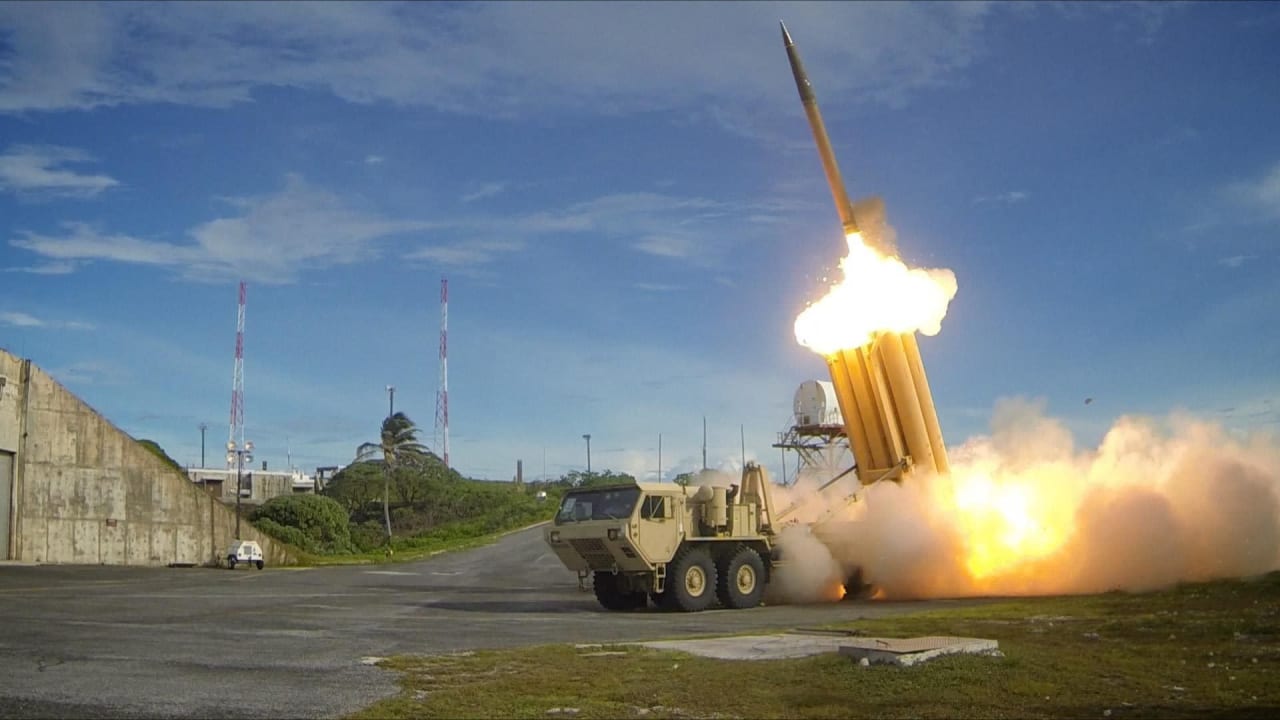
The US used approximately a quarter of its THAAD missile interceptor stockpile during Operation Rising Lion, CNN reported Monday, citing two sources familiar with the operation.
THAAD is a mobile system designed to intercept ballistic missiles during their final phase of flight.
US forces fired more than 100-150 THAAD missiles to counter Tehran's barrage. According to the report, the US had seven THAAD systems, two of which were used during the war with Iran. This level of use outpaced the US's levels of production.
This has also raised concerns about America's image of global security and its ability to create new supplies in a timely manner, according to former US defense officials and missile experts cited in the report.
According to the 2026 Defense Department's budget, the US is expected to receive 12 more THAAD interceptors this fiscal year; last year, the US produced 11.

The Pentagon responded that "[the US military] is the strongest it has ever been and has everything it needs to conduct any mission anywhere, anytime, all around the world. If you need further proof, look no further than Operation Midnight Hammer and the total obliteration of Iran’s nuclear capabilities."
When asked about the current THAAD inventory, a defense official would not provide details due to security issues; however, he did confirm that the us "remains postured to respond to any threat."
A defense official, citing operational security concerns, declined to provide details on the THAAD inventory but assured that the Defense Department “remains postured to respond to any threat,” according to CNN.
The number of THAAD interceptors used during the Operation Rising Lion was first reported by The Wall Street Journal.
Despite the heavy use of THAAD to defend against Tehran’s missile attacks, dozens of Iranian missiles still hit Israel.
Each battery is operated by 95 American soldiers, equipped with six launchers and 48 interceptors, each costing approximately $12.7 million, according to the 2025 Missile Defense Agency budget.
The US plans to acquire 37 additional THAAD interceptors in 2026, according to the 2026 Defense Department budget. A defense official explained, “The budget includes an additional $1.3 billion for industrial-based supply chain improvements and $2.5 billion for missiles and munitions production expansion.”
The official emphasized, “The department’s role is to ensure that the president is armed with the best possible military options for any scenario – and all options remain on the table.”
A missile defense expert tracking US government spending remarked, “The reports about THAAD expenditure are concerning. This is not the sort of thing that the US can afford to continue to do on and on.”
He added, “It was a major commitment to our Israeli ally, but missile defense interceptor capacity is definitely a concern, and THAAD is a very scarce resource.”
A retired senior US officer, speaking on condition of anonymity, revealed that around 25% of THAAD's total inventory was used in the conflict. “The (Department of Defense) is looking at wartime stockage levels of critical munitions and attempting to significantly increase annual production capacity, an effort that is long overdue,” he said.
This concern predates the war with Iran
The concern over missile defense stockpiles predates the Operation Rising Lion, according to several former senior US defense officials, CNN reported. One former official, speaking anonymously, expressed surprise at the low levels of readiness in some stockpiles: “Stockpiles are dropping. We need more. We need them faster than they are being built.”
Another former Biden administration defense official also highlighted this concern, saying, “This is a concern. It was a concern during the Biden administration. I’m sure it’s a concern now during the Trump administration.”
Former US assistant defense secretary for strategy, plans, and capabilities Mara Karlin echoed these concerns, stating, according to the report, “Air defense is relevant in all of the major theaters right now. And there are not enough systems. There are not enough interceptors. There’s not enough production, and there are not enough people working on it.”
According to Lockheed Martin, the manufacturer, nine active THAAD batteries are currently stationed globally.
A couple of THAAD batteries were moved to the Middle East to protect Israel, while others were deployed in the UAE to intercept Houthi missiles.
While most Iranian missiles were intercepted, dozens made it through, causing extensive damage across Israel. The IDF reported over 500 long-range ballistic missiles fired from Iran, with 86% intercepted, The Jerusalem Post previously reported.
Still, missile strikes caused significant destruction in cities like Tel Aviv, and 29 people were killed. The war is estimated to cost Israel at least $1.8 billion in damages.
As the war progressed, interception rates declined. In the first week, only 8% of missiles breached the defenses, but by the war’s final day, 25% of Iranian missiles had gotten through. Analysts suggest several reasons for this increase, including Iran's shift toward targeting populated areas and deploying more advanced missiles with decoys or multiple warheads, overwhelming air defenses.
Mora Deitch, head of data analytics at Israel’s Institute for National Security Studies (INSS), noted, according to CNN, “Iran increasingly employed more advanced systems,” while also suggesting Israel may have intentionally adjusted its interception strategy: “What appears as a decline in interception effectiveness might instead reflect a deliberate shift in strategy rather than a technological shortfall.”
Missile defense analysts pointed out signs of depletion in air defense systems. Sam Lair, a research associate at the James Martin Center for Nonproliferation Studies, explained, “The presence of the THAAD battery in the first place suggests that the Israelis don’t have a super deep interceptor magazine.”
Lair also confirmed, based on social media videos, that at least 39 of the advanced interceptors used in the war were THAAD, totaling at least 80 interceptors.