
Australia will recognize a Palestinian state at the United Nations General Assembly in September, Australian Prime Minister Anthony Albanese said Monday.
New Zealand Foreign Minister Winston Peters on Monday said he was carefully considering recognition of a Palestinian state.
In a joint statement, Albanese and Foreign Minister Penny Wong expressed their desire “to contribute to international momentum toward a two-state solution, a ceasefire in Gaza, and release of the hostages.”
Recognition of a Palestinian state would be predicated on commitments received from the Palestinian Authority to reform its governance, as well as the PA’s recognition of Israel’s right to exist, they said.
Australia has confidence in the PA’s new commitments, “including to reform governance, terminate prisoner payments, institute schooling reform, demilitarize, and hold general elections,” as well as reaffirmation of its recognition of Israel’s right to exist, the statement said.
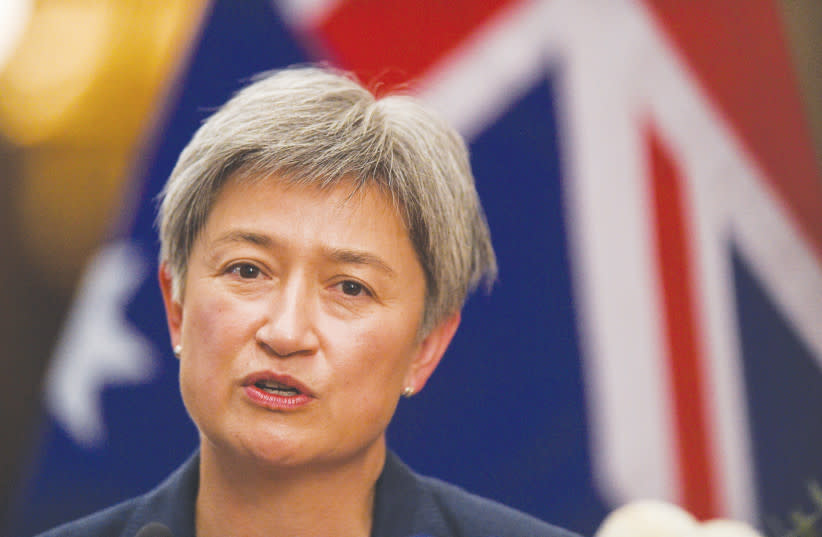
PA President Mahmoud Abbas has relayed these commitments directly to the Australian government, Albanese and Wong said, adding that now is “the best opportunity Australia may ever have to support moderate voices for peace in the region, to undermine extremism, and to further isolate Hamas.”
Australia has stood behind a two-state solution since 1947, Albanese said. It was the first country to support UN Resolution 181 – the partition plan for Palestine to create the State of Israel and a Palestinian state – and “more than 77 years later, the world can no longer wait for the implementation of that resolution to be negotiated between the parties,” he said.
The Australian government acknowledged Hamas’s constant attempts to sabotage “the prospects of a two-state solution” and its rejection of Israel’s right to exist, making it clear that “there can be no role for Hamas in a Palestinian state,” the statement said. It also called for the release of all hostages taken on October 7, 2023.
“Hamas still controls Gaza, and 50 hostages remain in captivity,” Zionist Federation of Australia CEO Alon Cassuto told The Jerusalem Post on Monday. “The Palestinian Authority is unreformed, lacks the support of its own people, and may not be able to deliver on its promises to the world. With no credible international plan to address these realities, Australia’s premature recognition may be a mistake that cannot be undone.”
The Australia Israel & Jewish Affairs Council (AIJAC) said it was deeply disappointed with the “misguided and counterproductive decision,” adding that the recognition would only be seen as “a reward for Palestinian terrorism and as punishment for Israel.”
The Executive Council of Australian Jewry (ECAJ) said while the announcement called for the release of the hostages, the disarmament of Hamas, and the need for Palestinians to recognize and make peace with Israel, it “relegates all these conditions to the status of a mere promise to be fulfilled at some future time, and says nothing about what will happen if those conditions are not met.”
That course of action therefore constitutes a “betrayal and abandonment of the Israeli hostages, [now giving] them no hope for release,” ECAJ president Daniel Aghion said. “Australia is now committed to recognizing as a state an entity with no agreed borders, no single government in effective control of its territory, and no demonstrated capacity to live in peace with its neighbors.”
The move removes any incentive Palestinians may have to recognize Israel as a Jewish state, he said.
The New South Wales Jewish Board of Deputies said the gesture was symbolic and would “achieve nothing other than to embolden Hamas to continue to resist ceasefire efforts.”
“At the very least, the Australian government’s announcement should have been conditional on Hamas releasing the hostages, who continue to languish in its underground dungeons,” it said.
Israeli Ambassador to Australia Amir Maimon said the decision was “a reward for terror.” The announcement ran counter to Albanese’s statement on July 31 that recognition of a Palestinian state was conditional on the demilitarization of Palestine, the reform of the PA, and the exit of Hamas from control of Gaza, he said.
“Today, however, the Australian government has abandoned these conditions and proceeded with recognition for symbolic reasons rather than genuine progress toward peace,” Maimon said.
Australian Sen. Michaelia Cash, the opposition leader, asked Albanese how the PA would be able to guarantee there will be no future role for the terrorist organization Hamas, “given that at their last elections 19 years ago, they delivered a Hamas majority.”
“The decision by the Albanese government to recognize a Palestinian state does not make the world a safer place, expedite the end of the conflict, deliver a two-state solution, see the free flow of aid, support the release of hostages, or put an end to the terrorist group Hamas,” she wrote on X/Twitter.
Sen. Jacinta Nampijinpa Price, the shadow defense industry and personnel minister, said the decision was “impulsive, irrational, and ill-timed.”
“Hamas’s barbarism on October 7, 2023, single-handedly set back the goal of a two-state solution,” she said. “The leaders of Hamas said they would repeat similar attacks until Israel is exterminated. Until Hamas is defeated, a two-state solution isn’t even conceivable, and there can be no peaceful future for the people of Gaza.”
If the Albanese government truly believed in a better life for Palestinians and a two-state solution, it “would lend its full support to Israel’s military response to rid the world of a death cult,” Nampijinpa Price said. “But in moving to prematurely recognize Palestinian statehood, the Albanese government has endorsed Hamas’s use of terrorism to achieve political ends.”
“This Labor government has lost its moral compass,” she said.
Sen. Fatima Payman said she was thrilled about the recognition and called on the Albanese government to enact sanctions against Israel and end all arms trade.
Similar positions made by the UK, France, and Canada
Wong has said such recognition would spur the Palestinian leadership to modernize and push for an end to the enduring Palestinian-Israeli conflict.
Israel has criticized plans to recognize Palestinian statehood, saying such a move would affirm Hamas’s use of terrorism and the continued holding of hostages.
Australia’s policy toward Israel has fueled antisemitism, Prime Minister Benjamin Netanyahu has said.
The UK, France, and Canada have either already recognized a Palestinian state or threatened to do so should the Israel-Hamas War not end soon.
New Zealand also said it would consider its position on the recognition of Palestine this month.
New Zealand Prime Minister Christopher Luxon’s cabinet plans to make a formal decision in September.
Peters said while Australia, the UK, and Canada have opted to recognize a Palestinian state at September’s UN General Assembly, his country has an independent foreign policy.
“We intend to weigh up the issue carefully and then act according to New Zealand’s principles, values, and national interest,” he said.
New Zealand’s recognition of a Palestinian state has long been a matter of “when, not if,” Peters said, but it needs to ascertain whether the prerequisites for a “viable and legitimate Palestinian state” exist.
New Zealand’s long-standing position has been one of support for a two-state solution, with secure and recognized borders for both Israel and Palestine, based on the 1967 lines. This would include the whole of the West Bank, east Jerusalem (to become the capital), the Golan Heights, and Gaza, he said..
In the meantime, New Zealand was an “active participant” in discussions about how to broker a ceasefire between Israel and Hamas and how to establish a peaceful two-state solution, Peters said.
At a press conference on Monday, Luxon was asked whether he was “going to reward Hamas by recognizing Palestine.”
In response, he said it was a very “serious and complex issue,” and his government was going to “weigh up our position over the next month.”
There are three parties in New Zealand’s ruling coalition, and all three will have to come to a unified position for any state to be recognized, Luxon said, adding that he was confident such a unified position could be reached.
Asked whether Hamas would need to release the hostages before New Zealand recognized a Palestinian state, Luxon said: “There’s no role for Hamas in any future Palestinian state.”
“Hamas started this on October 7 with 1,200 Jewish folk, innocent civilians, killed and hostages that have been held over a long period of time,” he said. “They need to release the hostages. It’s as simple as that. They’re a terrorist organization, and they need to release hostages immediately.”
Luxon declined to answer whether recognition of a Palestinian state would be conditional on Hamas releasing the hostages first.
He also declined to say what a future Palestinian state would look like, saying the specifics would be ironed out in governmental discussions.
“Since partition in 1947,” New Zealand has “strongly supported a separate Palestine, a separate Israel, [and] living peacefully together,” he added.
Luxon said he had spoken to French President Emmanuel Macron, British Prime Minister Keith Starmer, and Albanese about their expressions of intent.
“As a result, it’s important for us to weigh up our position as a government, and that’s the work that we’ll do over the next few years,” he said.
Luxon said he was not concerned that the move might receive a negative response from the US, as New Zealand “has an independent foreign policy, and we’ll make our own decisions that are right for New Zealand and consistent with our values.”
Regarding the humanitarian situation in Gaza, he said it was a “catastrophe,” and that the suffering needed to be stopped.
“We think Israel is wrong,” he added. “It certainly aggravates the humanitarian situation, and their plans and proposals risk violating international law.”
Luxon said he did not believe New Zealand had communicated its intentions to Israel prior to the announcement on Monday.
Debbie Ngarewa-Packer, co-leader of the Maori Party, said the announcement was “moral cowardice.”
“Recognition cannot wait, and it must be accompanied by action,” she said. “Without sanctions, without consequences, and with no intention of holding Israel accountable for genocide, the recognition of statehood is hollow.”
Rawiri Waititi, the Maori Party’s other co-leader, condemned Luxon for calling it a “complex issue.”
“There is nothing complex about genocide,” he said. “There is nothing complex about apartheid. The longer Luxon hides behind ‘complexity,’ the more tamariki [children] are buried.”
The Maori Party has repeatedly called for immediate and full recognition of a Palestinian state, an embargo on all trade in and out of Israel, and the cessation of diplomatic ties with Israel. It has also demanded the expulsion of the Israeli ambassador.
About 75% of UN member states recognize a Palestinian state.
Neither Australia nor New Zealand officially recognizes Taiwan as an independent state, adhering to the “One China” policy, which recognizes the People’s Republic of China as the sole legitimate government of China.