
Hong Kong's most vocal China critic, media tycoon Jimmy Lai, was sentenced on Monday to 20 years in jail, ending the city's biggest national security case that has fueled global concerns about Beijing's clampdown on freedoms in the ex-British colony.
Lai's sentence on two counts of conspiracy to collude with foreign forces and one for publishing seditious materials ends a legal saga that has lasted nearly five years.
The 78-year-old British citizen had denied all the charges against him, telling the court he was a "political prisoner" facing persecution from Beijing.
Lai, founder of the feisty and now shuttered Apple Daily newspaper, was first arrested in August 2020 and was convicted last year.
His sentence was within the harshest penalty tier for offenses of a "grave nature," reflecting the fact that he was the driving force behind "persistent" foreign collusion conspiracies, the three judges said in announcing their verdict.

They cited prosecution evidence that the conspiracies had sought sanctions, blockades and other hostile acts from the US and other countries while involving a web of individuals including Apple Daily staff, activists and foreigners.
Six former senior Apple Daily staffers, an activist and a paralegal were also sentenced to jail terms ranging from six to 10 years.
"In the present case, Lai was no doubt the mastermind of all three conspiracies charged and therefore he warrants a heavier sentence," the judges said.
Hong Kong leader John Lee said on Tuesday that Lai deserved the 20-year jail sentence handed down to him by a court this week after all the harm he had done.
'Evil deeds were beyond measure'
The US, Britain, Australia, the European Union, Japan, Canada and Taiwan expressed concerns about the impact of the sentencing.
US Secretary of State Marco Rubio called the sentence "unjust and tragic," saying it showed the lengths to which China would go to silence advocates of basic freedoms in Hong Kong.
"Mr. Lai and his family have suffered enough. The United States urges the authorities to grant Mr. Lai humanitarian parole," Rubio said in a statement, echoing similar calls from Britain and UN rights chief Volker Turk.
Britain will "rapidly engage further on Mr. Lai's case," foreign minister Yvette Cooper said.
Britain also announced an expansion of the visa route for Hong Kong residents wanting to move to the UK.
A spokesperson for the Chinese embassy in London urged Britain to "respect China's judicial sovereignty and stop interfering in Hong Kong's rule of law and China's internal affairs."
The spokesperson also said Britain should "stop shielding criminals."
Canadian Foreign Minister Anita Anand said in a statement on Monday that Canada is disappointed by the sentencing of Hong Kong pro-democracy critic Jimmy Lai to 20 years in jail and is urging his immediate release on humanitarian grounds.
The Hong Kong and Macau Affairs Office, under China's State Council, said the sentence was "a solemn and powerful declaration that whoever dares to challenge the law on safeguarding national security will be severely punished."
Hong Kong's leader John Lee said: "(Jimmy Lai) has committed numerous heinous crimes, and his evil deeds were beyond measure."
Lai's trial has drawn criticism from global leaders, including US President Donald Trump and British Prime Minister Keir Starmer, spotlighting a years-long national security crackdown in the China-ruled Asian financial hub, following mass pro-democracy protests in 2019.
Those concerns partly reflected Lai's long-standing international profile as a pro-democracy critic of China's Communist Party leadership and his extensive political connections, particularly among US Republicans, ties that prosecutors cited during the case.
At the height of the 2019 protests, Lai met then-US Vice President Mike Pence and then-Secretary of State Mike Pompeo in Washington. Last year, Trump appealed directly to Chinese President Xi Jinping to free Lai.
Beijing in 2020 imposed the national security law in Hong Kong, saying it was necessary to stabilize the city after months of sometimes violent unrest.
'He's going to pass away in prison'
Lai's friends and supporters say he is in frail health with diabetes and high blood pressure, and should be freed.
Lai's son, Sebastien, said the sentence was "devastating for our family" and marked the "total destruction" of Hong Kong's legal system.
"Much more needs to be done and quickly because, if not, he's going to pass away in prison," Sebastien Lai, also a British citizen, later told Reuters in London. He also urged Britain to pause its push to reset relations with China.
Hong Kong police played down concerns about Lai's health. The head of the force's national security department, Steve Li, said Lai's health concerns had been "exaggerated."
Beijing and Hong Kong officials say Lai has received a fair trial and that all are treated equally under a national security law they say has been vital to restoring order to the city.
Dozens of Lai's supporters queued for several days to secure a spot in the courtroom.
"I feel that Mr. Lai is the conscience of Hong Kong," said a man named Sum, 64, who was in the queue.
Lai's lawyer, Robert Pang, declined to comment when asked whether Lai would appeal, saying he has 28 days to do so.
Lai's son makes plea to UK government
Lai's son appealed to the British government on Monday to do "much more" to secure his elderly father's release, and he criticised Prime Minister Keir Starmer's efforts to reset London's relations with Beijing.
"Much more needs to be done and quickly because, if not, he's going to pass away in prison," Sebastien Lai, also a British citizen, told Reuters in London.
He said it had been a mistake for Starmer to visit China last month without first demanding that his father be released from jail.
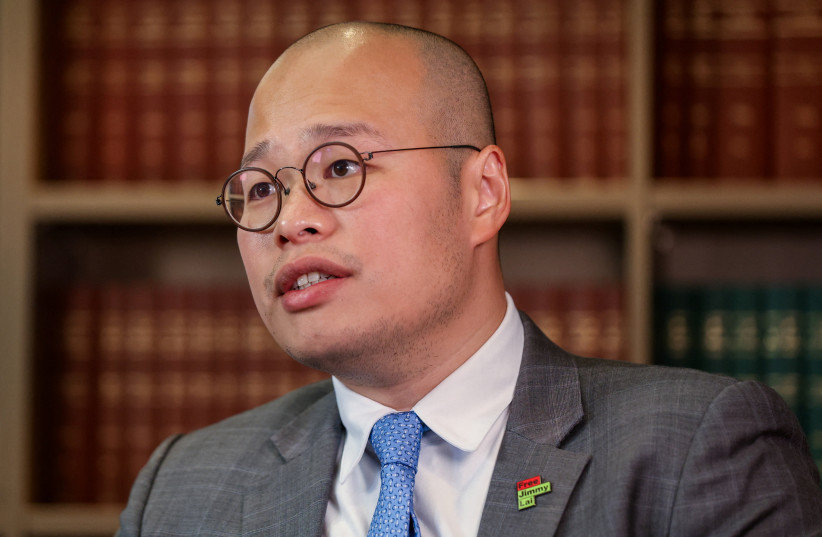
"I wish the prime minister did more," he said. "We're not asking the world. This isn't a hard thing for them to do."
Starmer went to China with dozens of business leaders for the first visit by a British leader to the country in eight years. While there he called for Jimmy Lai's release but the focus of his visit was reviving economic ties.
Starmer's spokesperson said the government's engagement with Beijing had allowed ministers to raise human rights concerns, including Jimmy Lai's case.
"Having a policy of not engaging at all with China is not a policy that benefits Britain or British citizens," the spokesperson told reporters on Monday.
Earlier, the government responded to the Jimmy Lai verdict by announcing an expansion of the visa route for those wanting to move from Hong Kong to Britain.