
Portugal returned three stolen archaeological artifacts to Mexico through the country’s Lisbon embassy on Thursday, the Mexican National Institute of Anthropology and History (INAH) announced, marking the first archaeological restitution to Mexico ever made by the European country.
Mexican Ambassador to Portugal Bruno Figueroa Fischer, Portuguese Judicial Police National Director Luís Neves, Camões Institute for Cooperation and Language of Portugal President Florbela Paraíba, Head of the Lisbon and Tagus Valley Directorate of the Judicial Police João Oliveira, and archaeologist Aline Lara Galicia took part in the handover ceremony.
“This return confirms that international cooperation protects who we are,” Mexican Culture Minister Claudia Curiel de Icaza said.
“Each restitution restores memory and identity to Mexico and reaffirms the shared commitment against the trafficking of cultural property.”
The artifacts will be formally repatriated via diplomatic pouch in the coming weeks.
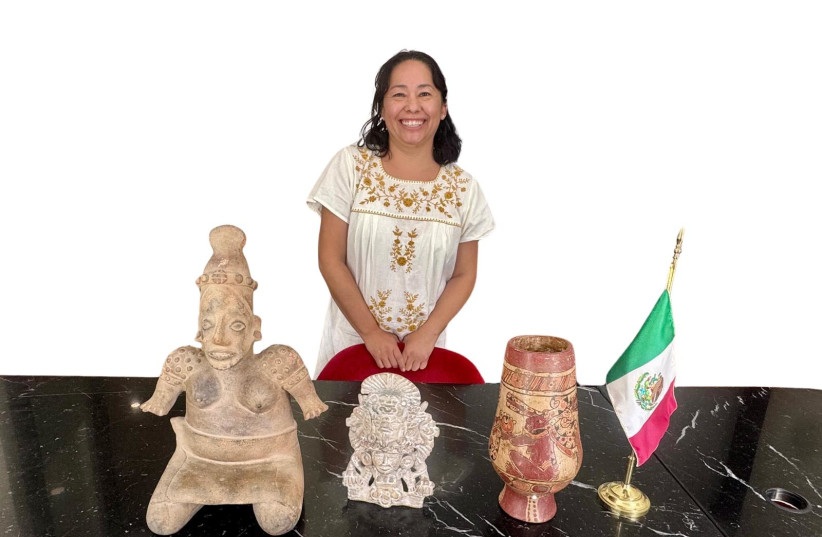
Portuguese authorities recover three stolen Mexican artifacts
After receiving notice of the artifacts’ discovery from Portugal, INAH specialists were sent photographs of the finds and conducted a preliminary review of the three, confirming that they indeed “form part of Mexico’s archaeological heritage.”
The first artifact recovered is of a modeled clay female figure, with a polished surface, applique details, and incisions, according to the statement.
She is displayed as kneeling, shirtless, while wearing a skirt and conical headdress, also bearing scarification marks on her shoulders.
“The piece, which corresponds to the Tala-Tonalá style of the shaft tomb cultural tradition, originates from the territory that is now the state of Jalisco,” the statement explained. “It is associated with fertility and maternity rituals and was manufactured between 300 and 600 CE.”
It was investigated by the Public Prosecutor's Office of Lisbon.
The second artifact is a Mayan polychrome vessel from approximately 600-900 CE, most likely originating from southeastern Mexico.
It is decorated with depictions of high-ranking figures and various glyphs, and is believed to have been used for the ritual consumption of beverages, such as cacao.
It was seized by the Public Prosecutor's Office of the province of Guimarães in northern Portugal.
The third artifact returned is a Zapotec funerary urn from the Central Valleys of Oaxaca, depicting Cocijo, the deity of rain and thunder. It is dated to have been from 600–1200 CE.
It was seized by the Public Prosecutor’s Office of Évora-Estremoz.