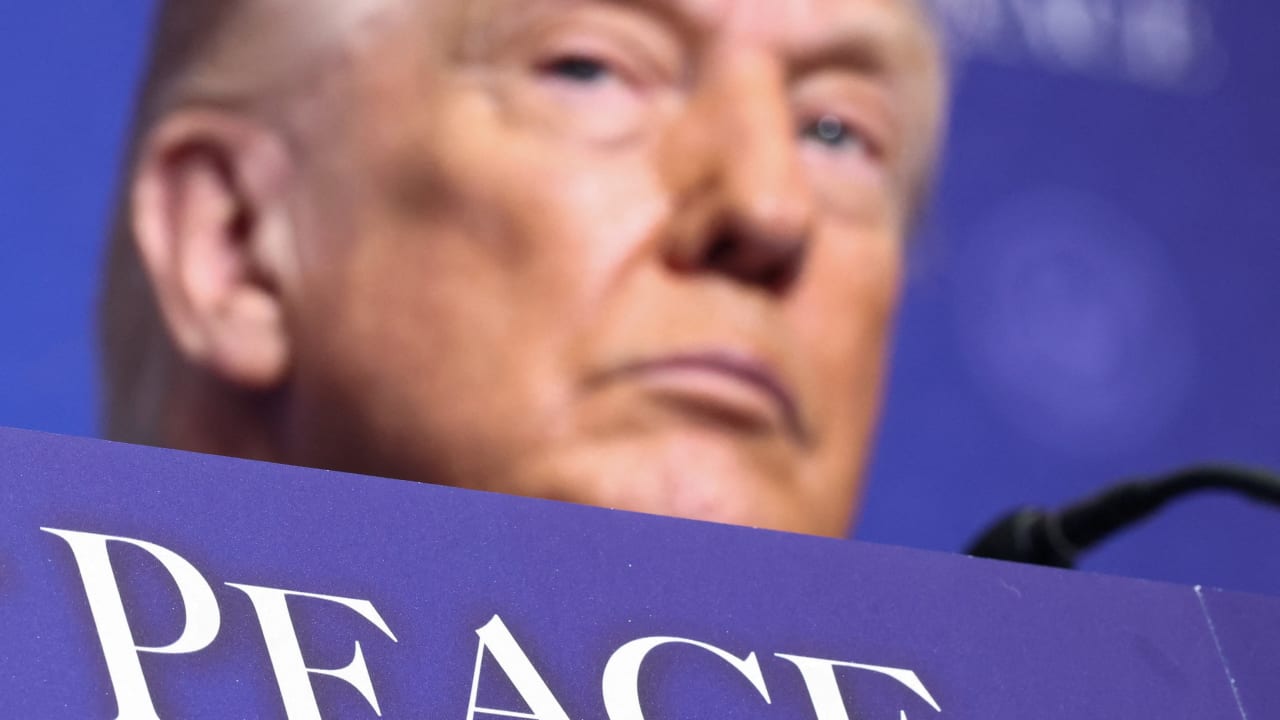
Images and videos from US President Donald Trump’s monumental first Board of Peace meeting showed that things are off to a good start.
The Board of Peace’s vision emerged between September, when Trump was urging countries to support a ceasefire, and January, when the second phase of the ceasefire in Gaza was announced.
The large meeting on Thursday showed that many countries are willing to participate and believe the administration is serious, as over 40 countries sent officials.
The Board of Peace meeting took place amid growing tensions with Iran, which has sidelined focus on Gaza. The Board of Peace is expected to focus on Gaza reconstruction and other issues. Trump was praised by attendees for his work toward peace in other regions, such as in South Asia between Pakistan and India.
The meeting is being praised throughout the Middle East. Arab News in Saudi Arabia noted that “Saudi Arabia and others pledge $7bn for Gaza relief.”

The report noted that “President Donald Trump announced Thursday at the inaugural Board of Peace meeting that nine members of the body have agreed to pledge $7 billion toward a Gaza relief package and that five countries have agreed to deploy troops to take part in an international stabilization force to the war-battered Palestinian territory.” Saudi Arabia will pledge $1 billion toward the endeavor.
Multiple countries have pledged billions of dollars
The report said that “Kazakhstan, the United Arab Emirates, Morocco, Bahrain, Qatar, Uzbekistan, and Kuwait are the other countries that are making pledges.” In addition, there appears to be progress on the International Stabilization Force for Gaza. “Indonesia, Morocco, Kazakhstan, Kosovo, and Albania have pledged to send troops for the Gaza stabilization force, while Egypt and Jordan have committed to train police for the efforts.”
Initial expectations are that troops will be deployed near Rafah and that a large base may be constructed. “Every dollar spent is an investment in stability and the hope of new and harmonious (region),” Trump said. “The Board of Peace is showing how a better future can be built right here in this room.”
Many European countries remain skeptical of the Board. According to the Arab News report, “More than 40 countries and the European Union confirmed they were sending officials to Thursday’s meeting. Germany, Italy, Norway, Switzerland, and the United Kingdom are among more than a dozen countries that have not joined the board but are taking part as observers.”
This comes in the context of the Munich Security Conference and the Davos meetings over the last month. US Secretary of State Marco Rubio spoke at the MSC, and he then went to Hungary. He spoke at the Board of Peace meeting.
Video from the Board of Peace meeting showed the Commander of the International Stabilization Force (ISF) in Gaza, Maj. Gen. Jasper Jeffers, speaking about which countries will participate. This is going to be a major test. Countries such as Albania, Indonesia, Kazakhstan, Kosovo, and Morocco are expected to take part. Egypt and Jordan may help train police. Separate reports say Italy previously said it could help support the police. It appears Indonesia will be the heavy hitter in the ISF.
Azerbaijan has said that as a founding member of the Board, it “supports the goals and objectives of the Board of Peace. In the future, Azerbaijan may consider participating in investment projects in Gaza through the Board of Peace.” Turkey’s Foreign Minister Hakan Fidan was at the meeting and said Ankara supports Gaza. Hungary’s leader also attended.
Turkish media covered the Board of Peace meeting and appears to take it seriously. It covered the countries that will contribute troops and the billions pledged to the Board. UAE’s Al-Ain media also covered the meeting, noting that the UAE will contribute to the $1.2 billion to the Board. Egypt has said it is committed to peace in Gaza and continues to reject the displacement of Palestinians in the enclave.
The coordinator of the Peace Council, Nikolay Mladenov, also announced on Thursday that the door to membership was opened to establish a police force in the Gaza Strip that would be independent of Hamas's influence, Al-Ain noted.
The head of the National Committee for the Administration of Gaza, Ali Shaath, also affirmed the work to restore security in Gaza “under one authority and one weapon,” and to build the foundations for a sustainable peace in the sector, a separate report said.
It is clear from the extensive coverage of the meeting that this is a momentous occasion and that many countries believe this is the way forward in Gaza. For Trump, the ability to bring together so many leaders and officials from so many countries showcases US influence.
It also shows how Trump’s foreign policy doctrine appeals to countries outside Europe. This has led to concern in Europe about the US commitment.
Many countries that attended find that they can work with the Trump administration. This is a major shift in terms of the US approach to the world order. Many reports from Davos and the Munich conference focused on how the world order of the last few decades is largely vanishing.
The Board of Peace meeting is another waypoint on this shift in US strategy under the Trump administration. The road ahead in Gaza is expected to be hard, and it will prove the first major test for this approach.