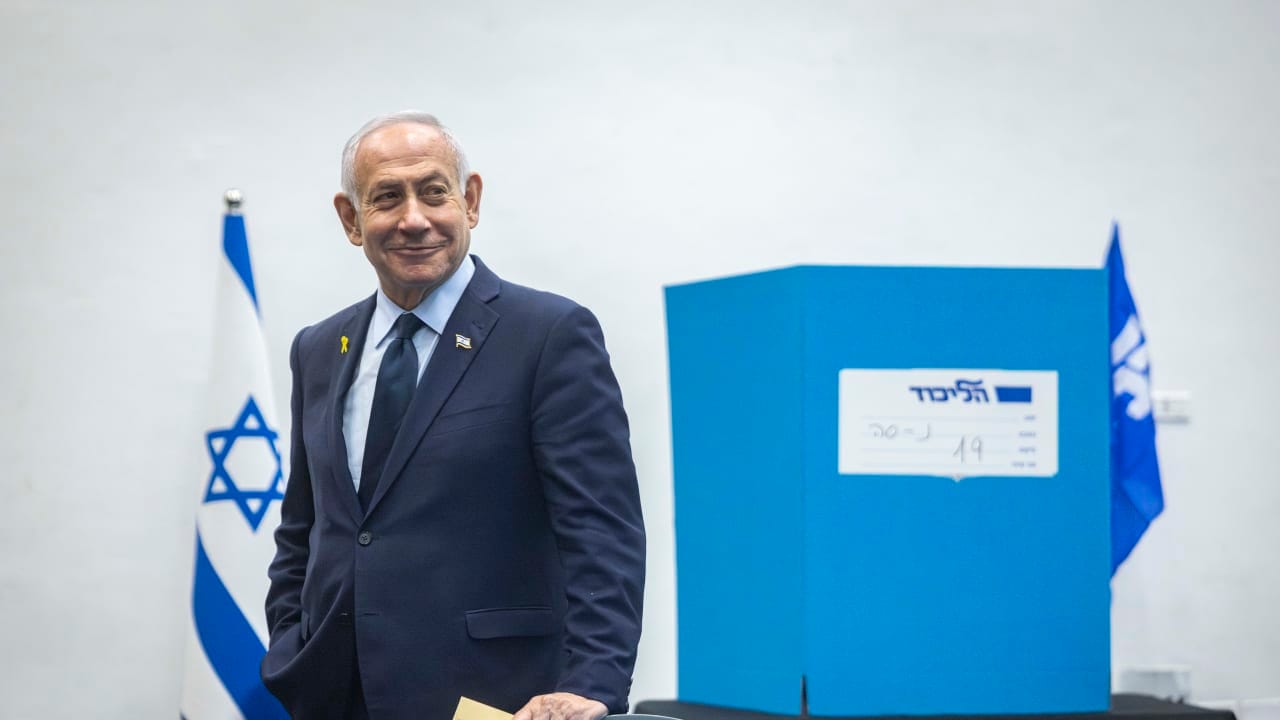
More than 140,000 Likud registered members are set to vote on Monday in the party’s highly competitive primaries, as candidates made their final campaigning push on Sunday.
The primaries come amid fierce internal tensions over changes that have expanded chairman Prime Minister Benjamin Netanyahu’s control over the party’s Knesset slate.
The polling will begin at 9 a.m. and continue until 8 p.m. at stations throughout the country.
Netanyahu stated ahead of the primaries yesterday that he will vote “for a winning slate.”
“I trust you, Likud members, to choose your representatives correctly, according to your own judgment. I am not interfering in the national list, and I wish everyone success,” Netanyahu added.

Netanyahu pushed to change Likud’s long-standing primary system for selecting its Knesset slate
Likud has for years prided itself on conducting primaries in which its registered members are eligible to vote for the Knesset list. Netanyahu pushed to change the system in recent weeks ahead of the primaries, leading to an especially competitive race with even fewer slots available than usual.
Netanyahu was granted the authority to determine eight slots within the first 30 spots on the party list last month following a vote on the controversial decision by the Likud Central Committee.
There were reports that Netanyahu had threatened to leave Likud if the proposed changes were not advanced.
Those within the party who oppose changing the primaries have argued that it will cause those who would otherwise score highly in the primaries to fall further down the list.
The Likud primaries are further competitive because the party currently has around 40 ministers and MKs serving in the government and Knesset, but recent polls project the party winning only about 22 seats, leaving many at risk of losing their places on the party’s Knesset list.
The vote comes ahead of the general elections, which are set to take place on October 27. Parties are not required to hold primaries in Israel, and only a few do so.
Court rejects bid to ease Likud district primary restrictions ahead of vote
Further tensions surrounding the slots also come after the Tel Aviv District Court on Monday rejected Likud MK Afif Abed’s attempt to restore a narrowly approved change allowing current and former MKs, ministers and deputy ministers to run in the party’s district primaries, leaving the restrictions in place ahead of the vote.
Likud had announced last week that one of Netanyahu’s first reserved slots would go to entrepreneur and businessman Oren Dobronsky.
Additional reserved slots were later granted by Netanyahu to three ministers: Defense Minister Israel Katz, Foreign Minister Gideon Sa’ar, and Likud Central Committee Chairman Haim Katz, who also holds multiple ministerial portfolios.
The party said its internal court ruled that the defense minister should receive a reserved slot in order to “allow him to focus on security needs rather than engage in politics at this time.”
Likud also stated that Sa’ar would receive a reserved slot as part of the merger agreement between his party and Likud and that the Likud Central Committee chairperson would receive a slot due to his senior position in the party.
Sa’ar had announced in 2025 that his New Hope-United Right would be merging with Likud, and would be returning to the party. He previously resigned from Likud in 2020, heavily criticizing Netanyahu at the time.
The changes to the party’s primaries that have expanded Netanyahu’s control over the Knesset list have led to fierce internal tensions, with some party members in favor and others strongly against.
A fierce critic of changing the system has been MK Tally Gotliv, who is viewed as a candidate who would receive broad support from registered party members.
Gotliv has sharply criticized the Tuesday decision to reserve the slots for the three ministers, condemning the defense minister.
She called the decision to grant the defense minister a reserved slot “a disgraceful move that mocks Likud voters, who understand one thing more than all the veteran ministers: the need to fight the legal establishment that is persecuting the right-wing government and right-wing figures.”
Likud MK Amit Halevi calls upcoming primaries a ‘democratic celebration’
Likud MK Amit Halevi, who has expressed support for allowing the premier to reserve slots, told The Jerusalem Post that the primaries “will be a democratic celebration in the Likud.”
“I wish more parties conducted themselves democratically like the Likud. Some 140,000 members, active, engaged citizens who make their voices heard and have an influence, will go to the polls tomorrow,” he added.
“Together, God willing, we will put together a winning team that will be able to meet the national challenges ahead of us.”
“I am confident that Likud members will vote correctly for the sake of the country. The war exposed the many ills in the country’s systems, particularly the legal and security systems, which require fundamental reform. We will make those changes,” Halevi told the Post.
An internal Likud poll released on Sunday projected Gotliv, Knesset Speaker Amir Ohana, and Transportation Minister Miri Regev to rank among the top candidates in the primaries.
Likud primaries combine national, district, reserved slots to shape Knesset slate
The primaries determine the Likud’s Knesset slate, with the party chairman placed first. Registered members then vote for candidates on the national list, while members from geographic districts vote for candidates from their respective districts.
Candidates chosen on the national list are combined with district representatives and places that guarantee representation for groups including women, immigrants, young members, and minorities. The regulations also reserve certain positions for candidates chosen by the party chairman.
In the 2022 primaries, for example, the first group of positions after the party chairman was largely filled by nationally elected candidates, while district positions and guaranteed-representation slots were inserted farther down the slate. Netanyahu was also given several reserved positions.
The precise locations of those different categories are determined before each election through the party’s temporary election regulations. That is why the current fight has centered not only on whether primaries will take place, but on how much of the resulting slate the members will actually control.
Sarah Ben-Nun contributed to this report.