July 1, 2025
I heard the ballistic missile whip past the building. And then I heard it strike. It was the loudest sound I had ever heard. And I knew it was right outside. I waited, thinking and observing from my upstairs neighbor’s safe room, where I had been taking refuge. The window had blown open from the impact, and dust or smoke was entering the room.
One of the four of us women was screaming. One was reciting Psalms. One eventually began singing songs. I was silent. And holding my breath. The building had swayed to the right, and then settled back to center. I thought to myself that it was either my building or the one next door – and that the rest of the building outside of the safe room was likely damaged.
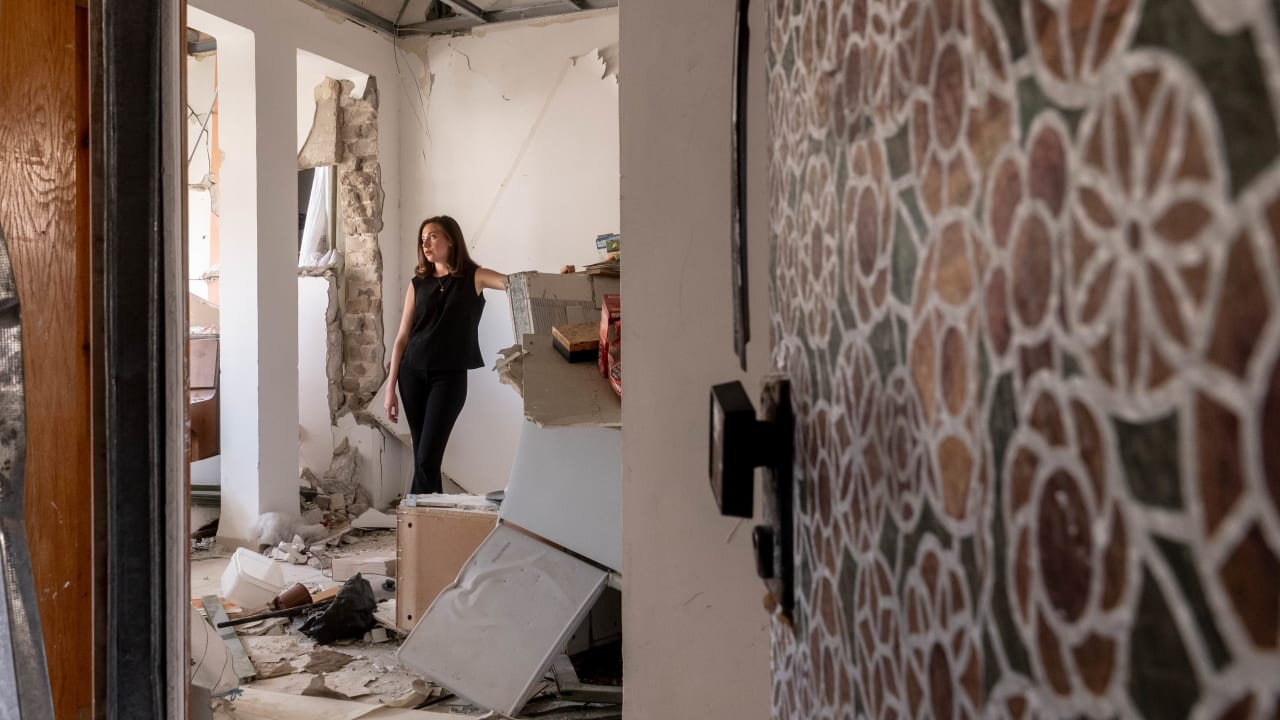
On Thursday night June 12, Israel had launched a sweeping operation, decimating nuclear sites across Iran. On Friday, Iran began returning the favor. By Monday morning, my apartment was gone – destroyed by the 4 a.m. ballistic missile that came to us on June 16. My home, and my carefully built Israel Daily News studio, were reduced to rubble.
The city of Tel Aviv placed me in a hotel. A friend of mine actually put me on the list – bless her. At first, it was for a week. Then, after the appraiser came and took one look at my home, it was extended to a month. I recorded news episodes from friends’ homes, wrote and took Zoom interviews with TV channels from hotel desks, and then eventually from the apartment of a generous young woman named Flo, who was stuck abroad. Her home became my sanctuary: a quiet space to record, think, and heal.
I returned to my apartment on a daily basis, taking photos and hoping the looters wouldn’t come back. They had already entered through the busted down front door and had stolen every piece of jewelry I owned. Whoever it was emptied the jewelry box and left it by the front door. It must have been easy to spot because the wall between my bedroom and the front door was vaporized, making everything very visible and open – including my valuables.

When I was being rescued, I was told not to enter my apartment on the way out due to safety concerns. It wasn’t clear if the building was minutes away from collapse, so I was told to just get out. When I returned several hours later, the jewelry box had been emptied out.
Through the layers of soot and busted sheetrock, I began recovering what I could: stinking clothes soaked from burst pipes, and books coated in dust. I later pulled out broken tripods, light stands, and camera gear from under rubble. I ran five loads of laundry in Flo’s apartment, salvaging some of my basics. I sent my professional wardrobe – soaked and smelly – to the dry cleaners, clinging to the hope that they might still be wearable. I haven’t gotten them back yet.
Beyond the physical loss, what this experience truly gave me was a huge reminder: Listen to your gut and follow your visions. Oh, and one more thing – self-leadership.
The power of intuition
I am grateful to myself and my mother. I assume I get it from her, and at this point, there’s no point in my keeping this to myself. I have visions, premonitions, dreams, and gut feelings that repeatedly come true. This was perhaps the biggest and most recent example of it.
In the month leading up to the attack, my thoughts kept drifting to my jewelry. I wondered, what would I do if things got desperate? Should I sell broken pieces or half sets? What is jewelry’s value during wartime? Would it help me if I were to need to evacuate or cross a border?
I wondered if my jewelry would serve me. I looked at it, thought about it, and even called a friend to ask if she would go with me to get an assessment on how much my broken gold chains were worth. Never in my life had I considered the pieces in that jewelry box. On one of those days, I put on my grandmother’s Star of David pendant, which I inherited after she passed away. I had loved it and identified it as one of her best pieces. I was very close with her, and everyone agreed I should have it. I put it around my neck and also put on a pair of gold post earrings.
I had made my selection at that point, both knowingly and unknowingly. I never imagined, however, that someone else would decide my jewelery’s fate for me.
After all those thoughts, there was nothing left to check, nothing to appraise. Only remorse that I hadn’t protected my precious items more. The loss of those stung deeper than I anticipated. Many pieces were gifts from loved ones who are no longer alive.
That looting – just hours after the blast – felt like the final violation.
This wasn’t the only premonition I’ve reflected on. Every day since Oct. 7, 2023, I have been closing my laptop and securely placing it in a laptop bag and zippering it closed. Then I would place it behind my couch. I do this every time I leave the room, go to a neighbor’s, or leave the house – even if it’s just for five minutes.
I have had a repeated vision that I can see clearly in my mind. It was of my living room window blowing in from a massive Iranian attack. I thought it would be a nuclear one. I had been shoving that image away.
(Because of my preventative safe keeping, my laptop survived. The bag absorbed water from a burst pipe and the couch protected it from the impact.)
On Sunday night, I returned from reporting in Bat Yam, where I covered the aftermath of a ballistic missile strike. I understood the power of these warheads. I remember standing in my bedroom thinking, “This could be me. This could be my home.”
I considered the possibility. I wondered, at the rate of the missiles coming in and even at the rate of them making hits: How long might it be before my apartment was hit? What would I work out with my landlord? Does the lease say anything about this kind of thing? The time was 10 p.m.

And then it was.
The siren blared at 4 a.m. I had just hit publish on my show, the Israel Daily News. I had just taken off my work clothes and I had just published an announcement from the Israel Police giving guidelines to the public on best practices for entering the safe room and exiting safely.
I thought about their message – to enter the safe room in closed-toed shoes. Recent victims have had troubles being rescued or exiting broken homes because their feet were exposed to the glass and rubble. I didn’t have time to heed their warning, though I had just read the communique.
I could feel in every fiber of my body that it was go-time. It was time to run. I grabbed my Velcro sandals – the best I could find in those seconds – and sprinted upstairs to my neighbor Marisa’s apartment. Her mamad (reinforced safe room) would be my refuge. The shoes on my feet would become my everyday shoes – because they were the only ones I had. I am still living in them.
Once inside the safe room, I felt strongly that I needed to record. The lights were off because it was late and everyone had been in bed for several hours, so I didn’t record video – it was too dark. But something told me to record in some way. I captured the entire experience on audio.
We heard the missile strike. The safe room’s window knob shot across the room like a bullet. One of the women screamed.
My neighbor later said something about the building. “If there is a rest of the building…” I stated. She laughed. But I was serious. “It might just be us up here in the mamad,” I said.
I was right.
After this, I began fielding phone calls but mostly worked with my partner, Rafael. He had come immediately from his home because he, too, had an overwhelming feeling that I was in danger. When he arrived, he saw the scene: bloodied people on the ground, confused emergency service officers. Glass everywhere. Debris falling from above.
He instructed the first responders to go upstairs and get us out. Our front door had been dented in and had to be broken down. Rafael didn’t give up until he got a team to enter the building. All this in spite of the fact that he was forcibly removed from the premises twice, only to return to the entrance of my building.
He said he refused to move until I was rescued. The whole time I spoke very clearly and calmly with him on the phone, working to keep my inner balance in hopes that others would be able to follow my lead and eventually get us out.

Leading through crisis
People asked me later how I kept it together. They expected tears, screaming, perhaps a full collapse. I didn’t. I remained quiet, observant, focused. My therapist said that was the real me: clear-headed in a crisis. Not a trauma response – just my nature.
Surviving a missile taught me that no matter how much help you receive, you have to lead your own recovery. I had friends, colleagues, even strangers (actually, a lot of strangers!) offering assistance, but I had to steer the ship. I had to decide what came next. Where to sleep. What to save. What to let go. And most importantly, what the plan of action would be for the foreseeable future.
That’s what no one tells you: In a disaster, the hardest part is not when you’re on adrenaline surviving the moment – it’s directing the aftermath and directing it well. Because there’s no guidebook for how to respond to a ballistic missile when it hits your home. Well, actually, I think I’m writing it right now. Is this helping?
When I walked out of the building, I came down stairs full of glass and walked under a burst pipe. The public street was packed with locals behind police tape, flashing cameras, reporters, first responders, soldiers (?), and shop owners who were in actual shock. I walked directly into Rafael’s arms. I saw him right away. I hesitantly gave an on-the-spot interview to CNN, knowing that telling the story matters, even when you’re not ready to be seen.
Accepting to stay at the hotel that the municipality provided was the best decision I made. And friends had pushed me toward it. The hotel has meals and on-site staff to help me file paperwork and start the long process of recovery. I write to you currently from the little desk in my room.
One of the hardest moments came 10 days later when I watched movers close the door to the storage unit I decided to get. Seeing my salvaged wooden table, washing machine, and scuffed-up couch locked away in a little metal tin triggered the realization: My life as I knew it had been packed up and stored away until an unknown date.
That hit me like a punch to the chest. I felt a sense of injustice. That’s when the mourning and the pain really began. Because until then, I had been checking things off the to-do list and still had my apartment. Unlivable, but still mine and still full of my things. Once everything was cleared out, it signaled the end of an era.
Living in survival mode
On Shabbat, when observant Jews traditionally refrain from carrying anything, I haven’t yet felt comfortable to be without my passport, wallet, and emergency supplies. I am still living in survival mode.
The looting reinforced that survival is not only about protecting yourself from bombs – but from the aftermath. I became fearful that what remained could be stolen, that the few things I had left would slip away.
I keep thinking about that jewelry. Is that where the desperation ends?
Trust the visions, trust your gut
I don’t speak much about my premonitions. I know that my mother has them, and we discuss them when they come up. But I assume it sounds unrealistic, and I don’t expect people who have never had one to relate to me. So I have kept it inside – until now. This experience has made me want everyone to give airtime to their private thoughts. They just might be protecting you.
I had seen the windows blow in before it happened. I had thought about the jewelry before it vanished. I had feared becoming the next Bat Yam story – and then I was.
As a child, I predicted that my next-door neighbor would take me to Disney World. I remember knowing what she was about to say, even though I had never asked, never overheard an adult conversation, and never displayed much interest in the place, despite many schoolmates who had visited. It is my first memory of “predicting the future.”
When I got to college, I predicted two family deaths and also felt the death of my grandmother from eight hours away. I’ll never forget suddenly becoming depressed and thinking about going home from school – something I never longed for in that way. It wasn’t for no reason; it was because my parents were working up the courage to call me and inform me. I felt the pain in my heart during their hesitation. They were in Queens, New York. I was in Oswego on the border of Canada, about 500 kilometers away.
In 2018, I had a major car accident. Before I left the house, my mother implored me to take the train, repeatedly asking me to leave my car at home. I refused. That event caused a five-year lawsuit that wreaked havoc on my life and the life of my family.
Intuition is a warning bell, not a passing thought.
Rebuilding and continuing
I’m still piecing things back together. My studio – the one I built by hand with the help of friends – is gone. The sound panels, the carefully arranged broadcast equipment, the professional wardrobe – all damaged, all scattered in different locations.
I’ve continued recording from wherever I can. Hotels. Friends’ homes. Temporary spaces. Israel Daily News lives on because it has to. Our listeners helped us raise funds to start again, and I will rebuild – bigger, better, stronger.
People keep asking if I’ll return to New York to live. My answer is no. The Jewish people have waited 2,000 years to come home. Our enemies want us to leave. That’s the point of this terror. I’m not going anywhere. I’m here to build the state.
Living in Israel means living with risk, but it also means living with purpose. When I’m here I feel creative, grounded, and Godly. Even in Tel Aviv, 62 kilometers away from the holy city of Jerusalem. My mission to report, to connect, and to build community is more important now than ever before.
I’m not leaving Israel. Not now, not after a missile from Iran decimated my apartment. The entire purpose of terrorism against Jews is to push us out, to scare us into leaving this land. I refuse to fulfill that mission for them. I am deeply committed to fighting brain drain in this country and even in this Middle East region – and making sure that Jews not only stay here, but thrive here.
Historically, this region has always gone through moments of peace and moments of poison. Is it crazy to think we could get onto a healthy trajectory for coexistence and excellence? My goal is to see Israel grow and flourish beyond its 100th year, and I plan to be here to celebrate that centennial.
Through my work as a community engagement and program director with Tribe Tel Aviv, I am building a community of international Jews – new immigrant olim – who I aim to empower as leaders, politicians, and business owners in this country. My Sunset Series program is one of the ways I bring that vision to life, connecting olim with high-profile Israeli leaders across industries to give them access, inspiration, and a sense of belonging.
You can’t be what you can’t see, and I work every day to make the pathways visible and attainable. I am committed to building this country, and to do that – I need to be here. A ballistic missile won’t send me packing: It only strengthens my resolve.
Though I hope we won’t see more ballistic missile attacks, I hope my observations and suggestions can help other make theirs less damaging.