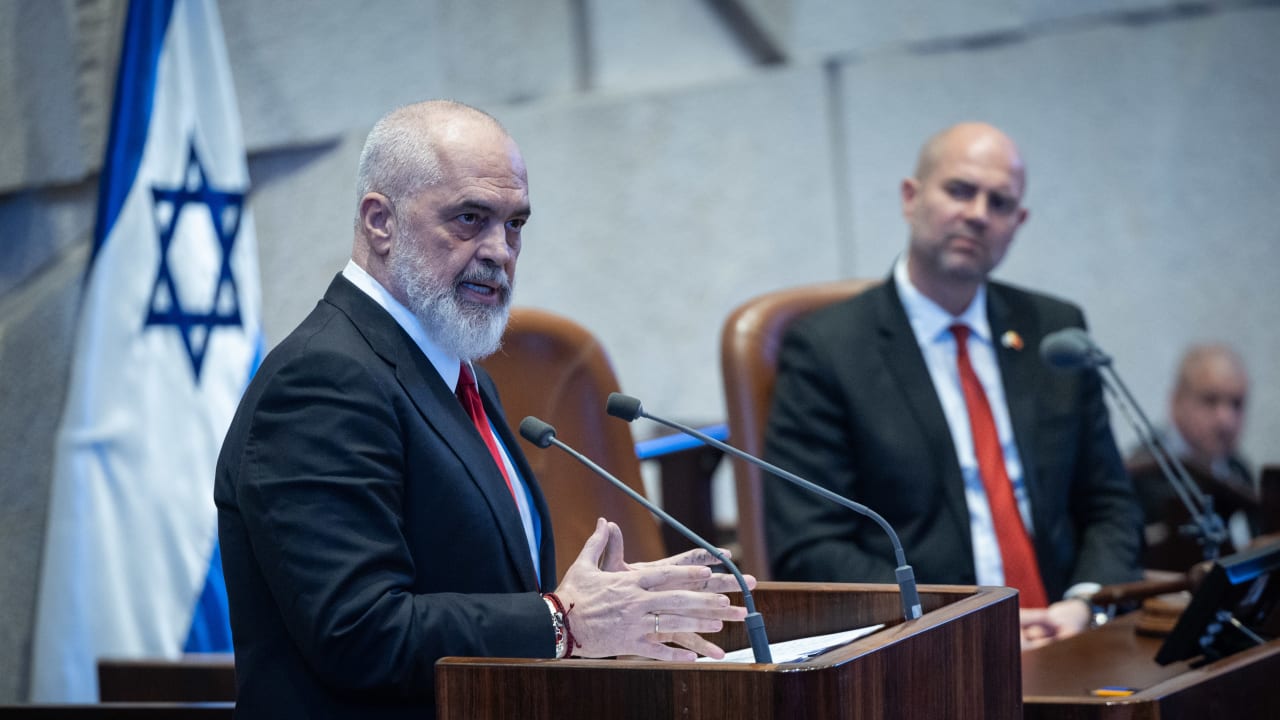
On stage in Jerusalem last week, Albanian Prime Minister Edi Rama chose his words carefully and took them from Jewish tradition.
“The Talmud teaches that whoever saves a single life, it is as if they have saved the entire world,” he said at the international antisemitism conference “Generation Truth” hosted by the Diaspora Affairs and Combating Antisemitism Ministry.
The gathering, held in Jerusalem for the second year in a row to coincide with International Holocaust Remembrance Day, brought international leaders and Jewish community figures to Israel to discuss the global surge in antisemitism.
Antisemitism is “not merely hatred against Jews but an assault on the moral architecture of humanity itself,” Rama said.
A few hours later, sitting down with The Jerusalem Post, he explained that he meant it literally.
“It’s about humanity,” he said. “History shows that it starts with the Jews, but it doesn’t end with the Jews.”
Rama’s warning, which is part historical instinct and part political judgment, sits at the center of his relationship with Israel. His view of Jerusalem is not the average diplomatic view. It came from a world where he grew up being taught to hate the Jewish state.

Jerusalem discussed behind the Iron Curtain
Rama’s personal story begins in a communist Albania sealed off from the world, where paranoia was state policy, and where few friends were to be found on either side of the Iron Curtain.
“Since I was a kid, I was obsessed with Jerusalem,” he told the Post. “We were living in a totally isolated country, and we were taught we had to prepare for the ‘big fight,’ because ‘they’ would come for us. ‘They’ were the American imperialists, the Soviet social imperialists, and the Israeli Zionists.”
Jerusalem arrived through two channels, Rama said. One was the state-approved version: that of schoolchildren reading the Communist Party newspaper in the mornings, with reports about “how badly the Zionist army kills, or wounds, or displaces Palestinians.”
The other channel was more private and much more forbidden under the Enver Hoxha regime.
“The other channel [of my connection] was the Bible of my grandmother, who was a very fervent Catholic,” Rama told the Post. “The Bible at that time was forbidden, but she had a real Bible, and so did my mother.
“Then, after the fall of the communists, I couldn’t come to Israel, because there was no air or sea travel. But I began to learn much more about the history of Jerusalem, and then I finally got to come, and the love only grew from there.”
After the Cold War, Israel and Albania’s modern relationship was rebuilt. Relations were established soon after Israel’s founding, severed for decades, and reestablished in the early 1990s.
Embassies were later established in Tel Aviv and Tirana, and cooperation expanded across economics, culture, agriculture, cyber, and tourism.
At the Jerusalem conference, Rama repeated the wartime story that has become Albania’s moral calling card: the code of honor known as Besa and how his country sheltered Jews during the Holocaust.
“When Albania became the only country in Europe not to hand over a single Jew during World War II, the Jewish population grew during the war,” Rama said.
Albania has provided more than 3,700 names to Yad Vashem of Jews it saved during the Holocaust, he said.
During the Holocaust, Nazi officials came to Albania with two demands: lists of Jews and lists of gold, Rama said at the conference. The response was delivered through Albania’s authorities and then reinforced by the country’s four religious leaders – the figures the Nazis themselves treated as moral arbiters and tried to enlist to resolve those “two issues,” he said.
But Albania did not bend or bargain, Rama said. Its answer was “simple and final: ‘You can take their gold; you cannot take our Jews.’ The gold was theirs to take; the Jews were ours to protect. And this is not a legend; this is record.”
“Antisemitism is once again resurfacing openly and shamelessly, often disguised as political critique, cultural anxiety, or even worse, moral superiority,” he said.
“Hatred does not begin with violence,” Rama said. “It begins with language. It begins with indifference. It begins with excuses.”
The line he kept coming back to, and one later unpacked with the Post, was his insistence that once you start tolerating antisemitism, you are effectively tearing a hole in the structure that keeps societies stable.
“It’s like opening a hole, then [it] gets bigger and bigger over time,” he told the Post. “Or having a building with no windows or doors for protection.”
Rama also addressed the October 7 massacre and the two-year war that followed.
Regarding the perception that Israel has failed in the “PR war” in the West, he said: “Terrorism is not a perspective. It is just a crime against humanity. So, the massacre of October 7 was not resistance. It was mass murder.”
Rama acknowledged Palestinian suffering in Gaza as “real” and “truly heartbreaking,” but he said moral obligations in the West had confused the truth for some people.
“We live in difficult times of truth, because now, opinions are being treated as facts, and the facts are being treated as opinions,” he told the Post. “It’s a mess. More than that, based on loyalties, people pick opinions that ‘this is right,’ and then they consider it as fact.
“It is a madness to blur moral lines or to legitimize terror in the name of proportionality. Peace does not and cannot mean neutrality toward terror.”
Albania’s relationship with Israel is not limited to ceremonial history, Rama told the Post. Israelis can feel it on the ground, particularly at a time when Jews have faced hostility in parts of Europe, he said.
“There was no gathering, there was no sign in any shape or form of antisemitism towards the very broad number of Jewish tourists coming to Albania,” he added, contrasting it with other, nearby countries where Jewish tourists had suffered because of Israel’s war against Hamas.
There were lighter moments during Rama’s visit. Knesset Speaker Amir Ohana presented him with a pair of custom-designed shoes embossed with the Albanian flag as a token of appreciation.
In addition, there were meetings to further Albania’s Chamber of Commerce in Israel and a press conference alongside Prime Minister Benjamin Netanyahu. Rama also received a standing ovation when he ascended the Knesset podium to address the MKs.
Rama explained that closeness in simpler terms.
“I think it’s normal to be friends with Israel, but it’s an honor to be considered such a close friend of Israel,” he told the Post.
Asked what comes next between the two countries, he said: “I hope we’ll have many more good things.”
For Israel, Rama’s visit was more than just a diplomatic gesture between friendly countries. Jerusalem has a real ally in the Albanian prime minister, who can stand on stage in the eternal capital of Israel and quote the Talmud.
But for Rama, the answer is obvious, and it comes back to his core idea of humanity: that if you let them begin with the Jews, soon they’ll come for you.