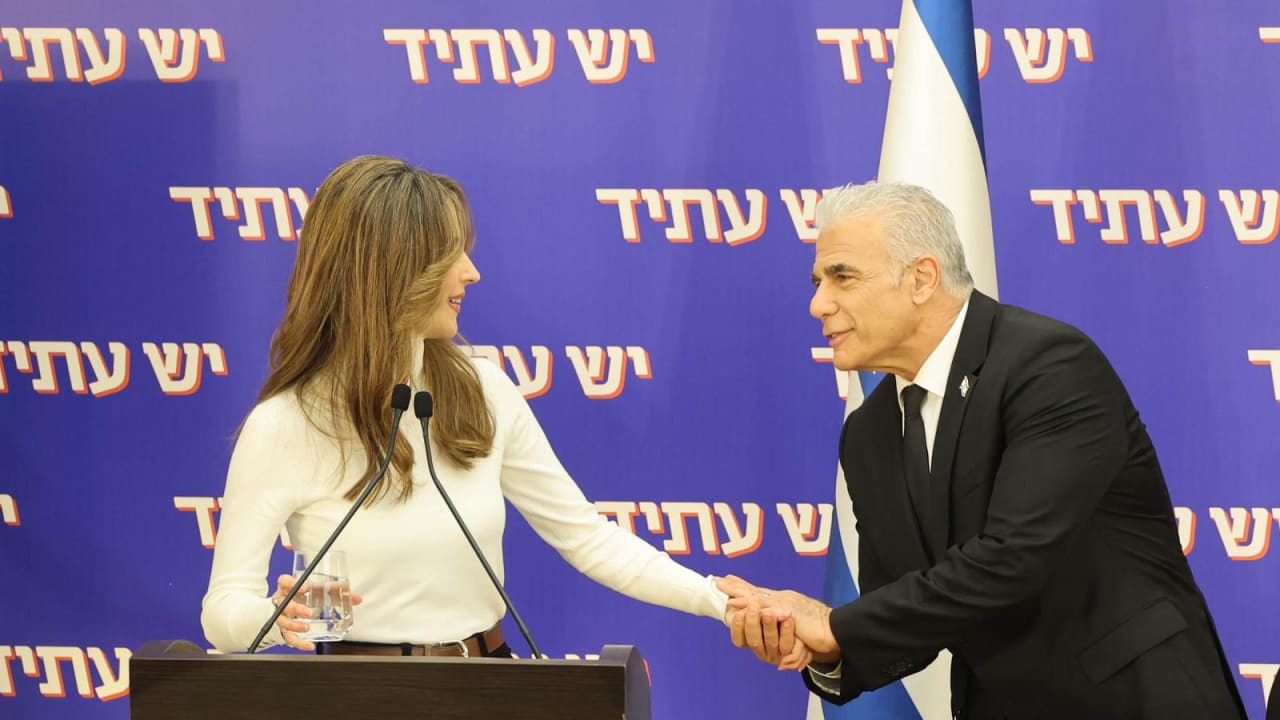
Opposition leader and Yesh Atid leader MK Yair Lapid announced on Thursday that his party would demand the Education Ministry portfolio in the next government, naming MK Meirav Cohen as his appointment for education minister.
Lapid presented the national education plan during a press conference, which he said is intended to address “Israel’s education crisis.” Cohen later outlined the main components of the plan.
The proposal is divided into five chapters and centers on improving conditions for both teachers and students through an investment of billions of shekels in the education system.
To confront the nationwide shortage of educators, the plan calls to allocate NIS 10 billion ($3.2b) toward raising teachers’ salaries and improving their working conditions.
A significant portion of the plan addresses education in the ultra-Orthodox sector, calling for haredi integration into Israeli society.

It proposes a complete halt to public funding for haredi educational institutions that do not teach the core curriculum subjects, such as math, English, science, and civics.
Plan formulated with experts team
Yesh Atid said the plan was formulated in cooperation with a broad team of experts, including research institutes, parents’ organizations, teachers’ unions, school principals, mayors, former senior government officials, and leading economists.
The plan also calls for the immediate allocation of billions of shekels to state education institutions. Among its goals is a gradual reduction of class sizes to an average of 20 students per classroom.
Additional measures include ending class cancellations and reorganizing school schedules through a system of incentives, compensation, and improved training programs. These steps also claim to aid in addressing the shortage of teachers.
Another component of the plan involves the gradual establishment of high-quality public daycare for toddlers, with subsidies for families where both parents are employed.
The plan also calls for a ban on mobile phone use during class time for students in grades 1–11, as well as the establishment of centers for gifted and excelling students in Israel’s periphery.
In addition, the plan calls for creating an independent national education council that would include representatives from all education streams and operate free of political influence.
“Our schools need to be the best in the world,” Lapid said. “They must be funded with the understanding that education is the only thing that can guarantee a society with shared values and a shared future.”
Addressing teachers, he said, “We entrust you with the most precious thing we have. You deserve better conditions.”
Cohen said she views taking on the role of education minister “as a life mission.”
“The education system is the foundation for the repair Israel needs,” she said. “We have a once-in-a-generation opportunity to steer the country from a path of collapse to a path of prosperity.”
Elections are currently set to take place no later than October.