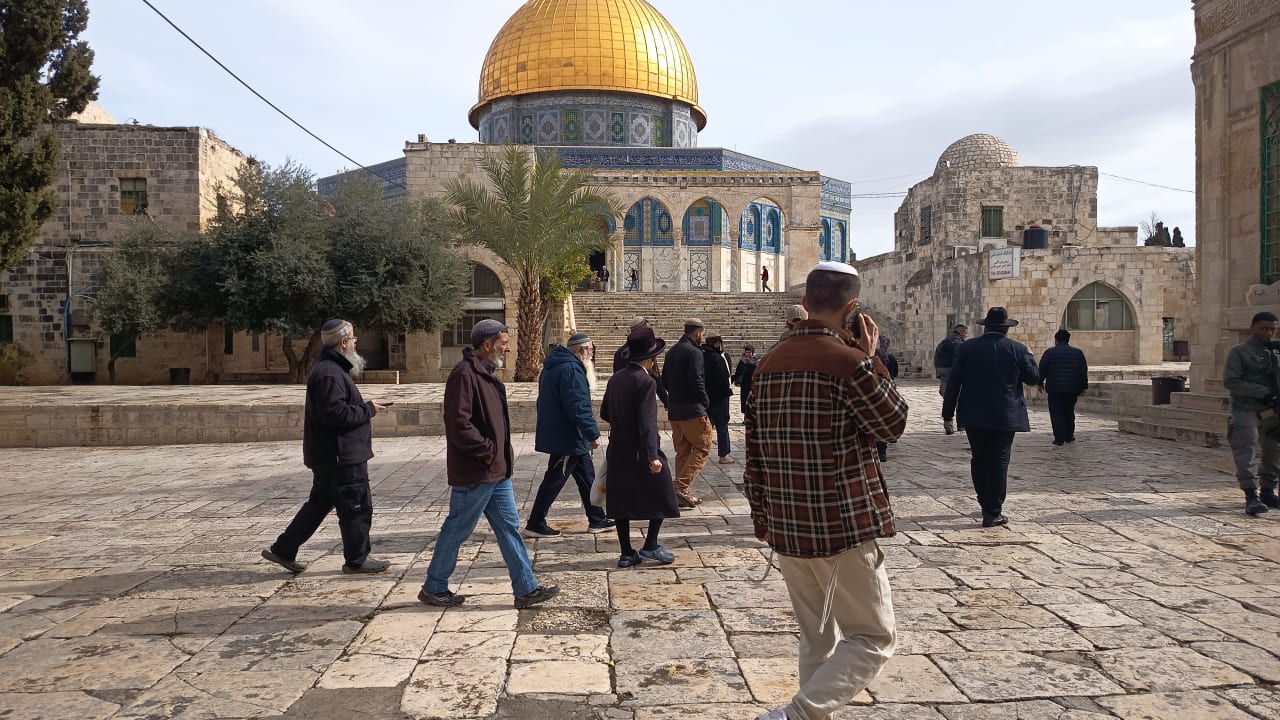
Israeli activist group Ir Amim issued a warning on Sunday against “the government and police's aggressive policy on the Temple Mount” ahead of the 2026 Islamic holiday of Ramadan holiday.
Ramadan, which begins on Wednesday, is a month-long Muslim holiday during which, on a daily basis, “more than 200,000 worshipers are expected to arrive at the [Temple Mount] compound during peak hours,” Ir Amim said.
The group decried what it described as recent “violations” of the status quo, which, up until recently, banned Jewish people from praying at the site where the First and Second temples stood before the Dome of the Rock was built.
Policies imposed since October 7, 2023, including “expanding Jewish prayers in the compound, granting permission to bring prayer sheets to Jews..., and continuing significant restrictions on the entry of Muslims” are cited as such violations.
Ir Amim claims 'systematic deterrance' of Muslim worshippers
In its condemnation of such changes to the status quo, Ir Amim drew attention to police data from 2025, claiming that the data shows that “the number of Muslim worshippers on the Mount was less than half of their number a decade ago,” a decline the organization stated reflects “systematic deterrence” of Muslim worshippers.

Ir Amim additionally criticised a “time-sharing” policy that allows both Muslim and Jewish worshippers to visit the Temple Mount at separate times as something that “could lead to widespread harm, especially during the sensitive month” of Ramadan.
Ir Amim issued a series of recommendations for the police and government aimed at relaxing what the group called “extensive restrictions on the freedom of worship of Muslims” at the Temple Mount.
The group implored Israeli authorities to take measures such as “avoiding limiting the number of worshipers,” “reinstating the ban on Jewish prayer in the compound in accordance with the status quo,” and “closing the Mount to non-Muslims during the last ten days of Ramadan.”
Aviv Tatarsky, a researcher at Ir Amim, said he believes “the prayers and all aspects of religious worship throughout the month are part of what makes Jerusalem a holy city.”
“The entire Muslim public deserves to make a pilgrimage to the Al-Aqsa Mosque without interference,” Tatarsky said. “In the face of calls from within the coalition to disrupt Ramadan, we call on the police to allow the Muslim public to enter the holy place smoothly."