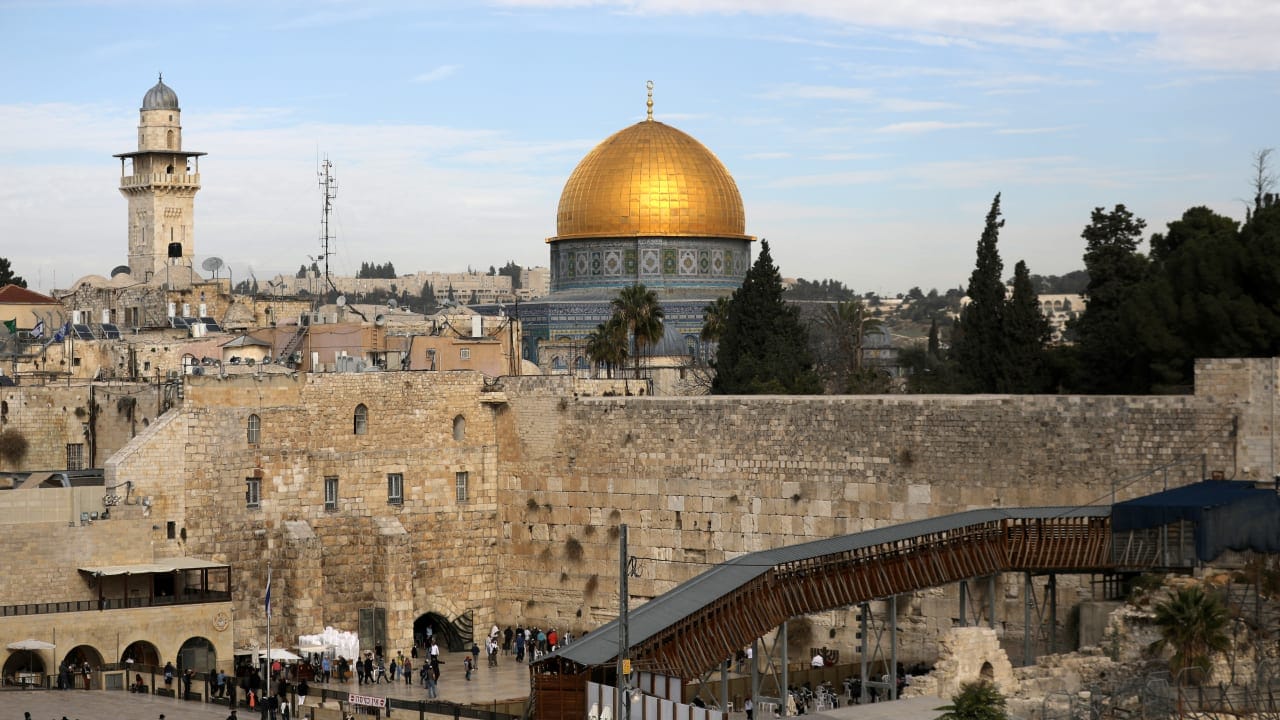
For decades, the Western Wall has served as both a religious site and a national gathering place for the Jewish people.
For more stories from The Media Line go to themedialine.org
Israel’s Memorial Day ceremony is held there every year, families celebrate bar and bat mitzvahs, and visiting Jewish delegations almost always include the plaza as a symbolic stop. That layered meaning is part of what makes the current legislative fight so sensitive.
“We say to the High Court: Enough is enough!” Member of Knesset (MK) Avi Maoz told The Media Line, describing his proposal as a response to what he views as judicial intervention in matters that should remain under Orthodox religious authority.
Maoz, the leader and only lawmaker of the far-right Noam party, proposed an amendment to the 1967 Law for the Protection of Holy Places. The bill passed a preliminary vote this week and now moves to committee review.
Under the proposal, desecration would be defined explicitly as conduct that contradicts the directives and rulings of the Chief Rabbinate. It also states that the chief rabbis serve as the exclusive representatives of the Jewish religion for purposes of implementing the law.
The legal change may appear technical, but its implications are not. Supporters argue that spelling out the Chief Rabbinate’s role removes ambiguity.
Critics counter that tying the definition of desecration directly to Rabbinate rulings could limit the courts’ ability to interpret disputes involving prayer arrangements at the site.
Court questions delays at Ezrat Yisrael plaza
Ezrat Yisrael is the mixed-gender prayer section at the southern end of the Western Wall complex and has once again become the focus of legal proceedings. In recent weeks, the High Court has questioned the state over why accessibility upgrades and construction plans there remain incomplete.
In 2016, Prime Minister Benjamin Netanyahu’s government approved a framework intended to formalize and expand that area as an egalitarian prayer space.
The decision sparked immediate resistance within parts of the coalition, and implementation was eventually halted. Legal petitions continued, bringing the matter back before the Supreme Court.
Maoz argues that this sequence allowed judges to enter what he considers a religious sphere. “When the High Court took upon itself the authority to tell the government what to do, and even to take the authority of the Chief Rabbinate, I said it was time to put an end to this,” he said. “Against the High Court’s decision, I am legislating this law.”
He rejected claims that the amendment introduces new penalties. “It’s all fake news,” Maoz said. “I am not touching the penalties in the law. The penalties exist today.” For him, the central issue is institutional clarity. “Who defines desecration?” he asked. “The court, or the chief rabbis?”
Following the vote, Maoz framed the moment in historic terms. “Today the Parliament set a clear boundary on High Court intervention in the sanctity of the Western Wall,” he said in a statement released by his office.
“It cannot be that a court decides what constitutes desecration at the holiest site of the Jewish people.” He described the amendment as restoring authority “to its natural and correct place” and preventing the court from continuing “to shape the character of the Wall contrary to halacha and the spirit of the legislator.”
The bill received explicit backing from four coalition factions: Shas, United Torah Judaism, Otzma Yehudit, and Religious Zionism. Justice Minister Yariv Levin voiced support as well.
Prime Minister Benjamin Netanyahu did not enforce coalition discipline, allowing members to vote without a formal government position on the bill.
During internal discussions, Finance Minister Bezalel Smotrich, who leads the Religious Zionism party, argued that the Wall has historically remained unified despite deep differences within Orthodox practice itself.
In faction remarks, he said that even within Orthodox Judaism, there are countless traditions, yet the Wall was never divided accordingly. There is no “Lithuanian Wall” and no “Hasidic Wall,” he said, despite the existence of hundreds of Hasidic courts.
The site remained unified despite internal differences. Creating denominational distinctions now, he suggested, introduces fragmentation that historically did not exist. He urged critics to “lower the emotions” and view the debate in proportion.
Amichai Eliyahu, Israel’s minister of heritage and a member of Otzma Yehudit, focused on demography. Speaking to The Media Line, he claimed that Reform Judaism represents “less than 0.3%” of Israel’s population.
“Understand the proportions,” he said. “They have about 50 synagogues. Compare that to almost 12,000.” He argued that Israeli society, including many who identify as traditional but not strictly observant, largely aligns with Orthodox custom.
“When you come to the Western Wall,” he said, “you respect the custom of the place.”
Maoz was direct about Diaspora influence. “With all due respect, I very much appreciate the help of American Jewry to the State of Israel,” he said. “But they cannot decide.”
If Diaspora Jews wish to shape Israeli legislation, he added, “let them come here, run for the Parliament and legislate their own laws.” Authority, he insisted, rests with those elected by “the majority of the people living in Zion.”
For Reform and Conservative leaders, that framing cuts to the core of the dispute. Outside Israel, those two movements represent the majority of affiliated Jews, particularly in the United States, where they form the backbone of organized Jewish communal life.
For many of their members, the Western Wall is not simply an Orthodox prayer plaza but a national symbol that belongs to the entire Jewish people.
Rabbi Mauricio Balter, executive director of Masorti Olami and MERCAZ Olami, told The Media Line that egalitarian prayer at the southern section has been taking place for decades and that thousands of ceremonies are held there each year.
“Why do we have to be hidden?” he asked, referring to the physical placement of the area. “Let us be separate from the classic section, but give us a reasonable place.”
Balter warned that the message conveyed by the amendment could reverberate beyond Israel.
“The Wall belongs to the entire Jewish people,” he said. He also raised concerns about enforcement implications, noting that under the existing Law for the Protection of Holy Places, violations defined as desecration can carry penalties of up to seven years in prison.
“Did you hear that? Seven years,” he said. While the amendment does not change the penalty itself, Balter argued that expanding the Rabbinate’s authority to define desecration could have serious consequences for non-Orthodox worshippers.
He described the prospect as deeply troubling, saying it risks pushing other Jewish streams to the margins.
MK Michal Shir, a lawmaker from the centrist Yesh Atid party, told The Media Line that religion is “very delicate” and “very personal,” and that political leadership requires sensitivity to timing.
“After the great massacre and after the biggest war in the history of the State of Israel,” she said, lawmakers should be lowering tensions rather than igniting new ones.
She stressed that the Western Wall carries symbolic weight far beyond domestic politics. “One of the most sensitive issues at the heart of Israeli Jewish identity here in the Land of Israel and in the world, including Diaspora Jewry that is deeply affected by this, is the Western Wall,” she said.
She described the legislative push as “a lack of leadership responsibility,” arguing that it risks widening the gap between Israel and large segments of world Jewry at a moment when cohesion matters.
Supporters acknowledge that the debate is not only about prayer arrangements. It is about institutional hierarchy and the role of the judiciary in religious matters. Maoz maintains that the amendment simply restores balance.
“It is not the role of a court to decide what is desecration at the holiest place of the Jewish people,” he said. “That authority belongs to the chief rabbis.”
The bill now moves to committee preparation before its first formal reading. Its sponsors have indicated they intend to advance it during the current session.
If approved in subsequent readings, the amendment would formally anchor the Chief Rabbinate’s interpretive authority within the 1967 law governing Jewish holy sites.
For supporters, the measure defines institutional boundaries between the judiciary and religious authorities. For critics, it formalizes a hierarchy of religious recognition at one of Judaism’s most symbolically charged sites.
The coming committee deliberations will determine whether the preliminary majority translates into final passage.