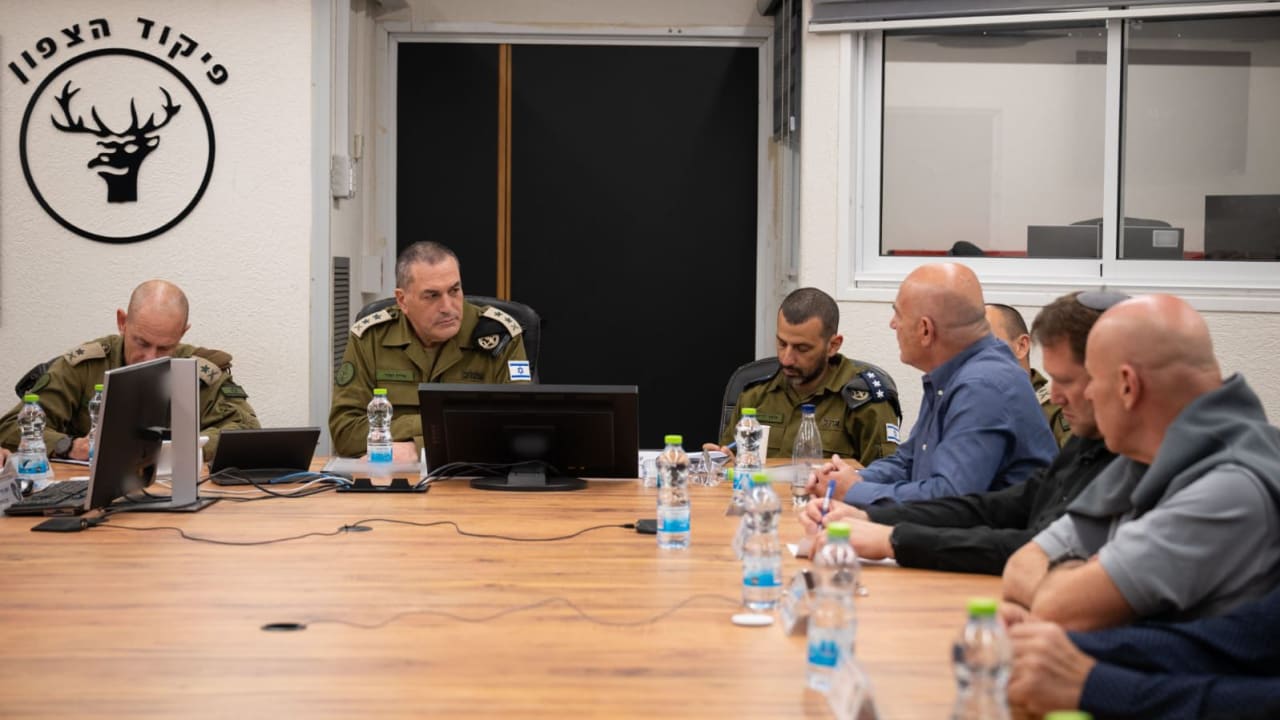
Lebanon is now a co-equal primary front with Iran in the current war, IDF Chief of Staff Lt.-Gen. Eyal Zamir said on Thursday.
Zamir’s comments came amid a flurry of messages from top Israeli defense officials about the next stage in the conflict with Hezbollah, with some emphasizing a graduated escalation, and others a potentially imminent, much wider invasion.
Less than an hour after the IDF said that it was not close to engaging in a broader invasion of Lebanon, Defense Minister Israel Katz issued a statement seeming to threaten exactly such an imminent invasion.
Just before Katz’s statement, multiple IDF sources told The Jerusalem Post that the IDF is still not in favor of launching a full invasion of Lebanon, despite Hezbollah’s heavy attacks on the North on Wednesday night, but is considering it as a more real option once the war with Iran calms down.
Despite Hezbollah firing over 200 rockets overnight (compared to at most 100 per day until now during this conflict) and an increased pace in drone attacks, earlier Thursday, IDF sources said they still viewed Iran as the central theater of the current multifront war, with Lebanon being a secondary front – mainly to prevent any attacks from Hezbollah and to keep the terror group on its back feet.

However, Katz then issued a statement saying that he had warned Lebanese President Joseph Aoun on behalf of Prime Minister Benjamin Netanyahu that if the Lebanese military did not crack down on Hezbollah rocket fire on Israel, the IDF would launch a larger invasion in Lebanon to bring down the rocket fire.
In video footage of their meeting, Katz was seen sitting next to IDF Deputy Chief of Staff Maj. Gen. Tamir Yadai, IDF Operations Command Chief Maj. Gen. Itzik Cohen, Air Force Chief Maj. Gen. Tomer Bar, Home Front Command Chief Maj. Gen. Shai Kleper, and other top officials, as he spoke. Yadai maintained a nondescript facial expression throughout the video.
Zamir was not in the video. Katz and the Zamir have made fewer joint appearances than some prior officials in their roles, likely given pre-war tensions between the two over the defense minister’s interference in various policies and appointments which Zamir sought to implement.
Israeli policy unclear regarding Lebanon invasion
It was unclear whether Israeli policy has shifted to an imminent larger invasion of Lebanon – even with the Iran war still fully playing out – or whether the IDF’s stated policy of waiting at least until the Iran war is over is the real policy, and Katz’s statement was more for public and political consumption.
Meanwhile, according to the IDF, the results of air defenses and military coordination versus Hezbollah’s larger attack on Wednesday night were mixed.
On one hand, IDF intelligence collection, forward attacks, and unspecified mysterious operations prevented Hezbollah from firing off around two-thirds of what it meant to launch against Israel.
Also, Iron Dome and other air defenses have shot down almost all drone threats, about 100 so far, including Iranian drones launched at the North.
On the other hand, there were rockets that got through and caused damage and harm in larger numbers than in prior days.
The fact that Hezbollah got up to 200 rockets put it back in the range of the number of threats it was able to launch during the 2023-2024 conflict, which the IDF had hoped would now be beyond its capabilities.
Also, all the additional efforts the IDF expended when it learned, earlier on Thursday, that Hezbollah would try to launch a larger attack, only helped to locate and destroy one rocket launcher before the attack started.
In addition, the IDF said that the Northern Command should have given more advance notice to northern residents about an anticipated larger attack.
Zamirs asks residents of north for forgiveness
In a highly unusual move, Zamir himself publicly said that he was responsible and asked northern residents for forgiveness.
The military said that providing such warnings was always a dilemma, as it also betrayed intelligence to the adversary.
After the attack started, the IDF destroyed 50% of the rocket launchers involved, although this was less strategically valuable, given that they had already fired. IDF sources were not optimistic about finding a majority of the rocket launchers before they could fire, given that most of them are now north of the Litani River, beyond much of the IDF’s range and efforts.
Earlier on Thursday, The Jerusalem Post reported that Hezbollah has over 1,000 long-range missiles with which to continue to hammer Israel’s home front, in addition to potentially tens of thousands of shorter-range missiles.
The IDF noted that it had killed over 300 Hezbollah fighters and downed around 50 large structures in Hezbollah’s Dahiya stronghold in Beirut.
Four IDF divisions are already deployed in southern Lebanon, where Divisions 36 and 91 are advancing deeper.
At press time, while there had been additional missile fire from Iran and Hezbollah, there had not yet been a similar major hit as on Wednesday night.
However, the hit on Wednesday night occurred in the late hours.