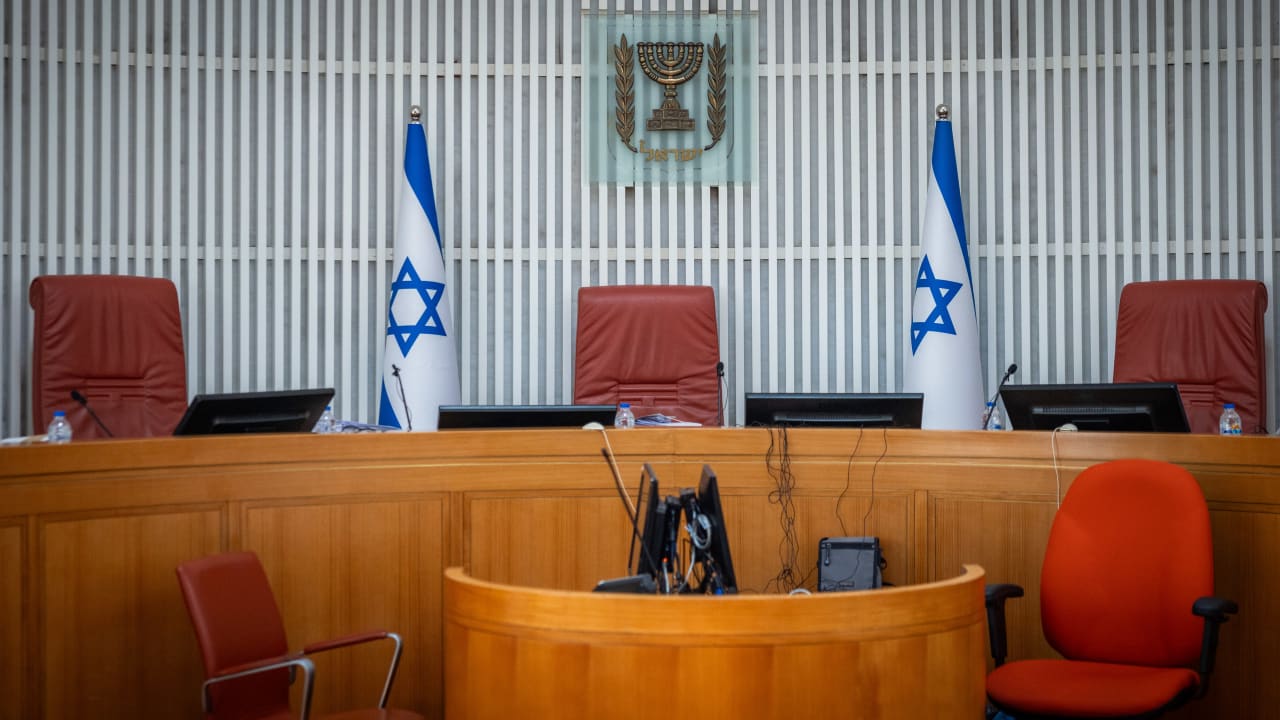
The Haifa District Court on Tuesday convicted David Abu Aziz of the murder in aggravated circumstances of attorney Ephraim Arnon, nearly five years after he was stabbed to death outside his home in Nesher in a killing the court found was planned and carried out together with another person whose identity remains unknown.
In the same ruling, the three-judge panel – Court President Avi Levy, Judge Eran Kotton, and Judge Idit Raz-Weinberger – also convicted Abu Aziz of aggravated wounding for injuring Arnon’s widow as she tried to fend off the attackers and of obstruction of justice for the disposal of evidence after the murder.
At the same time, the court acquitted him on the separate counts of threats and malicious damage to property that had also appeared in the indictment.
The March 24, 2021, killing was carried out after two men entered the yard of Arnon’s home armed with knives and waited for about an hour. When Arnon emerged at about 6:30 a.m. with his wife, the two rushed him and stabbed him about 37 times before fleeing.
The court held that the murder was committed after planning and “a real process of weighing and forming a decision to kill,” supporting a conviction for murder in aggravated circumstances.

The ruling centered on a circumstantial evidentiary chain that the court said was coherent and mutually reinforcing. Judges accepted the prosecution’s reliance on security-camera footage, police license-plate camera records, and vehicle-tracking data that showed it arriving at and leaving the scene.
Forensic evidence links David Abu Aziz to Ephraim Arnon murder
The court also relied on forensic findings recovered along the route the car was found to have taken after the murder, including shoes discarded near Daliat al-Carmel – with DNA from Arnon found on one shoe and DNA from Abu Aziz on the other – as well as coats recovered in the Carmel area, one of which carried Arnon’s DNA.
The judges rejected a series of defense attacks on the admissibility and weight of that evidence. Among other things, the defense had argued that the vehicle data was unlawfully obtained because the vehicle had been disconnected from the service about a year earlier. It had also challenged the handling of camera materials and the reliability of the DNA findings.
The court nevertheless held that the data and camera outputs were admissible and carried substantial evidentiary weight, finding that the materials were obtained under warrants or consent, documented as original and unedited, and together created what it described as a clear evidentiary picture.
At the heart of the prosecution case was the long-running property dispute in Nesher involving three parcels of land, two of which Arnon had been appointed to manage as court-appointed receiver.
The indictment alleged that the legal conflict around those plots provided the motive for the killing, and the court summary said the overall evidence established a “boiling dispute” between Abu Aziz and Arnon that formed part of the backdrop to the murder.
The full judgment shows that the court traced the dispute through a series of civil and enforcement proceedings tied to the Einhorn compound in Nesher, where Arnon acted in his capacity as receiver and lawyer in efforts connected to disputed possession, construction permits, and registration of rights.
Prosecutors had alleged that Abu Aziz, who had held rights in one parcel since the 1990s and was in conflict with heirs and other stakeholders over adjacent areas, ultimately decided to kill Arnon over the legal campaign against him.
The court stopped short of entering a separate conviction on the alternative aggravated-circumstance theory of “special cruelty,” even while noting that the circumstances – two men repeatedly stabbing Arnon in front of his wife as she screamed and tried to protect him – could potentially have supported such a finding.
It said that because premeditated aggravated murder had already been proven, there was no need to decide that question conclusively. Under Israeli law, the offense for which Abu Aziz was convicted carries a mandatory life sentence.
The case has drawn sustained attention since Abu Aziz was indicted in May 2021.
Coverage during the early stages of the trial described the prosecution’s theory that Arnon was murdered over his role in the property dispute and highlighted family protests outside court, where relatives said he had been killed in connection with his professional work. Later reporting from the evidentiary phase focused on testimony from Arnon’s widow, the only eyewitness to the stabbing, as well as the prosecution’s effort to rebut Abu Aziz’s alibi account.