
State prosecutors filed an indictment Monday against 17 ultra-Orthodox (haredi) men, including four minors, over a violent anti-draft protest in which demonstrators allegedly broke through the locked gate of the chief military police officer’s home in Ashkelon while his family was inside.
The indictment, filed with the Ashkelon Magistrate’s Court, charges the defendants with rioting, trespassing to commit an offense, and malicious damage.
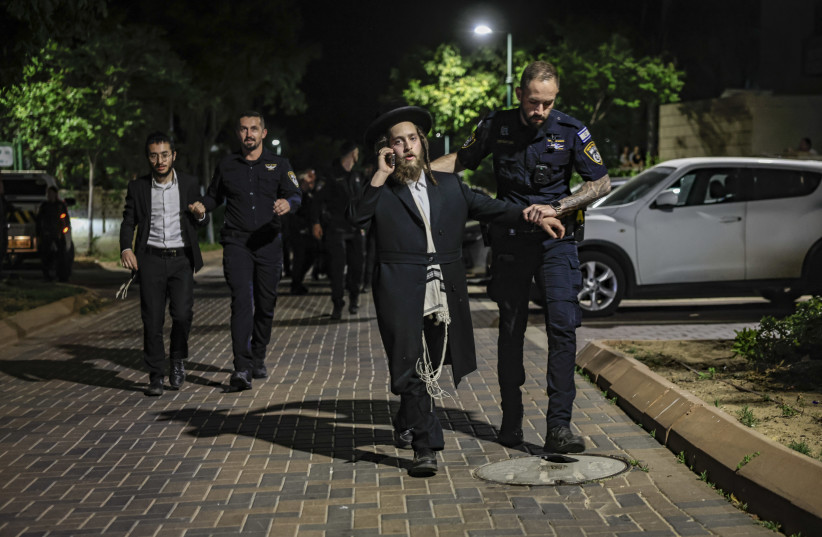
According to the indictment, the incident took place on the evening of April 28, when dozens of haredi protesters gathered outside the home of Brig.-Gen. Yuval Yamin, the IDF’s chief military police officer, to protest the enlistment of yeshiva students.
The protest came as Israel’s haredi draft crisis has moved from the Knesset and the High Court of Justice into the streets, with increasingly aggressive demonstrations against enforcement measures targeting draft evaders.
The dispute has intensified since the High Court ruled that the state no longer has legal authority to grant sweeping exemptions to haredi yeshiva students, as soldiers and reservists continue to serve under the burden of the ongoing war.
The indictment says protesters carried signs reading, “War on the draft law, in actions and not words,” and shouted slogans including, “We will die and not enlist,” and “Yuval Yamin is a traitor.”
Shortly after the protest began, at around 8 p.m., some of the protesters allegedly broke open the locked entrance gate and entered the yard. Yamin was not described in the indictment as being inside the home at the time, but his wife and two of his children were there, including one minor.
The protesters caused thousands of shekels in damages
Dozens of protesters, including the defendants, allegedly spread through the yard, porch, and entrance stairs. Some sat or stood while holding hands, while others sang protest songs, waved signs, and shouted against Yamin and the IDF, according to the indictment.
The family, prosecutors said, was effectively trapped inside the house, unable to leave safely, while more protesters crowded the entrance from the street.
As a result, Yamin’s family members felt they were in danger and feared physical harm, the indictment says. They closed the shutters, locked the front door, and called the police.
Neighbors also reported the incident, and police forces who arrived at the scene ended the riot and arrested the defendants.
Prosecutors said the incident caused thousands of shekels in damage, including to the gate’s locking mechanism, parts of the wall, porch tiles, and nearby plants.
The state also filed a request to set conditions for the defendants’ release, including measures meant to ensure that they appear for future court proceedings. The case was investigated by the Ashkelon police station.
Prosecutors also notified the court that if the defendants are convicted, the state may ask that they receive actual prison time.
The indictment follows a broader escalation in extremist haredi anti-draft protests.
Earlier this month, dozens of haredi protesters rioted outside the home of Deputy Supreme Court President Noam Sohlberg in Alon Shvut, damaging his home and car, as part of protests against enforcement of draft orders.
More than 60 suspects were detained in that incident, and prosecutors have since filed indictments against four men from Beit Shemesh.
That incident was viewed as especially severe because it targeted a sitting Supreme Court justice at his private home. The Courts Administration said at the time that attempts to intimidate judges would not affect their work.