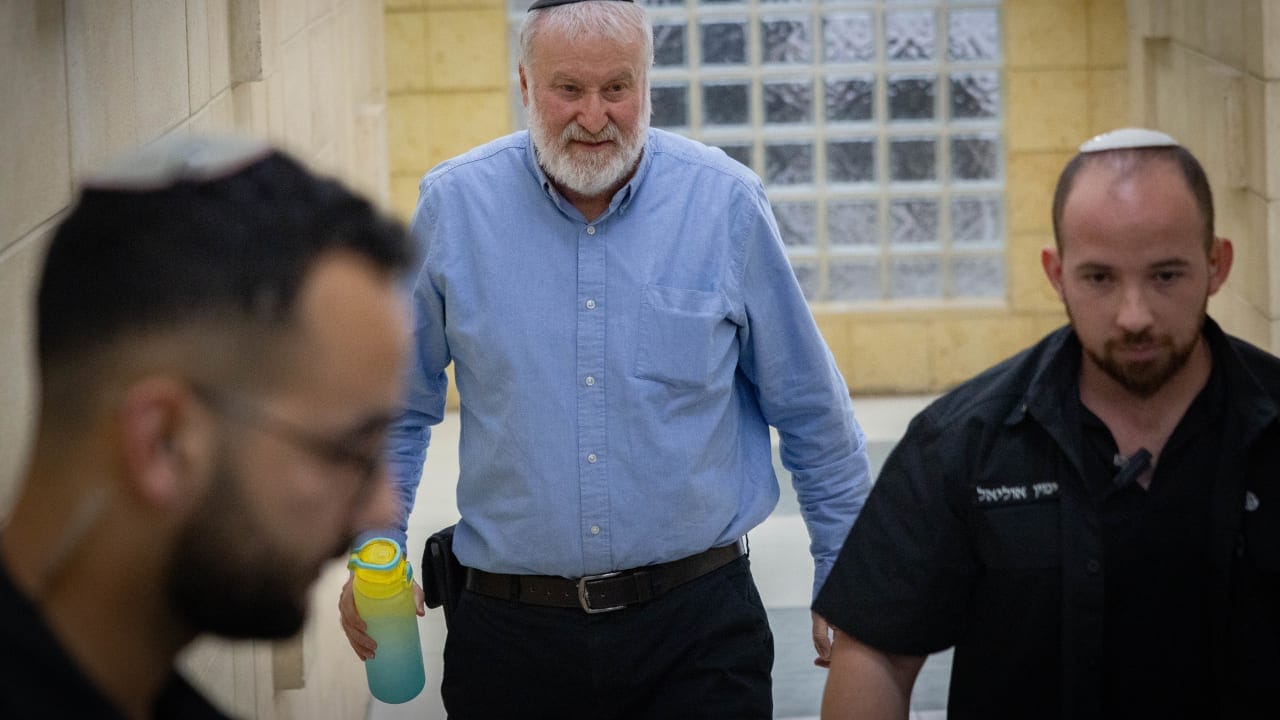
Former attorney-general Avichai Mandelblit testified Wednesday that he had suspected figures in the prosecution and police of leaking information to pressure him to allow investigations into Prime Minister Benjamin Netanyahu, but said the pressure had not swayed him.
His testimony at the Jerusalem District Court came as Netanyahu’s defense continued to challenge the timing and scope of the approvals Mandelblit gave investigators, pressing for fuller disclosure of the records of those decisions.
Asked by Judge Moshe Bar-Am whether he had yielded to the pressure, Mandelblit replied: “Exactly the opposite. I was very cautious.”
Mandelblit, who approved the indictment against Netanyahu, was called to testify by the defense. His questioning has focused on the authorizations he gave investigators and whether the records supplied to the defense establish what he approved.
Mandelblit questioned on law enforcement contact with journalists
Defense lawyer Amit Hadad also questioned him about contacts between police and journalist Ben Caspit. Mandelblit confirmed that he had asked police to end the contact because he felt Caspit was directing their work.

“I had a feeling that instead of the police investigating, he was directing the police. It was an uncomfortable feeling,” he said.
Mandelblit distinguished between journalists conducting their own investigations and police using a journalist to carry out investigative work on their behalf.
“A police officer cannot use a journalist as his extended arm,” he said.
Hadad also challenged Mandelblit over his own contacts with the media, presenting a television report that described an internal prosecution meeting. Mandelblit said the reporter had learned the details during a telephone conversation with him, coordinated with his spokesman.
Hadad argued that the defense had been denied access to internal discussions whose contents had been shared with a journalist.
Mandelblit defended background briefings intended to explain the process, provided they did not extend to analysis of testimony and evidence. He said a filmed encounter with the reporter in the street had been arranged in advance and that he had not claimed it was accidental.
Questioning turns to topic of Case 1000
The questioning also returned to Case 1000, concerning expensive gifts Netanyahu allegedly received from wealthy business people.
Mandelblit said testimony from Hadas Klein, a personal assistant to businessman Arnon Milchan and the Israeli representative of Australian billionaire James Packer, had changed the picture from occasional gifts to a more serious suspicion.
Following this, the preliminary examination transformed into a criminal one. Klein testified that she helped arrange the purchase and delivery of gifts to Netanyahu and his wife.
Mandelblit said investigators also needed to take testimony from Milchan and Packer.
Hadad argued that Mandelblit’s account of the approvals he gave in 2016 differed from the state’s previous descriptions. Mandelblit said he remembered the subjects discussed but could not pinpoint the dates.
“It is clear that you ultimately approved it. The question is when,” Hadad said.
Hadad then quoted passages from the record of a July 2016 meeting in which Mandelblit criticized investigators for pursuing matters beyond those he had authorized. The passages described Mandelblit’s concern that the material gathered did not establish the large-scale provision of gifts investigators had initially suspected.
Hadad quoted him as saying, “This is explicitly not what I authorized at the time.”
Prosecutor Alon Gildin responded that other passages from the same record provided the full picture. The judges said the appropriate course was to give the defense the complete record, which Mandelblit could then also review. Prosecutors said they would respond as soon as possible.
Netanyahu facing charges of fraud, breach of trust
Netanyahu faces fraud and breach-of-trust charges in Case 1000 and Case 2000. The latter concerns discussions with publisher Arnon Mozes about favorable coverage in Yediot Aharonot in exchange for steps against rival newspaper Israel Hayom.
In Case 4000, prosecutors allege that Netanyahu advanced regulatory measures benefiting telecommunications company Bezeq in exchange for intervention in the Walla news website’s coverage. He faces charges of bribery, fraud, and breach of trust in that case.
Netanyahu denies wrongdoing in all three cases. His trial began in May 2020.