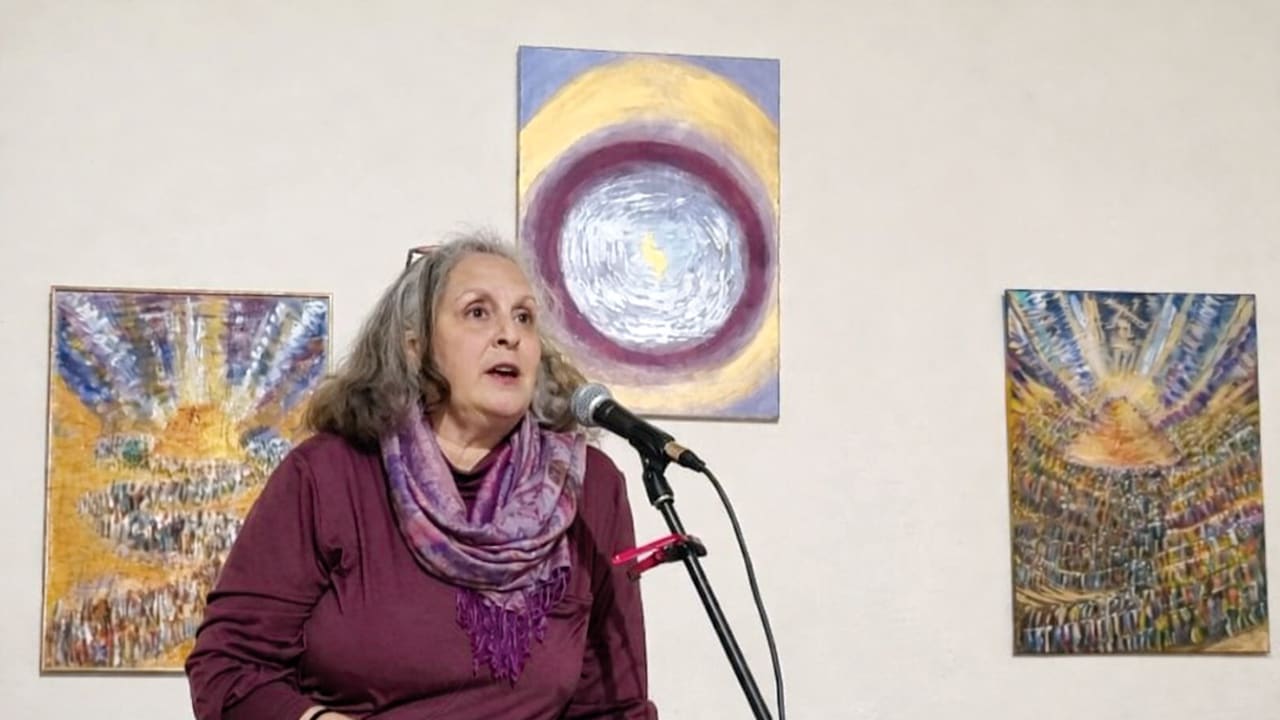
Once a railway waiting room, filled with passengers shuffling their feet as they impatiently awaited their trains, today The Terminal at the First Station is a happening place – and the only foot shuffling to be seen is when people get up to dance. A cultural venue, with bar and kitchenette, The Terminal hosts music nights, concerts, and other events, and can also be booked for private parties, by appointment with managing partner Yosef Gross.
It has also recently become home to rotating art exhibitions that cover its walls in images and hues. Its third exhibition, Redemption and Healing, opened on February 2, showcasing the beautiful artwork of American olah Rikki Rose Horowitz. A native of Plainview, New York, Horowitz dabbled in art from a young age but did not at first take herself seriously.
“Growing up, I always perceived my mother as the artist, while I was the singer,” she told In Jerusalem. “If I told her that I liked a particular painting, she’d say, ‘You could make something like that,’ and I’d reply, ‘No, Mom, you could make something like that.’
“I drew a bit, but I never tried my hand at painting until I fell in love with the silk-painted covers for challah and tallitot I saw for sale on Ben-Yehuda Street back in the late 1980s. I decided to try my hand at painting using this medium, and one of those works is on display here.”
The birth of her son Raphael (today a landscape architect and painter himself) was another milestone, as she chose art as a key play activity for them to do together. Through attending artistic community events, she gained confidence and began producing paintings. “I mostly used acrylics because, living in rented apartments, oils were likely to stain the furniture,” she explained.

After making aliyah in 1986 and having to leave in 2000, Horowitz dreamed for many years of returning to Israel, finally achieving her goal in 2019. In Jerusalem, she encountered artist Liane Wakabayashi and her Genesis Intuitive Art method, which helped Horowitz develop her skills and gave her a philosophy to work with. Other influences range from Claude Monet to local artists Yoram Raanan and Raquel Sanchez.
Since arriving here, Horowitz has created dozens of pieces. One of these appeared on the cover of The Jerusalem Post’s Shavuot 2024 edition, and several will be featured in the forthcoming Az Nashir Haggadah (Shvilli Center/Layers Press, in partnership with Matan), as well as in Judith magazine.
From lowest to highest
The route through the exhibition at The Terminal begins with paintings inspired by the Creation story and proceeds to Kabbalistic-themed pieces. One shows the 10 spheres intertwined with the body’s chakras. Dubbed The Portal, it became a popular prop in improv workshops run by Horowitz’s flatmate at the time, the multi-talented Lauren Stein. Circles are, in fact, a prevalent motif, with several disc-shaped canvases on display.
Following this are waterfall themes (see box) and, at the far wall, scenes from the Book of Exodus: Moses and the burning bush, the Israelites leaving Egypt, the splitting of the Red Sea, and the revelation at Sinai. The final two pieces represent the artist’s recent venture into mosaics, which includes an eye-catching rendition of the Temple, with doves flying above.
Colors for healing and holistic therapy
The theme of redemption is important to Horowitz – she has authored a novel, Have You Seen the Signs? (Book 1 of The Messiah Chronicles). Color plays a key role, too. She is a practitioner of Aura-Soma, a holistic therapy system using colors to heal. In the Genesis Intuitive Art Method, black is excluded, and Horowitz’s palette tends strongly toward purples, blues, teals, and golds. Exhibited together, her paintings create a compelling cumulative effect that could be described as a mixture of calming, uplifting, and mysterious.
In the spring of 2024, Horowitz joined the Sefirat HaOmer project. Inspired by Rabbi Benji Elson’s book Dance of the Omer, Horowitz succeeded in producing one painting a day over the course of the 49 days of the Omer count up to Shavuot, a number of which are displayed in The Terminal exhibition.
“The Sefirat HaOmer period is when the Israelites ascended each day, from the lowest level of impurity to the highest level of receiving the Torah,” Horowitz explained. “Every year, we reenact this experience. The energy is available for us to grow, heal, and transform – to become the best versions of ourselves, who we are truly meant to be.”

Horowitz opts to use recycled materials in her art wherever possible. “I love to use canvases and other surfaces I find, and to reuse materials like pieces of wood, glass, ceramic tiles, or cardboard,” she noted.
The exhibition at The Terminal will be open for viewings with the artist on February 12, from 10 a.m.-3 p.m., and February 17 and 24, from 10 a.m.- 4 p.m.
Along with the originals themselves, prints and cards are available for sale. For more information,
visit rikkirose.com