
When Prof. Mel Rosenberg made aliyah from Canada in 1969, just short of his 18th birthday, his dream was to write children’s books. Yet only now, in his early 70s, has he finally broken into that field as a published author, via the uber-reputable Penguin Random House.
Rosenberg, who experienced what he calls a “double career” in science and music, told the Magazine that he had always wanted to have a children’s book published, but that “it was not as easy as one might think.”
However, when his book’s original Hebrew version finally saw the light of day, Emily Saw a Door won several awards, including Israel’s prestigious Dvora Omer Prize for children’s and youth literature.
Rosenberg had dedicated himself to a scientific career, spending decades studying microbiology, becoming a professor at Tel Aviv University, and an expert on halitosis and microbial adhesion. He co-developed a two-phase mouthwash technology later commercialized as Assuta in Israel and Dentyl pH in the United Kingdom, designed to reduce the presence of bacteria responsible for tooth decay, gingivitis, and halitosis.
It wasn’t until 1991 that he took up playing jazz again, an interest he had cast aside for some 25 years. He plays the piano and saxophone and sings, and has released several jazz albums.

A book about acceptance and self-discovery
“I thought I knew everything about publishing children’s books until I had an awakening 10 years ago,” he said. Then, in 2013, having already written and self-published many children’s stories, he co-founded Ourboox, “to enable writers, illustrators, and educators to create and share free picture books online.” Today, the platform hosts more than 300,000 books in several languages and is used in many countries.
Rosenberg’s first traditionally published book, Emily Sees a Door, is the story of a young girl who wants to be welcomed and accepted. She is outside looking in and wants to be inside looking out. The book opens with Emily knocking on a door, requesting permission to enter.
Knock, knock, knock.
“Who’s there?”
“It’s me, Emily. May I come in?”
And so begins the little girl’s search for the perfect door to open up for her.
“She wants to find her home, the place where she feels welcome,” Rosenberg explained, “but instead she finds doors that refuse her or try to trick her,” treat her as not good enough, or welcome her into a world which will only allow her to climb but never reach her destination.
“There are autobiographical elements in Emily, issues I encountered in my own life,” Rosenberg said. “Doors opened up in my career, but perhaps they were not the right doors. Emily is tempted by danger, evil, and wrong decisions. I was too short or too fat, or Jewish,” he related.
Eventually, Emily becomes dejected – until she decides to create her own door.
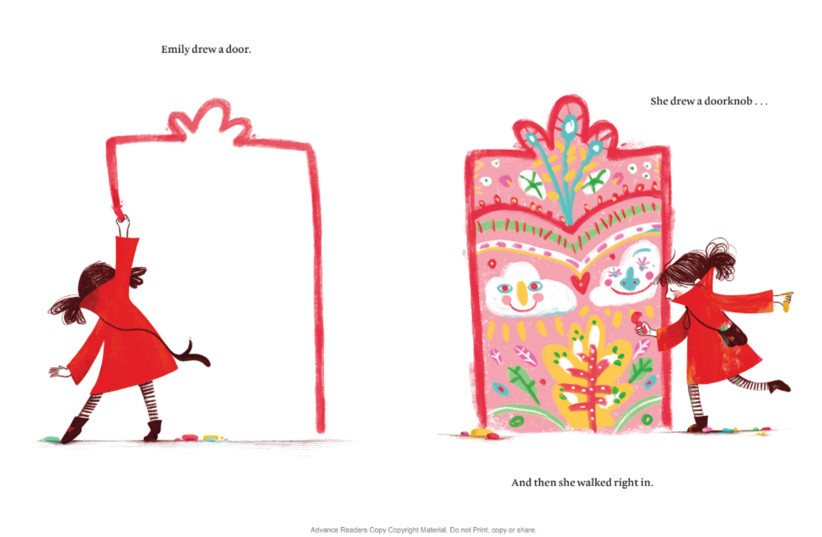
“Finally, she comes to a place without a door. She sees a hopscotch game, takes the chalk she has hidden in her hair, and decides to create a door of her own, adds a doorknob, and goes right in.”
And then, when someone knocks on her door, she is able to welcome them into the beautiful place that she has created herself.
“The door is open!” she tells her visitor.
“So Emily finally also opened the door for me,” Rosenberg stated. “Emily ended up telling me what to write, and she is still with me.”
The book’s illustrator, Orit Magia, breathed crucial, additional life into the Emily framework that Rosenberg had created, he said.
The author cautioned, “You have to be willing to lose your story in the hands of the illustrator.”
He elaborated, “After Emily creates her own door and walks in, Orit decided to dedicate another double spread to Emily drawing a world of her own. This was not in my original text, but if you ask me, it is the most beautiful part of the book.”
It has been quite a journey for Rosenberg. “I feel incredibly fortunate to have come this far, even though it has taken me most of my life to finally break into the world of children’s books!”
Following the outstanding success of the original Hebrew version of Emily Saw a Door, published in 2023 by Tal-May, the English version will hit bookstore shelves in North America on February 24.