
Soldiers from the IDF Paratroopers Brigade’s 202nd Battalion carried out a drill this week in which the battalion, together with its equipment, was transported on Karnaf and Shimshon transport aircraft to a combat zone.
Since the beginning of the war two and a half years ago, the Paratroopers Brigade had not practiced landing a paratrooper force with its heavy equipment in a combat zone using transport aircraft.
During October 7 and throughout the war, the Air Force, using Shimshon and Karnaf transport aircraft, carried out numerous troop movements to combat zones.
In one case, near Kibbutz Alumim, an Air Force Yasur helicopter that had landed soldiers from the Paratroopers Brigade’s 890th Battalion, who had arrived to fight in Kibbutz Be’eri, was hit. The helicopter was struck by an anti-tank missile. It caught fire, and apart from the pilot, who was lightly wounded in the hand, none of the soldiers or crew members were injured.
"It is a drill that is broken down into elements," deputy commander of the 202nd Battalion, Maj. P. described. "Two planes arrive at a building in Hatzerim; from there, vehicles are loaded, and they practice entering with a force. Along with the forces, we practiced loading and unloading in the field. For the infantry forces, it is important to carry out drills so they will be prepared for every scenario and every development in all sectors."
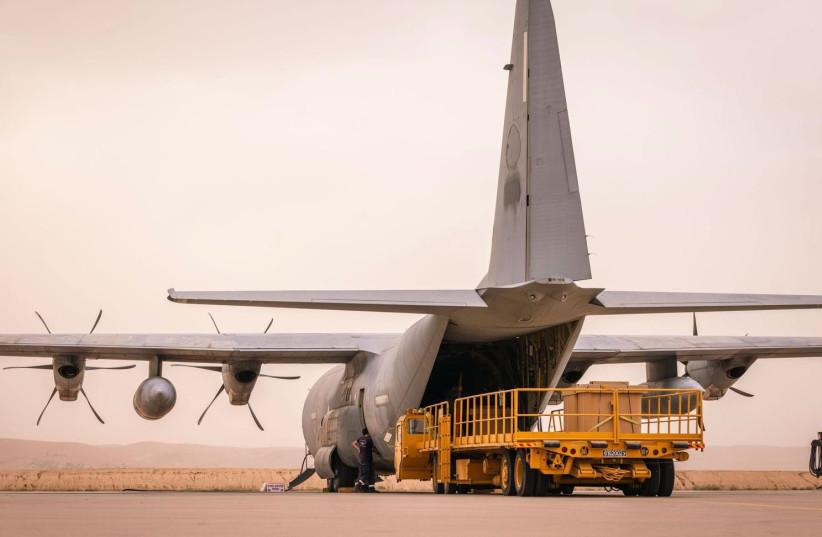
Landing military forces with equipment is a complicated procedure, pilot says
Capt. D., a pilot in Squadron 131, said that over the past two and a half years "there have been many operations that included flying soldiers to sectors, also through platforms. Including in the current war."
He described the complexity of landing a large military force together with its equipment, saying, "Loading the vehicles, each vehicle has its own complexity, and obviously once you get closer to the ground, things become more complicated."
"From our perspective, it is about how we take operational tools out for training while carrying out operational activity," Maj. P. added, describing the complexity from the paratroopers’ side. "The drills for linking up with the aircraft are something we have not practiced for two years, from preparing to unload to what equipment they take."
IDF emphasizing connection between Air Force, ground forces
This week’s drill is part of the change taking place inside the IDF, with an emphasis on the close operational connection between the Air Force and ground forces.
Capt. D. said that, "Since October 7, the connection with the paratroopers has been very strong, and we are assisted by them a great deal. P. and I have been friends since Bahad 1. P. is a friend from the officers’ course, and they have been in contact since then. The squadron is very connected to the ground forces, both in logistics and supply missions, flying troops and vehicles, and in additional missions. On a personal level, it is very moving to know that the squadron is taking an active and meaningful part in the mission of assisting the maneuver, certainly as an officer who served in the ground forces. It is no less moving to fly a friend who served together with me on the team."
"We neglected many things related to our readiness because of the operational need, and the operational calm allows us to invest in additional things," Maj. P. added. "I am putting aside everything related to the world of aviation; the very interface with the forces is important. We want to train for the most extreme scenario that could be; we always want to improve cooperation with the planes."