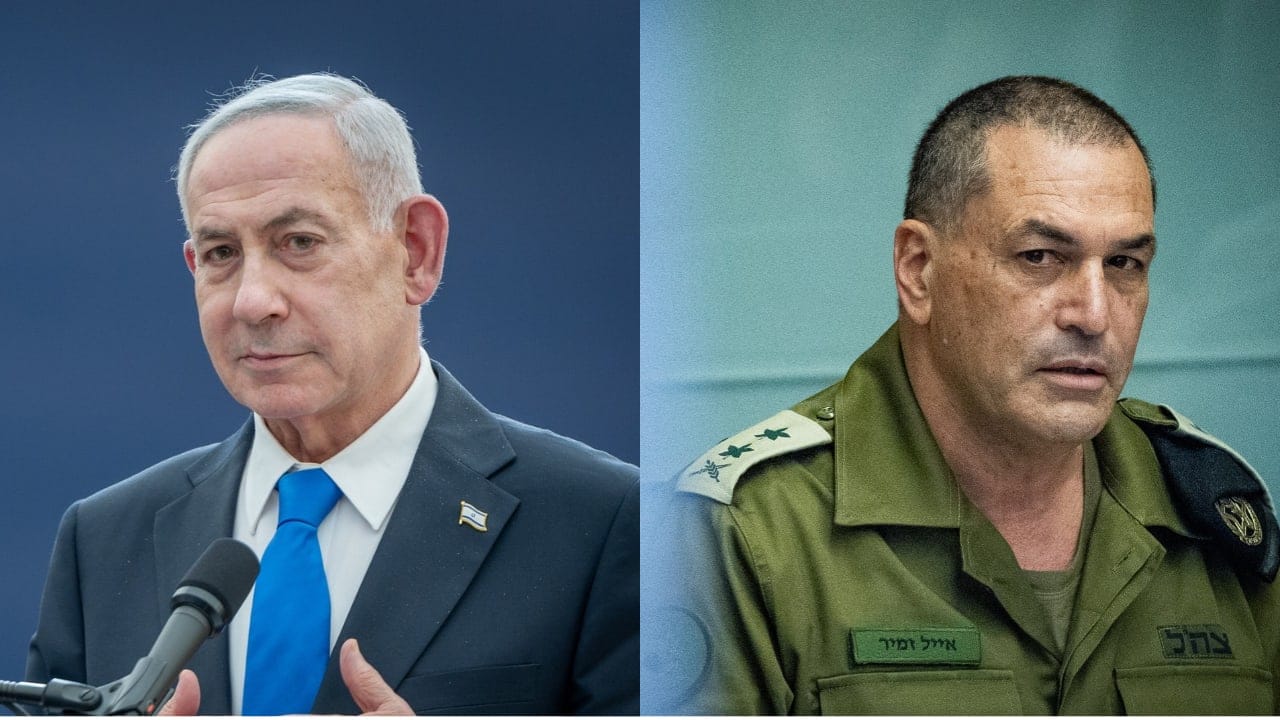
Prime Minister Benjamin Netanyahu and IDF Chief of Staff Lt.-Gen. Eyal Zamir clashed over a military action that could renew the conflict with Iran days before Israel's elections, N12 News reported Sunday evening.
Recently, Zamir received a directive from the political echelon to carry out an action, which security officials told N12 would "trigger a rapid escalation into a confrontation with Iran."
Due to the sensitive nature of the action, N12 reported that Zamir requested an in-depth discussion and formal authorization before moving forward with the action.
Sources familiar with the details told N12 that Zamir and additional IDF leadership are concerned that the political echelon may be trying to exploit the front with Iran ahead of elections for political gain.
Netanyahu denied the report late on Sunday night, saying on Channel 14’s The Patriots that “there is no confrontation” and that “someone is trying to obscure the fact that Zamir himself had said Iran was attempting to interfere in the elections.”

US President Donald Trump and Zamir have, at different points during the election season, acted as constraints on Netanyahu’s approach regarding aspects related to a potential renewed conflict with Iran.
It remains unclear how far Netanyahu would have been willing to go if he had not anticipated that certain figures would place the brakes on certain actions.
The prime minister would have welcomed a US return to war with Iran in August, earlier in October, and again more recently. In some of those scenarios, Israel would have been prepared to join the US.
Netanyahu may also have played with the possibility of Israel taking a leading, ‘first-attacker’ role, or serving as a spoiler to prevent versions of an Iranian nuclear deal which he would view as a bad deal.
In all of these discussions, Trump, while vacillating, has ultimately, to date, come out in trying to continue to stare down Tehran with a mix of military threats and economic pressure.
Likewise, in all of these decisions, Zamir has had Israel on a war footing versus Iran if necessary, but has viewed the meaning of "necessary" before Election Day in a limited fashion.
To avoid interfering with the election, and given that Iran poses no immediate existential threat since prior Israeli attacks have pushed back its nuclear and ballistic missile threats, Zamir has only been ready to attack Iran if two conditions were met: If Iran were preparing to strike Israel, or if Trump initiated a new round of fighting and Israel had full US backing for both offensive and defensive operations.
Generally, Zamir's instinct has been that he is ready to strike Iran if it starts recovering its threat capabilities too fast, which it has not yet done, or if such a strike would be part of a well-thought-out and considered strategy to finally push Tehran into making key nuclear concessions to the US.
More broadly, Zamir has viewed military action as potentially justified if Iran rapidly rebuilt its nuclear and ballistic missile capabilities or if a strike formed part of a carefully considered strategy to compel Tehran to make significant nuclear concessions to Washington. Previous Israeli attacks have set back Iran’s capabilities, reducing the immediate urgency for another round of strikes, according to this assessment.
The requests for formal authorization and an in-depth discussion, as reported by N12, could serve to clarify the government’s intentions and ensure that any military action had a clear legal and strategic basis.
The report further described ‘new lows’ in the Netanyahu-Zamir relationship.
Netanyahu selected Zamir to lead the military because he was his personal military secretary, and for the latter’s known aggressive approach to warfare. The prime minister partially alienated the IDF chief by refusing to draft haredi (ultra-Orthodox) men into the IDF and allowing Defense Minister Israel Katz to politicize certain key military appointments.
Zamir has likewise partially alienated Netanyahu even before this point, by slowing the Gaza war in late 2025 and by pressuring him over the haredi conscription issue.
Eisenkot warns Netanyahu against using IDF as political tool
Yashar party chairman Gadi Eisenkot on Sunday night said he supports Zamir's decision to be cautious, warning Netanyahu against putting his political interests above the state's.
"Netanyahu, my eyes are on you," stated Eisenkot. "The man, on whose watch the greatest disaster in the nation’s history occurred, refuses to grasp that Israel’s security is not a political plaything; that the lives of Israeli citizens and IDF soldiers are not to be treated with reckless disregard; and that the State of Israel is not his private property."
"I have full confidence in IDF Chief of Staff Eyal Zamir and the IDF commanders, who act with professional responsibility and an absolute commitment to the nation’s security. We will not allow the IDF to be turned into a tool for Netanyahu’s political survival campaign."
"Do not dare to place your own political interests above the security of the State," Eisenkot warned the prime minister.
He added that holding elections according to the set schedule is a "cornerstone of Israel’s national resilience," stating that he "will not let you [Netanyahu] jeopardize Israel’s future just to preserve your own rule."
"In two days, the citizens of Israel will put an end to this era of reckless, lawless governance and restore responsibility, a sense of statehood, and the security of Israel," Eisenkot said. "I give you my word."
Betrayal of state, security
The Democrats party chair Yair Golan echoed Eisenkot's support for Zamir's caution in a Sunday night post on X/Twitter, saying that he wholeheartedly backs Zamir for "standing firm on his professional duty."
"It is forbidden to allow any military action that lacks a clear security need, a strategic purpose, and a responsible action plan behind it," Golan wrote. "When Israeli citizens go to the polls next Tuesday, they must remember this: Netanyahu constitutes a security threat to Israel. He does not hesitate to sacrifice the lives of our children for his survival on the eve of elections, and this is what the IDF is trying to thwart."
"Israel's security is in the hands of a corrupt political echelon, unfit and deranged people who do not hesitate to sacrifice Israel's security in order to cling to their seats."
Yisrael Beytenu head Avigdor Liberman called Netanyahu's attempt to "drag Israel into military action in order to prevent the elections" an act of "betrayal of the state and its security."
"The duty of the chief of staff is to prevent the political use of the IDF and to safeguard the lives of IDF soldiers, not endanger them because of the prime minister's fear of losing the elections."