
Yisrael Beytenu chairman Avigdor Liberman warned on Monday that an independent Israeli strike on Iran without US participation would constitute a manifestly illegal act if driven by political considerations, raising concerns that Prime Minister Benjamin Netanyahu could seek military action as a way out of his political crisis.
Liberman made remarks earlier on Monday during a classified discussion of the Knesset Foreign Affairs and Defense Committee's Intelligence Subcommittee, attended by IDF Chief of Staff Eyal Zamir and Knesset Speaker Matan Kahana.
Later, at a faction meeting closed to the media, he addressed the possibility of an independent Israeli strike on Iran and warned that such a decision could stem from political and personal considerations.
"Recently, reports have appeared in the American and Israeli media regarding chemical weapons that Iran is trying to obtain," Liberman told members of his faction. "If this is true, it is a serious threat, but not one that necessitates or justifies immediate independent action without American participation."
"If such a decision is made by the cabinet, it will be a decision stemming solely from political and personal interests, and therefore such a decision must be treated as a manifestly illegal order," he added.
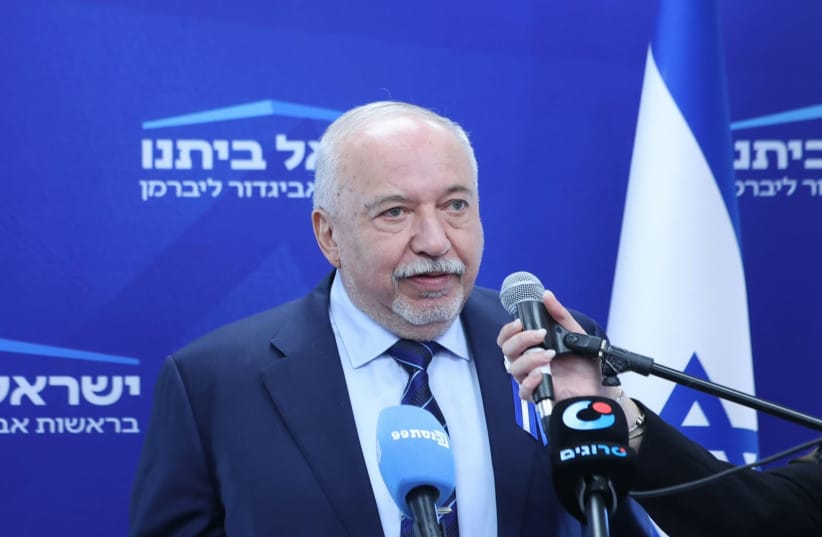
Liberman went on to express concern that Netanyahu could view an attack on Iran as a way out of the political crisis.
"The concern is that Netanyahu may see an attack on Iran as his last political way out. If he decides to attack Iran independently, without cooperation with the US, it would be a manifestly illegal act," he said.
Eisenkot: 'I do not see a direct and immediate threat'
Gadi Eisenkot also addressed the Iranian threat during a faction meeting on Monday.
"Regarding Iran, I do not currently see a direct and immediate threat to the State of Israel that requires action before the formation of a government. The most serious threat from Iran is those 440 kilograms of enriched uranium that have still not been destroyed or removed. We need to focus on them," Eisenkot said.
Netanyahu, meanwhile, addressed the security threats facing Israel and the need to establish a unity government during a Likud faction meeting on Monday.
"An overwhelming majority of the country's citizens who see Israel as the nation-state of the Jewish people yearn for a unity government. This yearning stems from a simple understanding that our ability to secure our future in the face of the great threats surrounding us depends on our unity."
"Those who downplay these threats and dismiss them do so for political reasons. And this yearning also stems from the desire to reach agreements that will put an end to the divisions among us. That is why, even during the election campaign, I said that our mission was to establish a broad national government, and I repeated this immediately after the election results were published.
"To bring about a national unity government, each side must show the flexibility needed to reach agreements, including on the issue of military conscription, where we must reach an agreement together with our haredi brothers. They must be part of the unity government," Netanyahu said.
Netanyahu reportedly pushing for short, intensive strike on Iran
On Saturday, Western diplomatic sources told senior political commentator Ben Caspit and Al-Monitor that Netanyahu was pushing for an immediate, brief, and powerful strike against Iran, amid growing concerns in Israel over Tehran's intentions to develop chemical and biological weapons and fortify the site at Mount Pickaxe.
While those concerns are rooted in intelligence assessments of the Iranian regime's intentions, political considerations in both the US and Israel are significant factors in any decision by the two countries to attack Iran, the sources acknowledged.
Israel is attempting to convince the Trump administration that it faces a window of opportunity to act before Democrats take control of Congress in January and prevent US President Donald Trump from renewing the war with Iran, a senior Israeli official told Al-Monitor on condition of anonymity.
At the same time, the official acknowledged that the Americans were suspicious of Netanyahu's urgency in pressing Trump to authorize strikes immediately, amid concerns that the Israeli prime minister wanted to bring the country into a state of war to remain in power.
According to the Western diplomatic sources, Israel's latest proposal to the Trump administration calls for an intensive bombing campaign lasting four to seven days, rather than an all-out war.
"There are things that must be done to erode Iran's capabilities and prevent it from making its facilities immune, and this can be achieved in a relatively short time and at low cost," the Israeli official said, explaining the proposal Israel had presented during recent high-level talks with Washington.
According to the official, the Americans are primarily concerned not with the duration of the proposed military campaign, but with whether it would stop Iranian attacks on vessels in the Strait of Hormuz and ensure an uninterrupted flow of oil.
The Israeli official also noted that Netanyahu's envoys, newly appointed Mossad chief Roman Gofman and former strategic affairs minister Ron Dermer, had encountered skepticism regarding the prime minister's motives during recent contacts and meetings in the US and elsewhere.
"Suddenly there is an unusual sense of urgency, and suddenly we absolutely must strike right now, lest the Iranians do terrible things," a senior Israeli political source told Al-Monitor on condition of anonymity.