In the high-octane, razor-thin world of alpine skiing, where races are won in the milliseconds between a sharp turn and a desperate tuck, the most formidable obstacles aren’t always the icy gates or the vertical drops. Sometimes, they are the dates on a calendar and the heavy, visceral pull of a heart left back in the Middle East.
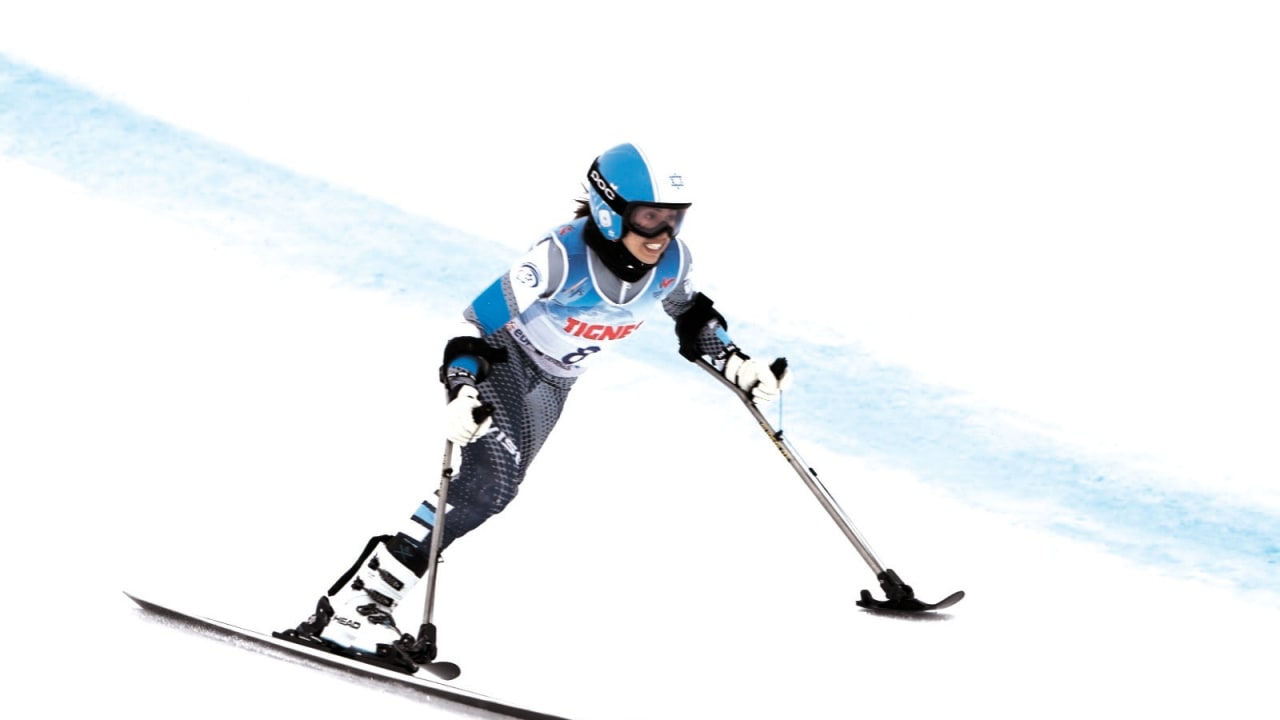
Meet Sheina Vaspi. She is 25 years old, a Chabad-raised pioneer from Yesud HaMa’ala, and currently the only person on the planet ensuring that the blue-and-white flag flies over the slopes of the 2026 Winter Paralympic Games in Cortina-Milan.
But as she navigates the “ice-rink” conditions of the Italian Alps, Sheina is carrying far more than just her expensive carbon-fiber equipment. She is carrying a nation in the throes of a historic conflict, the memory of fallen loved ones, and a religious conviction that occasionally dictates she skip the biggest races of her life.
“It’s a mission from above”, Sheina says, speaking over the rhythmic hum of a physiotherapy session in Italy. She arrived two months early to acclimatize, trading the Galilee for the snow-capped peaks. “Being the only representative is a massive responsibility, especially now. My heart is in Israel; my family is in Israel. There’s a natural pull to be home, but that only gives what I’m doing more meaning.”
To understand the sheer improbability of Vaspi’s career, one must look at her “origin story”, which sounds less like a professional athlete’s resume and more like a series of divine interventions. Growing up in a religious home without a television, the word “Olympics” wasn’t part of her vocabulary.

At age three, a car accident resulted in the loss of her left leg. In many worlds, that would be the end of a sporting narrative. In the Vaspi household, it wasn’t even a speed bump.
This resilience is etched into her DNA. Sheina is the granddaughter of the legendary Yoav Vaspi, a decorated tank battalion commander in the IDF. Major Yoav Vaspi was posthumously awarded the Medal of Courage (Itur HaOz) for his heroic actions on the northern front during the 1973 Yom Kippur War, where he fought valiantly until he was killed in battle.
Sheina Vaspi's path to the paralympics
For Sheina, the legacy of a grandfather who sacrificed everything for the defense of the North isn’t just a family story; it’s a standard of bravery she brings to the starting gate.
“I’m lucky I was born to my parents”, she says with a dry wit that underscores her resilience. “The word ‘handicapped’ was never uttered. When they bought my sister her first bike, they bought me one too. There was zero difference.”
She didn’t touch a ski until she was 16, a geriatric start in a sport where elites are usually on boots by age three. It wasn’t a burning passion for the cold that drove her, but a suggestion from a relative, Amit Mizrahi, a volunteer for the Erez Association (now the Shevet Foundation).
From the Hermon to the high-performance camps of Colorado, Sheina’s ascent was vertical. By 19, she had moved to the US to train seriously, eventually realizing she wasn’t just “participating”, she was beating girls who had been born on the snow.
To appreciate where Sheina stands today, one must look back at the surreal landscape of Beijing 2022. It was there that she officially became the first Israeli to ever compete in the Winter Paralympics, a milestone that resonated far beyond the sports world.
The conditions in Beijing were, in a word, antiseptic. “It was the COVID era”, she recalls. “Everything was sterile, quiet, and isolated. There were no families in the stands, no roar of the crowd. It was just you and the mountain”. Despite the eerie atmosphere, Vaspi delivered a performance that defied her limited experience. At the time, she had only two professional seasons under her belt, a blink of an eye in alpine terms.
Competing in the Giant Slalom, she navigated the technical “Ice River” course with a tenacity that surprised the international circuit. She finished in a respectable 15th place, but for Sheina, the number on the scoreboard was secondary to the statement she made.
“In Beijing, I was still learning how to stand in the starting gate, how to read the gates, how to breathe under that specific kind of pressure,” she explains. “I was a novice among giants. But crossing that finish line and seeing the Israeli flag on the screen, that was when I realized this wasn’t just a hobby. It was a career.”
That 15th-place finish served as the “proof of concept” for Israeli winter sports. It wasn’t just a historic appearance; it was a competitive one. It proved that a girl from the Galilee could hold her own against veterans from Austria, Switzerland, and the US. Beijing wasn’t the destination; it was the foundation.
The road from Beijing to Cortina wasn’t just paved with snow; it was paved with grit and medical tape. A year ago, Sheina suffered every skier’s nightmare: a torn ACL. For a para-athlete who relies entirely on one leg for balance, speed, and navigation, this wasn’t just an injury; it was an existential crisis.
“I’m coming back from a place of deep fear”, she admits candidly. “Before the injury, I didn’t know what fear was. I just chased speed. After the surgery, the fear of falling again started to trickle in. It’s a new opponent I have to face on every run.”
Her support system is small but formidable. Her physiotherapist, Dr. Ronnie Kiek – a former Israeli alpine skier herself – is her shadow in Italy.
“Sheina is a pure ‘player,’” Kiek says. “In this sport, you need a specific kind of mental hardness to hurl yourself down a mountain at 100 km an hour on one leg. She has it. But more than that, she has the soul of a fighter. My job isn’t just fixing the knee; it’s keeping the fire lit.”
Vaspi’s career is defined by a unique set of constraints. She famously fought the International Paralympic Committee for the right to wear a skirt over her sleek racing suit for reasons of modesty. While she admits she wears it less frequently now to shave off precious seconds of wind resistance, her commitment to her faith remains unshakeable.
This week, as the world’s eyes turn to the Downhill and Slalom events, Sheina will be nowhere near the starting gate.
They fall on Shabbat. For an elite athlete at the peak of a four-year cycle, missing a podium opportunity is usually unthinkable. For Sheina, it’s a non-negotiable appointment with the Divine.
“I’ve been doing this my whole career,” she says calmly. “I’m a believer. If God wants the race to happen for me, He can change the weather and delay the event. There’s a saying: ‘More than the Jewish people have kept the Sabbath, the Sabbath has kept the Jews.’ In a sport this dangerous, I feel that Shabbat is my protection from above.”
The 2026 Games feel different than Beijing 2022. Back then, the world was sterile, locked behind COVID protocols.
Today, the world is loud, and for an Israeli athlete, often cold in ways that have nothing to do with the temperature.
“I put a giant Israeli flag on my helmet”, she says. “I want it to be at the top, literally and figuratively. When I’m on that mountain, I am the flag.”
The last two years have been grueling. During the current conflict, Sheina lost her cousin, Arnon Benvenisti Vaspi, a soldier who exemplified the same “no-excuses” excellence Sheina strives for. Shortly after, her grandmother, Sarah, passed away.
“My grandmother told her doctors she wanted to live just long enough to see me in this Olympics,” Sheina recalls, her voice softening. “Arnon’s motto was ‘If you want it, you can.’ I don’t see their memory as a burden. I talk to them on the mountain. I ask them to glide with me, to push me, to keep me safe. Every run is with them.”
European snow is notoriously different from the “champagne powder” of Colorado.
“In Europe, the snow is like an ice rink”, Sheina explains. “Every mistake is magnified. You feel every bump in your bones.”
Despite being the sole representative, she doesn’t feel alone. She is part of a global community of para-athletes, though she admits that the lack of a large Israeli delegation is something she hopes to change. “We need more than just heart; we need budgets and sponsors. We need people to realize that winter sports aren’t a gimmick, they are a platform for Israeli excellence”.
When pushed for a prediction, Top 10? Top 5? A miracle podium? – Vaspi dodges with the grace of a veteran slalom pro.
“I can only control my 100%. I don’t know what 100% of my competitors will look like. My goal is to finish the run and feel like I brought all five years of training, all the knowledge, and all the soul into the track.”
Sheina Vaspi is a study in contradictions: a Chabad woman in a secular sporting world; a daughter of a desert nation reigning on the ice; a fierce competitor who will walk away from a gold medal if it conflicts with a Friday sunset.
As our conversation nears its end, I ask what she misses most while living out of a suitcase in Colorado and Italy. The answer isn’t the Mediterranean sun or her mother’s cooking.
“Cottage cheese,” she laughs. “Israeli cottage cheese. You can’t find anything like it abroad.”
This week, when Sheina slides into the starting gate, she won’t have her cottage cheese, and she won’t have a stadium full of Israelis cheering her on in person. But as she stares down the icy pitch of Cortina, she knows exactly who she is, who she represents, and, most importantly, who is watching over her from above.