
For more than a decade, my work as a travel photojournalist has taken me to places where nature strips people down to their essentials. Over the past year, that journey sharpened into a deliberate exploration of how wild environments, intentional distance, and structured community can function as practical tools for healing trauma.
That exploration was never detached from home. Moving through remote landscapes and emerging wellness models, I kept returning to Israel and what our people have been through. I became convinced that healing, especially for those who carried the war on their bodies and in their souls, would become one of the central national challenges of the years ahead.
Since Oct. 7, that realization is no longer theoretical: It demands a response.
Adventure, trauma, and the pursuit of wellness
The emotional cost carried by Israel’s combat soldiers is not abstract. It lives in their bodies and their silence; in the difficulty many face when attempting to return to ordinary life after giving everything. Those who paid the highest toll are often the least equipped to articulate it.
Existing frameworks in Israel are under strain, and the scale of this moment demands new thinking, new spaces, and models that are both professional and humane.

For decades, tens of thousands of young Israelis have marked the end of service by traveling abroad. Since the war, many combat soldiers leave Israel carrying unprocessed trauma, moving directly from an intense, life-threatening reality into the freedom of the world outside.
Without a structured transition, that gap can become dangerous. In uncontained environments, the search for quiet can slide into disconnection, and the absence of boundaries can lead to unhealthy coping mechanisms, including substance use, isolation, and emotional collapse.
It was through this movement of Israeli backpackers that the story of Retreat Lochamim (Fighters’ Retreat) began.
Rabbi Yariv and Lital Klein did not set out to build a retreat. Over more than a decade, they hosted tens of thousands of Israeli travelers through their Chabad House. After the Israel-Hamas War, they began encountering combat soldiers arriving with burdens far heavier than familiar post-army fatigue. Panama wasn’t where this story began: It was where the need finally took shape.
That understanding led me across the world, from Israel to the Pacific coast of Panama, to a place called Playa Venao.
Playa Venao: The origin of Retreat Lochamim
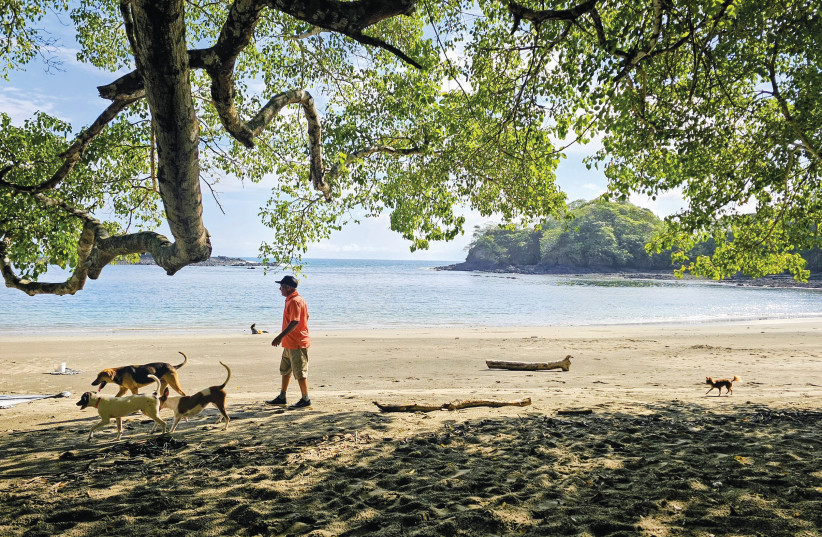
Playa Venao sits far enough off the map that you have to mean it if you want to go there. The road narrows as you leave the highway, the jungle thickens, and the air grows heavy with heat and moisture. Then the Pacific opens up and long lines of waves roll toward a wide beach.
The retreat is held in a private villa compound on a quiet stretch of coastline, away from crowds. The setting is not a luxury detail. This is part of the clinical logic: silence, routine, and a protected perimeter that allows the nervous system to downshift before deeper work begins.
This is where Retreat Lochamim operates: a structured, research-backed retreat for IDF combat soldiers navigating PTSD, emotional collapse, numbness, hyper-alertness, insomnia, and profound loneliness.
The retreat grew organically, shaped by who kept arriving at the Chabad House, and emerging from what the Kleins witnessed. For years, their Chabad House was a landing pad for Israeli post-army travelers. But after the war, something shifted. Soldiers were no longer arriving simply to decompress: They were arriving wounded in ways that were difficult to identify.
Rabbi Klein described it to me as “a change in the soul.” Soldiers avoided eye contact. Many were emotionally distant, unable to articulate what they carried. Some appeared numb, others hyper-alert. Loneliness often outweighed physical exhaustion. Bar Yohanan, part of the retreat’s operational leadership, described rising patterns of depression and behavior that no longer matched the familiar post-service profile.
What united these soldiers was not a single battlefield story but a shared inability to process what they had returned with. Many had gone to reserve duty and come back different, without having a language to express that difference.
In Israel, few felt they had a safe platform to speak openly. Judgment, expectations, and unit dynamics often silenced them.
Rabbi Klein recognized that this was no longer a matter of hospitality: It was an emergency unfolding quietly, traveler by traveler. He began raising support in Panama City, describing the moment not as a strategy but as a call to mission. What became clear was that warmth alone was not enough – what was needed was structure.
Retreat Lochamim became that structure: a first-of-its-kind model designed for combat soldiers who need emotional healing through a supportive community and disciplined, body-based experiences. It is built around sequence: moving soldiers from guarded survival into regulated presence, and from isolation into belonging.
The program is supported by integrative academic research conducted through Ben-Gurion University of the Negev.

In January 2026, a research article by Prof. Nurit Zeidman summarizing the first year of a three-year study was published. The paper examines the effect of surfing after group processing circles were held, exploring how the combination functions as a trauma-treatment sequence rather than separate activities.
Building trust: Clinical discipline and the road to the discussion circle
When I arrived to document and understand the retreat, I was not allowed to participate in its first three days. The decision came from clinical discipline.
The opening phase is sealed. No observers. No journalists. No visitors. Only the participants and the therapeutic professionals guiding the process. Being asked to step back did not feel like exclusion – it felt like discipline. The retreat’s first loyalty is to the internal safety of the group, not to documentation.

Roni Yaari, a yoga, meditation, and somatic instructor, explained the logic: “We won’t do deep work, like intensive rebirthing, on the second day. First, the greenhouse must be ready; the womb must be ready.” Intensity without containment, she said, can do harm.
The first three days are devoted to building trust. Combat soldiers are grouped with others who share similar service backgrounds. Shared reference points allow trust to form quickly. Silence does not require explanation.
Throughout the week, alcohol and drugs are strictly prohibited. The retreat insists on clarity, so emotions can surface without distortion. The process is designed to remain clean and unfiltered, allowing participants to stay present with their emotions without numbing or distortion.
My most direct interaction with participants came before the retreat began. I joined the shuttle from Panama City to Playa Venao, a long drive that gave space for silence and for stories to surface.
The men in that van came from everywhere. The youngest was 22; the oldest, 42. There were tank commanders, infantry soldiers, and veterans of elite units. Some had only recently left Israel; others had been traveling for months.
One man beside me said he had slept no more than two hours a night for the past two years. A combat tank sergeant. Always responsible. He had recommended the retreat to soldiers under his command before finally allowing himself to come. “This is the first thing I’ve done only for myself,” he told me.
By the time we reached Playa Venao, nothing had been resolved, but something had shifted. Strangers had become familiar; differences began collapsing into recognition.
The retreat experience: Six days of structure, bodywork, and community
When I saw the group again after three days, the change was visible. Shoulders lowered. Eye contact steadier. The intensity had redistributed.
Michal, a clinical social worker and emotional affairs officer in the reserves, articulated the core injury: “The main injury is to trust. Trust in myself, in those above me, and in people. Relationships are injured, and relationships need space where people can be trusted again.”
Shabbat marked an emotional peak. The Chabad House filled up on Friday night, and the retreat participants were joined by additional elite combat soldiers connected to a separate community-led initiative called Masa Leiter (Leiter’s Journey). Another process, another circle, under the same roof. It did not dilute the experience. It revealed what Venao has become – a place capable of holding parallel needs without confusion.
Panama offers Jewish infrastructure, cultural familiarity, and enough distance to loosen the grip of routine. When soldiers are removed from familiar geography and social roles, expectations loosen and defenses soften. There is room to feel without the immediate demand to function. This disconnection is not indulgence; it is a starting condition for healing.
While the retreat is meticulously structured, it is also held by the local Israeli community in Playa Venao, a committed network of families and professionals who have made the project a shared responsibility.
Physiotherapist Rotem Sol works directly with participants, focusing on the body, often the first place where trauma speaks.
“When a soldier arrives, the whole community mobilizes,” she told me. “That is what makes the model work. It is a home.”
The support network extends beyond Venao. The Jewish community of Panama City has helped fund the project, with restaurants and families hosting soldiers upon landing. The initiative also receives active support from the Israeli Embassy in Panama.
Retreat Lochamim runs for six days under the professional supervision of Dr. Lia Naor and is studied as a unified system within a doctoral research framework at Ben-Gurion University of the Negev.
The week follows a consistent rhythm: morning meditation and yoga, group circles to process war experiences, then body-based work that reinforces what words alone cannot carry. The toolkit includes surfing, breath-based work, ice baths, body treatments, and evening practices that support integration, including a bonfire circle and a future vision board at the close of the retreat.
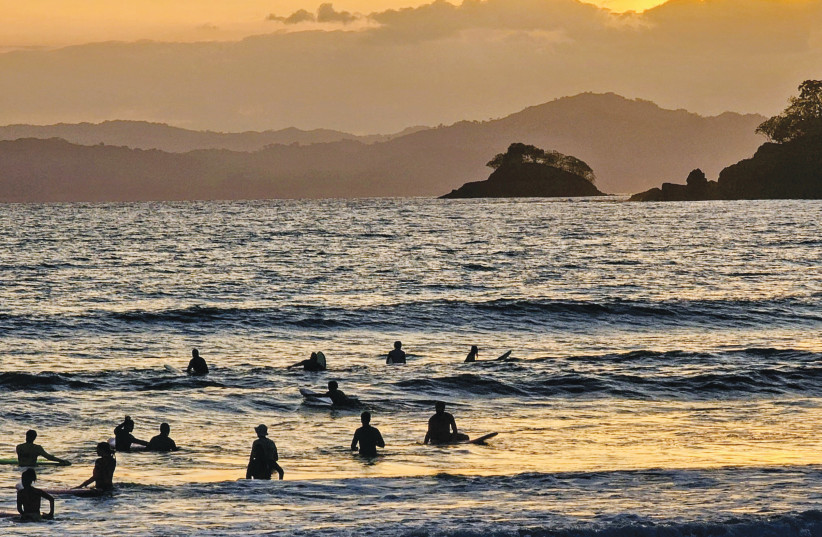
Yohanan described the structure: “We begin with the mind: the discussion circle. On top of that come the body and spirit. After the circle, there is surfing.” The sequence matters. Language without grounding drifts; bodywork without reflection can remain locked.
Michal followed the group from the opening discussion circle to the final one. At the start, soldiers arrived guarded, carrying skepticism and defenses shaped by years of service. Trust was limited. Openness was cautious.
By the final day, that posture had shifted. A cohesive group formed, grounded in shared language and mutual recognition. Trust developed both in the professional team and between participants. Soldiers committed themselves to the process, to the group, and to themselves.
Michal also described what she witnessed between the first circle and the closing one on day six. “They started as strangers,” she said, “different in age, personality, and the units they came from, and they finished as a cohesive group with a shared denominator and a real group to continue with.”
The early armor – skepticism, cynicism, quiet judgment about who carried more or less – gradually dissolved as safety took hold. Soldiers learned an emotional language many had never used: how to name a trigger without collapsing into it, how to share without performance, and how to listen without trying to fix. The shift was not sentimental. It was measurable in the room: more eye contact, more patience, more willingness to be seen.
For many, the week included first-time experiences that were intentionally framed as confidence-building rather than thrill-seeking: paddling into waves, rebirthing breath work, ice baths, even standing on nails. Even participants who had done some of these before described the difference here: the same practice, inside a protected container, with a team that watched the nervous system as closely as the story.
By the end, Michal said, the most important change was relational: trust in others returned, the sense of loneliness softened, and the feeling of being “broken” became less absolute. “It was far beyond expectations,” she concluded.
Yaari framed her role as giving soldiers tools they could carry home: “Through breathing, I can return to some kind of zero,” she said. Surfing, the retreat’s most visible element, is not treated as a sport. It is nonverbal therapy. Waves demand presence. They force breath control. They teach surrender without collapse.
The final days focus on transition, preparing participants for the emotional drop that can follow leaving a contained space, and emphasizing connection and continued support. The retreat does not promise closure – it offers direction.
Continuity and expanding the circle
Healing does not end when the retreat does. After returning to Israel, participants are invited into an ongoing support framework. Once a month, alumni gather for six-hour mini-retreats held at centers across Israel, with facilitated circles and practices drawn from the retreat week. The intention is to sustain momentum and keep soldiers connected to a community that understands what they are carrying.
Retreat Lochamim has expanded beyond male combat soldiers. The first retreat for women combat soldiers was held, with another scheduled in the coming months. In November 2025, a dedicated retreat was held for young IDF widows who lost their spouses during the Israel-Hamas War. Each program follows the same principles: structure, containment, and respect for process.
The people who carry it forward: Leadership and a model that can travel
As of December 2025, Retreat Lochamim has hosted more than 150 combat soldiers across 14 cycles, with hundreds more applying. The growth has been organic, driven by word of mouth. Operationally, the model now runs at a steady pace, with about two retreats each month, each serving 12 soldiers.
Yohanan described the demand: “My registrations fill up by themselves. For every retreat, I have over 40 people registered and only 12 spots. This is word of mouth, and it reflects the national need.”
Tzachi Banay arrived in the first cycle after months of reserve duty, carrying exhaustion and uncertainty. During the retreat, something aligned. He stayed on and now manages kitchen operations and logistics, present in every cycle since. His role is not clinical, but it is essential.
Klein described another long-term trajectory. A Supernova music festival survivor and combat soldier diagnosed with PTSD arrived unable to fly alone. After the retreat, he remained in Venao for a year, integrated into the community, learned to surf, and gradually rebuilt his confidence. He later returned to Israel and now speaks publicly about his journey. “Seeing that two-year trajectory proves the strength of the model,” the rabbi said.
What I encountered in Playa Venao is not a location-specific miracle. It is a model built on four elements: a trusted Jewish home, a committed local Jewish and Israeli community, professional trauma-informed leadership, and a wild natural environment that intensifies experience.
Surfing the waves can be replaced by mountains, desert, snow, or rivers. What must remain constant is structure, clear boundaries, and respect for process.
The global Chabad network already provides much of the necessary infrastructure. Retreat Lochamim demonstrates how that infrastructure can be activated with professionalism rather than improvisation, and with a clear understanding that hospitality alone is not treatment. The vision is to share this model with organizations in places where Israeli soldiers already travel, including India, Thailand, North and South America, and Australia.
The model is already moving outward. The team is scheduled to fly to Sydney to teach trauma-coping tools for leaders of Sydney’s Jewish community following the terrorist attack at Bondi Beach during Hanukkah.
Toward a sustainable blueprint and national resilience
Two directions stand out for expansion without losing integrity.
First, formalize an Ambassador Program. The most powerful vehicle for understanding this work is not a brochure. It is a soldier who can speak honestly about the journey from collapse to function, from sleeplessness to breath, from isolation to belonging. A structured ambassador track can identify those ready for that role, train them, and bring them into communities through curated events and trusted networks.
Second, develop a mission-aligned “soft landing and taking off” layer that strengthens, rather than competes with, the retreat. Guided nature-based experiences and structured outdoor programming can provide continuity for graduates while creating modest earned income. Done with discipline, this layer can add stability, meaningful roles for veterans, and an added dimension of self-efficacy that supports long-term healing.
Israel is entering a long season of recovery. Reserve duty cycles continue, and emotional processing lags behind operational demands. For many combat soldiers, the battlefield remains present long after the uniform comes off.
Models like Retreat Lochamim are not substitutes for Israel’s mental health system. They complement it by addressing what often falls between categories: the need for distance, containment, community, and a language that allows soldiers to reconnect with themselves without being reduced to diagnoses.
What I witnessed in Panama was recovery, carried out with structure. A remote stretch of Pacific coastline became a place where soldiers could breathe again, speak honestly, fall without collapsing, and begin moving forward with direction rather than avoidance.
For this generation of combat soldiers, that is a core need.
More than 500 soldiers have applied for limited places. Each retreat is intentionally small, usually 10 to 12 participants. Soldiers contribute roughly $500, but the full cost per participant, including staff, accommodation, food, logistics, and programming, is estimated at about $1,850, placing the operating cost of a cycle in the range of $18,000 to $22,000.
Recovery for combat soldiers is not measured in weeks – it is measured in years. Keeping such a protected space open requires stewardship and long-term commitment from those who understand that national resilience is built one healed individual at a time.
If this model is protected, refined, and allowed to grow with integrity, it can become one of the most meaningful contributions the global Jewish community makes to this generation of warriors.
The waves of Playa Venao will continue to break, indifferent to human struggle. What matters is that, for a brief and carefully held moment, those waves are used with intention, turning distance into healing, and helping soldiers return stronger to the lives, families, and responsibilities waiting for them.`