
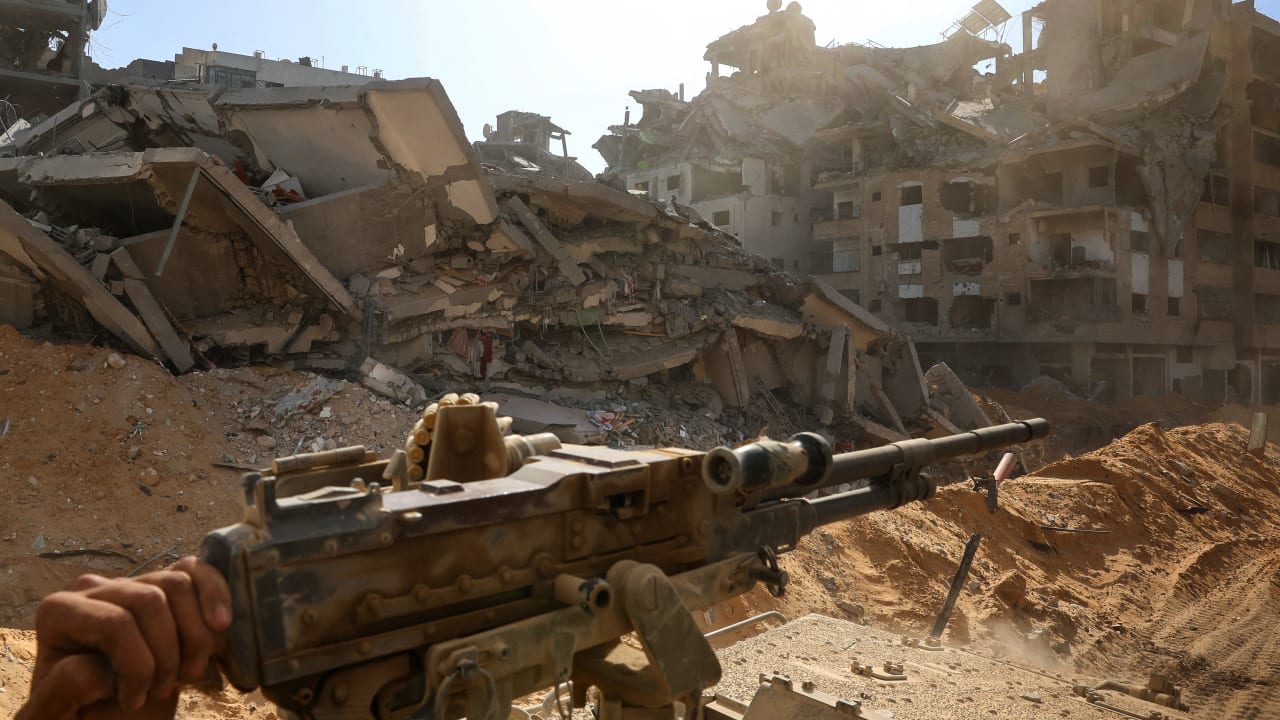

Gaza is now discussed in the West almost exclusively through allegations: war crimes, even genocide. Those are serious claims that require evidence, investigation, and legal judgment. These concepts are not well served by social media verdicts.
However, democracies also have a duty that is less emotionally satisfying and more urgent: to learn from what happened militarily because our own forces could be sent into the next city fight with the same cameras, the same civilian density, and the same enemy tactics.
Western tunnel vision
My upcoming Henry Jackson Society paper, “Tactical Lessons from Gaza,” interprets the 2023–2025 campaign as what it genuinely was: a modern urban war rather than a “policing problem.”
A crucial warning is the need to properly understand the enemy. Hamas is often dismissed as just an insurgency or terror network; however, it initiated the conflict with geographic brigades, battalions, and companies, featuring an organized command structure, fortified defensive positions, and extensive infrastructure.
As NATO forces learned in Iraq and Afghanistan, misclassifying such an opponent will result in inadequate training, improper equipment, and misjudging the true cost of city fighting.
The report also challenges Western tunnel vision. Ukraine has become the blueprint for “future war”: drones, electronic warfare, precision strikes, and attrition.
However, Ukraine is not the only example on the spectrum of conflict. Gaza presents another: intense fighting in crowded neighborhoods, underground maneuvers, and an information war where narratives outrun facts.
NATO might face a Baltic port city, a Middle Eastern metropolis, or an Indo-Pacific megacity. None will look exactly like Ukraine, and that is the point.
Ability to adapt
The most valuable lesson is about organization, not technology: adaptation. The IDF “transformed in contact,” developing new structures for underground operations and fostering changes through layered lesson learning systems.
After deadly surprises, the force was able to pause, share lessons, and swiftly modify tactics. Western militaries need to be honest: Our learning cycles often take months, while procurement processes span years. In urban warfare, that delay can be fatal.
On the ground, Gaza emphasizes that combined arms must operate at the lowest levels. Infantry, armor, engineers, and drones must work as a unified system, street by street, because no single arm can survive alone in narrow streets, rubble, and multi-level threats.

Active protection
My report highlights how active protection systems can even alter the infantry-tank relationship, bringing infantry into a tight protective bubble around armor. It also shows that combat engineering is not merely “support” but decisive: Armored breachers and bulldozers facilitate maneuvers, minimize exposure to booby traps, and make “last-mile” resupply possible when every road move is effectively an advance to contact.
Add drones to this picture, and the character of the fight shifts again: Small units gain their own intelligence and precision, while drone fleets become something like ammunition–wearied, replaced, and issued down to small units as routine equipment.
Nothing here can be separated from legitimacy. Civilian protection is not just a legal duty; it also influences operational freedom. The IDF undertook measures such as advance warnings and legal advisers closer to targeting decisions, and even extensive mitigation can be strategically undermined if the information environment is lost.
Gaza’s propaganda battles, where an explosion can be globally portrayed as an atrocity before evidence is verified, preview what any Western force will face.
That is why recent calls by a small group of retired British generals and activist figures to boycott engagement with the IDF are misguided.
A blanket boycott does not establish legal truth; it simply leads to less learning later, at a higher cost. Democracies have always studied controversial wars, including their own, because the alternative is to repeat mistakes with more soldiers and civilians losing their lives.
The responsible response is critical engagement: absorb what can be learned, reject what is unique to Gaza, and update training and doctrine before the next urban war teaches its lesson in blood.■
Andrew Fox is a retired British Army officer and research fellow at the Henry Jackson Society.