


Over the past two years, Britain’s Jewish community has been subjected to a level of public hostility and antisemitism unprecedented in modern British history, surpassing anything seen since the Jew hatred, massacres, blood libels, and expulsion that took place during the Middle Ages.
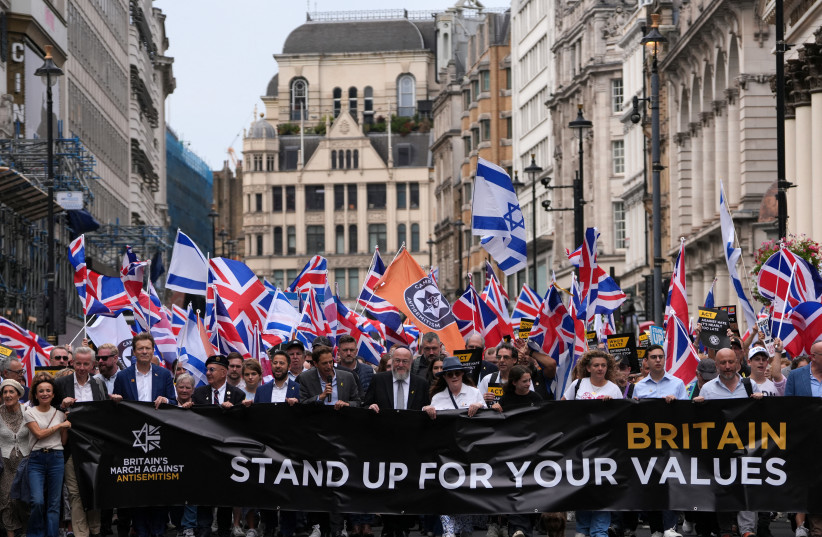
This time around, the Jewish community is not taking the onslaught lying down. It is fighting back, and parts of the government have voiced strong support.
A slow, but undeniable, increase in antisemitic activity in the UK over the 1980s and 1990s led to the establishment in 1994 of the Community Security Trust (CST), a charity dedicated to protecting British Jews from terrorism and antisemitism.
Working closely with the government and the police, the CST provides physical protection for synagogues, Jewish schools, and communal institutions. It also monitors, records, and analyzes antisemitic incidents and extremist activity, publishing widely cited statistics and research reports.
Post-October 7 surge
In the three months following Hamas’s October 7, 2023, attack, the CST recorded a 589% increase in antisemitic incidents in the UK compared with the same period in 2022.
Unlike earlier spikes that faded quickly, CST noted “sustained levels of antisemitism” through 2024, tied to the continuing Israel-Hamas war. Regular pro-Palestinian rallies in London and other cities, with activists displaying anti-Israel banners and shouting anti-Israel slogans, have helped maintain fear and pressure on the Jewish community.
The surge has been visible in schools, universities, workplaces, and on the streets. Online abuse is at an all-time high. Leading community figures, such as CST Chief Executive Mark Gardner, have described British Jews as being “harassed, intimidated, threatened, and attacked” in daily life.
Others repeatedly describe a climate in which many Jews feel the need to avoid certain public spaces on protest days, hide religious symbols, and increase security for synagogues and schools.
The deteriorating situation in the UK recently led Robert Garson, described as a lawyer associated with US President Donald Trump, to declare that “the UK is no longer a safe place for Jews” and suggest they seek sanctuary in the United States.
In an interview with The Jerusalem Post on January 19, he said, “I thought: ‘Jews are being persecuted in the United Kingdom. They fit a wonderful demographic for the United States… So, why not?’”
Good question. There is an answer.
No easy refuge
The notion of the US offering refuge to British Jews is ironic, not to say paradoxical, given that American Jewish communities are themselves experiencing historic highs in antisemitic incidents.
Across many US university campuses, anti-Israel activism and protests have expanded dramatically since October 2023. In New York City, one of the first acts of the newly inaugurated Mayor Zohran Mamdani was to revoke city-level adoption of the International Holocaust Remembrance Alliance (IHRA) definition of antisemitism.
Fleeing across the Atlantic would, as the old English saying goes, be jumping out of the frying pan into the fire.
All the same, a 2025 survey commissioned by the Campaign Against Antisemitism found that some 61% of British Jews had considered leaving Britain in the previous two years. The survey did not record their preferred destination, but it is far more likely to be Israel than the US.
From quiet diplomacy to public action
In the atmosphere of crisis, the body accepted as representing the UK’s Jewish community, the Board of Deputies of British Jews, modified its traditional quiet diplomacy position – often criticized in the past – and adopted a more active approach.
In the week immediately following the October 7 attacks, the Board of Deputies, together with the Jewish Leadership Council, organized a vigil outside Downing Street, attended by around 5,000 people, and a large vigil in central Manchester, to show solidarity with Israel and give public voice to British Jews’ shock and fear. The Board’s then-president, Marie van der Zyl, also issued a public message condemning the Hamas atrocities and stressing the Jewish community’s distress.
The government responded. On February 28, 2024, at the CST annual dinner, then–prime minister Rishi Sunak announced “more than £70 million over the next four years” for the Jewish Community Protective Security Grant, calling it “the biggest single financial commitment any government has made to protect Jewish communities.” The grant was later guaranteed until 2028.
In late October 2025, in partnership with other communal bodies, the Board of Deputies published a document detailing the Jewish community’s vision for strategies to combat antisemitism, focusing on policing and security, extremism, civil society, and schools and universities.
This document drew on months of engagement with ministers and officials following the deadly attack on a Manchester synagogue on Yom Kippur 2025. It was explicitly designed to “form the foundation for ongoing work between government, experts, and partners within and beyond the Jewish community to root out antisemitism from British society.”
All across the UK, local Jewish communities have also set about taking action, from actively engaging with councils and universities to more organized professional and student pushback against post-October 7 antisemitism.
For example, in the northern city of Leeds in West Yorkshire, a grassroots group called Leeds Leads Against Antisemitism (LLAA) was set up in March 2024; it started out by asking city leaders to reaffirm the IHRA definition of antisemitism. In Scotland, the Glasgow Jewish Representative Council (GJRC) reported that in response to “ongoing disruption on the university’s campus, it demanded action from university professionals.” And in Bristol last October, the local city council declared its “solidarity with the Jewish community,” following approaches from local Jewish representatives.
Speaking for the community
Throughout this period, Britain’s Chief Rabbi, Ephraim Mirvis, has acted as the lead spokesman on behalf of the Jewish community. On the day after the Hamas attack, he spoke out.
In a BBC interview broadcast on October 8, 2023, he framed the attacks as “one of the most awful terrorist outrages in living memory,” linking Israel’s trauma to UK Jewish vulnerability. He said that “every Jewish family in the UK” had been affected by the Hamas attacks, underscoring the need for the UK to protect its Jewish citizens.
The next day, Monday, October 9, Mirvis convened and addressed a large community gathering at Finchley United Synagogue in North London. Prime minister Rishi Sunak attended and, speaking from the bimah, addressed the community: “My first duty is to protect you… I promise you: I will stop at nothing to keep you safe.”
Within days, Sunak announced an additional £3 million for the CST to protect schools, synagogues, and other Jewish buildings, bringing the Jewish Community Protective Security Grant to £18 million for 2023-24.
In July 2024, a new Labour government, headed by Prime Minister Keir Starmer, took office. Although it offered more restrained support to Israel during the Gaza conflict, it has taken action in response to the upsurge in antisemitism in the UK itself.
On October 15, 2025, following the Manchester synagogue attack, the government announced “up to £10 million in an emergency cash injection” to scale up security at synagogues and schools, noting that Jews are “proportionally, the most likely victims of hate crime in the UK.”
British Jews form a tiny segment of the global Jewish Diaspora. In the 2021 UK Census, about 290,000 people identified as Jewish – roughly 0.5% of the population. Under intense pressure since October 7, the confidence of many British Jews was shaken. However, increasingly, signs suggest a reassertion of communal resolve and a determination to fight back.■
Neville Teller, a former senior civil servant, is the Middle East correspondent for Eurasia Review. Follow him at: www.a-mid-east-journal.blogspot.com/