
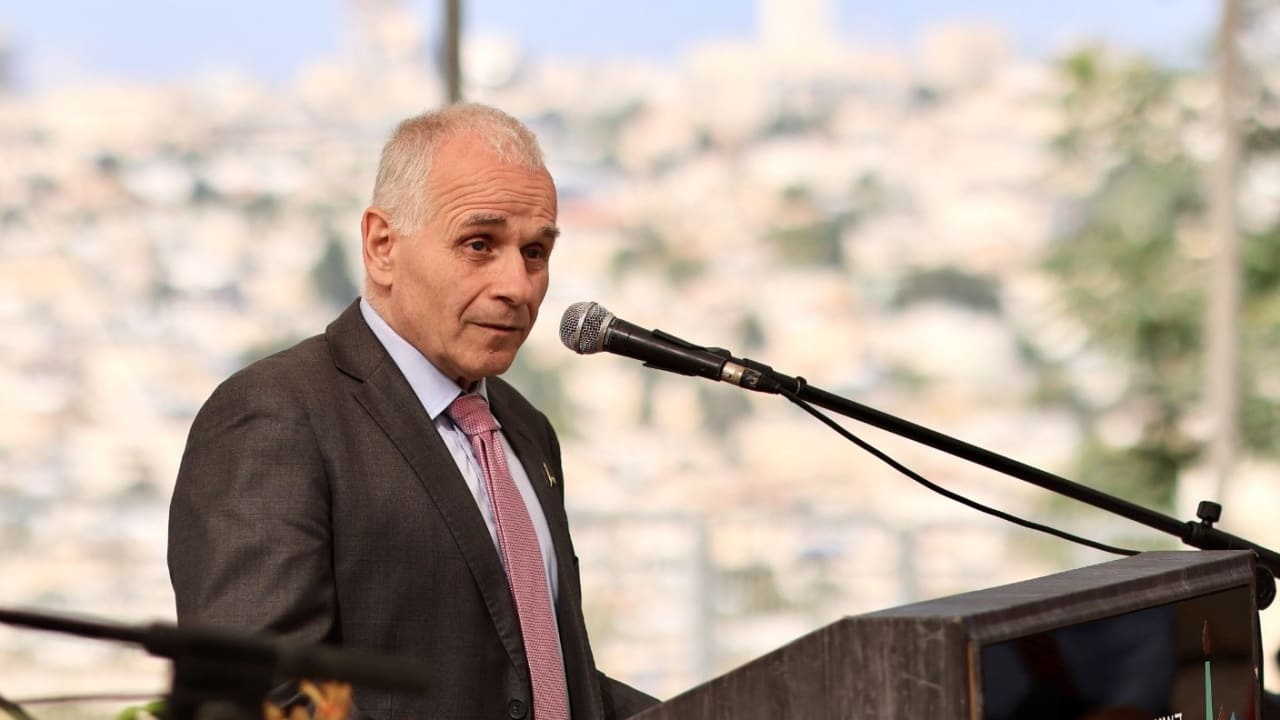

Prof. Asher Cohen has served as president of the Hebrew University of Jerusalem for the past eight years, ending a tenure that included the coronavirus pandemic, internal tensions over the judicial reform, Hamas’s October 7 attack, and the ensuing war.
Throughout this tumultuous period, Cohen continued to lead significant institutional initiatives, such as recruiting leading researchers from Israel and abroad; launching new academic tracts; strengthening the university’s real estate assets; and advancing research infrastructure.
A professor of cognitive science, Cohen specializes in the relationship between human perception and response mechanisms in situations requiring exceptionally rapid motor reactions. His contributions include the development of a theoretical model that predicts when performing two tasks simultaneously will reduce performance and when it will not.
Looking back on your eight years as president, which decision or initiative do you believe will have the most lasting impact on Hebrew University and Israeli academia?
It is difficult to single out one decision. One notable step was the establishment of a hi-tech park at our Edmond J. Safra Campus in Givat Ram, the first such park within an academic campus in Israel, which brings industry onto campus, creates jobs, and helps translate research into technologies that touch people’s daily lives. Two very important academic initiatives were the creation of a digital humanities center and a computational medicine center, both the first of their kind in Israel. The digital humanities center uses advanced tools to study language, history, and culture and to open our archives to the wider public, while the computational medicine center harnesses data and AI to improve diagnosis and treatment in hospitals and clinics. Finally, we brought to our Mount Scopus campus a center focused on mental health and addiction (ICAMH), which combines cutting-edge research with treatment for the general public, expanding access to care and underscoring our commitment to the
community.
Hebrew University has a very diverse student body with Jewish, Arab, and international students studying together. How did the October 7 events impact campus life, and what did you do to keep things calm while maintaining freedom of speech?
The past two years have posed a serious challenge to diversity in Israel, especially in relations between Jewish and Arab citizens, and our campuses have not been immune. I am proud to say that life inside our campuses remained largely calm and focused on study. This was not by chance. For years, before the war, we invested in diversity programs, mentoring, support centers, and staff training, which built trust and clear channels of communication. During this period, these frameworks helped us address tensions early and make our position clear: Freedom of speech is protected, but incitement and violence are not.
Some students and faculty have strongly criticized Israel’s conduct in the war in Gaza – how did you handle such sentiment on campus?
Our approach was to stay out of partisan politics as much as possible while remaining faithful to our core values as a public university. This is easier said than done, especially in wartime. We chose to speak out only on issues directly connected to those values: calling for the release of the hostages, supporting efforts to prevent hunger in Gaza, and opposing attempts to weaken Israel’s legal and democratic system, while avoiding broader political positions. On campus, this meant allowing a wide range of opinions within the law and our code of conduct, and intervening only when speech crossed the line into incitement or personal harm.
There have been growing calls abroad to boycott Israel and Israeli institutions, and some partners announced they were cutting ties with Hebrew University. How did you respond, and what impact did this have on the university?
The attempts to boycott Israeli academia pose a serious challenge to all our universities. Together with other institutions in Israel, we have consistently explained to our partners that universities are not part of the political system or involved in government decision-making, and that academia by its very nature is based on cooperation, not boycotts. In the face of BDS campaigns that often spread misleading claims, we made sure to lay out the facts and engage directly with every institution considering cutting ties. In many cases, we succeeded in preserving relationships, but not in all, and the boycott challenge remains with us. We will have to continue working hard to limit its impact on our students, researchers, and international collaborations.
In the latest Center for World University Rankings, Hebrew University rose to 65, while most other Israeli universities dropped. What explains this relative strength?
Actually, our position has not changed significantly. In most of the major rankings, including the prestigious Shanghai ranking, Hebrew University has been consistently placed among the world’s top 100 universities, alongside two other Israeli institutions. This stability reflects the long-term strength of Israeli academia as a whole and our sustained investment in excellent faculty, competitive research, and international collaboration. We are very proud that Hebrew University continues to be recognized at this level year after year.■