


When Chaya and Yossi Stern step onto a stage, they are not simply recounting their aliyah story. They are performing it.
Their show, Aliyah in Wartime: A story of courage, faith, and miracles, told with musical accompaniment, transforms their move from the United States to Israel just after the outbreak of war into part concert, part memoir, and part reflection on uncertainty, belief, and what they describe as divine guidance shaping their path.
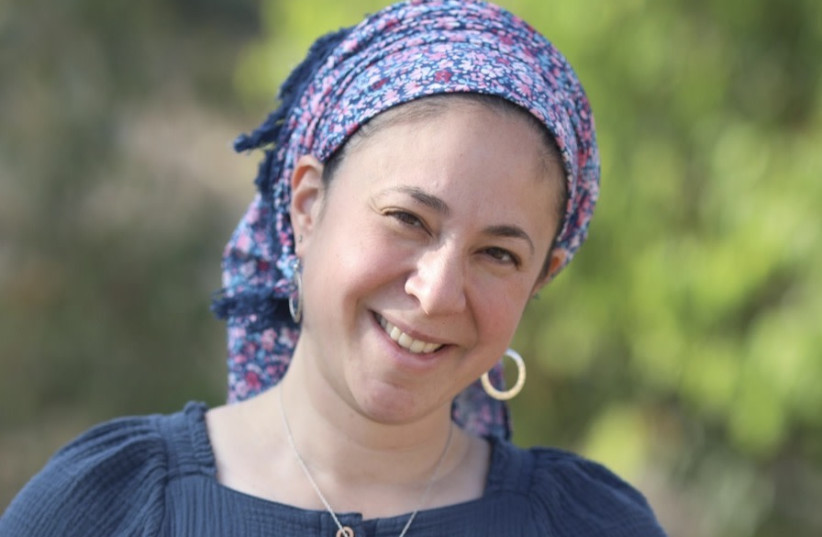
“We share about our aliyah process, how we grew through it, overcame obstacles, and saw divine guidance along the way,” Chaya recently told The Jerusalem Report.
Each segment is paired with live music performed by Yossi, Chaya’s husband, who sings and plays on stage.
At the center of the performance is a question that lingers throughout the show: Why leave stability for uncertainty, and how does a family come to interpret that decision not as risk, but as guidance?
A distant dream
For Chaya, the answer begins long before marriage or children.
She grew up in New York in a Chabad family shaped by a strong connection to Israel and the teachings of the Lubavitcher Rebbe. In her teenage years, she recalls being very involved in advocacy around Jewish life in Israel.
“We were very vocal supporters for those living in Israel,” she told the Report.
At that stage, Chaya had never considered living in Israel, and making aliyah was not common in her community. It was just a far-off idea held at a distance.
But this all changed when Chaya visited Israel for the first time at 16 years old.
“From that first trip, I knew… one day I was going to live here,” she said.
The feeling stayed through college, marriage, and four children. Yossi, originally from London, was open to Israel but did not share the same pull. Still, aliyah remained an option that was never fully off the table.
“I did bring it up pretty much from our first or second date, that making aliyah was a very big part of what I wanted in our future life,” Chaya recalled.
Years passed in the United States. The family moved from New York to Philadelphia, life became busy, and aliyah, though always present, began to feel like a distant dream.
Then came a family trip to Israel in 2022 that was initially canceled and rebooked because of COVID.
“So we came to Israel in 2022 for a visit… and we just started to experience our two-week vacation turning into a very unplanned, but very divinely guided pilot trip,” Chaya said.
Almost immediately, the same question kept appearing – from friends, acquaintances, and strangers: When are you making aliyah?
Chaya described these moments as the start of a chain of “little miracles.”
The most pivotal moment came at the end of the trip, when the airline unexpectedly offered flexible ticket changes.
Testing the waters
Although Chaya and the children had to return home, Yossi saw an opportunity to stay a few extra days and test life in Israel more seriously – not as a tourist, but as a potential citizen. He wanted to stay, but only if key conditions were met: housing, transport, and work.
Within hours, unbelievably, all of the conditions were met.
“Within an hour, he had been offered a place to stay by a complete stranger,” Chaya recalled.
A rental car reservation that had been unavailable also reopened after a cancellation.
Still, he hesitated.
At the airport, Yossi learned that extending his stay would cost $150. After deliberating, while his wife anxiously awaited his decision and the children grew restless, he decided it was a small price to pay for a few extra days that might determine the family’s future – only to reach the counter and be told the fee had been waived entirely.
“I’m giving it to you for free because you’re doing the right thing,” he was told.
For the couple, this generosity symbolized more than coincidence. It became a turning point. Those three days changed everything.
Yossi worked in construction in Hebron, joined renovation crews, drank Turkish coffee with coworkers, and experienced daily Israeli life beyond tourism.
“When he came home, he said, ‘This was an incredible experience,’” Chaya recalled.
Soon after, they opened their aliyah file. What followed was far less cinematic.
Faith and paperwork
“The process stretched into a year and a half of paperwork, expenses, and uncertainty,” said Chaya.
Documents expired while others were still being gathered. Government offices requested records that did not exist or could no longer be retrieved. At one point, Chaya was asked to prove details of her own birth, records that her hospital no longer had.
“I kept thinking, ‘What are we getting into?’” she said.
Alongside bureaucracy came financial strain that tested the family’s sense of feasibility.
“We had about $25 in the bank account,” she said. “We had nothing sorted out financially. How do we think we’re going to do this?”
Yet even in moments of doubt, Chaya described ongoing support and guidance they received as a series of unexpected signs reinforcing their decision.
A mortgage refund check arrived unexpectedly after sitting unopened in the mail for weeks. US-based christian organizations that encourage aliyah even stepped in to help by providing funding.
The couple were referred to these organizations by other olim and consulted a Rav before accepting the money.
At one point, their mechanic’s son, gave them an unexpected and generous donation that Chaya said significantly improved the family’s finances.
“It felt like little miracles,” she said.
She also turned to letters from the Lubavitcher Rebbe and religious texts for guidance, which Chaya recalled solidified their decision and commitment to making aliyah.
“How do faith, ideals, and courage transform reality?” the couple ask in their performance.
A friend also gifted her Shaar HaBitachon, a book on trust and faith, which she said strengthened her resolve. In the book, she was struck by a passage about giving money to others without expecting gratitude, because all wealth comes from God – a lesson she said reflected these miracles she had just experienced.
Finally, after a year and a half of bureaucracy and uncertainty, the family moved to Israel in November 2023, shortly after the war began, despite the shock and disbelief of family and friends.
They settled first in Shiloh, later relocating to a nearby hilltop community. The adjustment was not simple. Their children arrived without Hebrew, and bureaucracy did not end upon landing.
But life gradually took shape.
Chaya passed Israel’s occupational therapy licensing exam. Yossi worked at a winery and later served in reserve duty as a unit gunsmith. Their children adapted, learning Hebrew and integrating into their new environment.
One child, who arrived as a baby, now “runs barefoot on the mountaintops singing Hebrew songs he learns in daycare.”
As life stabilized, people who heard their story encouraged them to turn it into a performance.
“We told people our story, and they said, ‘You should be telling this professionally,’” Chaya said.
The result is a live show combining narrative and music.
“It’s more than a performance,” she said. “It’s an experience that is inspirational, meaningful, and miraculous.”
Audiences respond not only to the story but to the music itself.
“Again and again, audiences remark on Yossi’s extraordinary musical talent,” she said. “They tell us, ‘We could listen to him play all night.’”
The show is structured around the same question that defined their journey: Why leave certainty for uncertainty?
Their answer is not theoretical anymore. It is embodied in the life they built, and performed in real time. The story began in an airport, with a decision still unresolved.
Today, it continues on stage, one song at a time.■
Readers are also welcome to reach out to Chaya or Yossi with any questions via their email chayah935@gmail.com or instagram page: @thishilltoplife