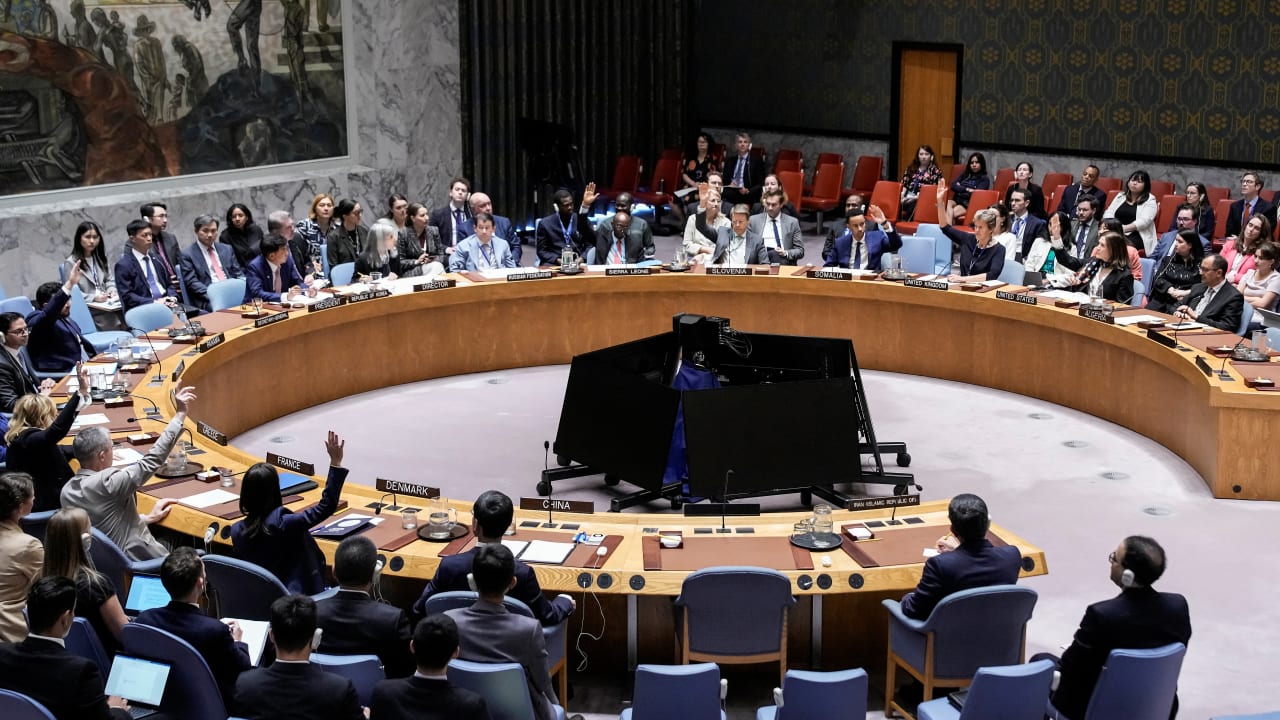
The UN Security Council will vote on Monday evening (5:00 p.m. New York time) on the draft resolution regarding the International Stabilization Force (ISF) that is expected to be deployed to the Gaza Strip.
The draft resolution is identical to the version presented to the Security Council on Thursday, which states that the multinational force will work to secure the borders, destroy military infrastructure, and demilitarize the Strip. In addition, a Palestinian police force will be trained to join the multinational force.
The proposal stipulates that decisions will be made together with Egypt and Israel, as members of the force, and that Israel’s withdrawal from the Gaza Strip will depend on its deployment throughout the territory (except for the perimeter zone, where the United States will remain for an extended period).
A clause in the draft resolution that sparked controversy is the one outlining a “pathway to a Palestinian state.” It states: "After the PA [Palestinian Authority] reform program is faithfully carried out and Gaza redevelopment has advanced, the conditions may finally be in place for a credible pathway to Palestinian self-determination and statehood.”

The clause continues: “The United States will establish a dialogue between Israel and the Palestinians to agree on a political horizon for peaceful and prosperous coexistence.”
It should be emphasized that this language is identical to that of President Donald Trump’s 20-point plan (included as an annex to the draft resolution), but the new development is that it has now been incorporated into the main text of the proposal itself, not only in the annex.
Netanyahu makes it clear Israel objects to Palestinian statehood
Despite efforts by Israel and other actors to change the wording, the current assessment is that the chances of doing so are slim. At the start of the weekly government meeting… prime minister [Benjamin Netanyahu] made it clear that, “with regard to a Palestinian state, our opposition to a Palestinian state on any territory west of the Jordan River remains firm and unchanged.”
Netanyahu added that he has been pushing back against such attempts for decades, facing pressure both from abroad and at home. “I do not need encouragement, tweets, or lectures from anyone,” he said.
During the government meeting, ministers criticized the prime minister over the decision. “This was never part of the discussion at any stage,” some said. Netanyahu attempted to justify the decision by claiming that “no country was eager to join the multinational force in the Gaza Strip” – meaning, he argued, that the clause was necessary in order to form such a force.
On social media, ministers publicly attacked the move. Finance Minister Bezalel Smotrich wrote on X: “Two months ago, immediately after several countries announced their unilateral recognition of a Palestinian state, you (the Prime Minister) promised to respond decisively as soon as you returned from the United States. The deterioration we are now witnessing is dangerous, and it is your responsibility, caused by your silence. Formulate an appropriate response immediately.”
Likud Minister Miki Zohar also issued a statement saying: “A normalization agreement with Saudi Arabia is a paramount Israeli interest and will change the future of the Middle East for generations, of course while preserving Israel’s vital principles and without recognizing a Palestinian state that would endanger our security.
“Israel as a security powerhouse working alongside the Gulf powers – that is the greatest nightmare of Israel’s enemies,” he said.