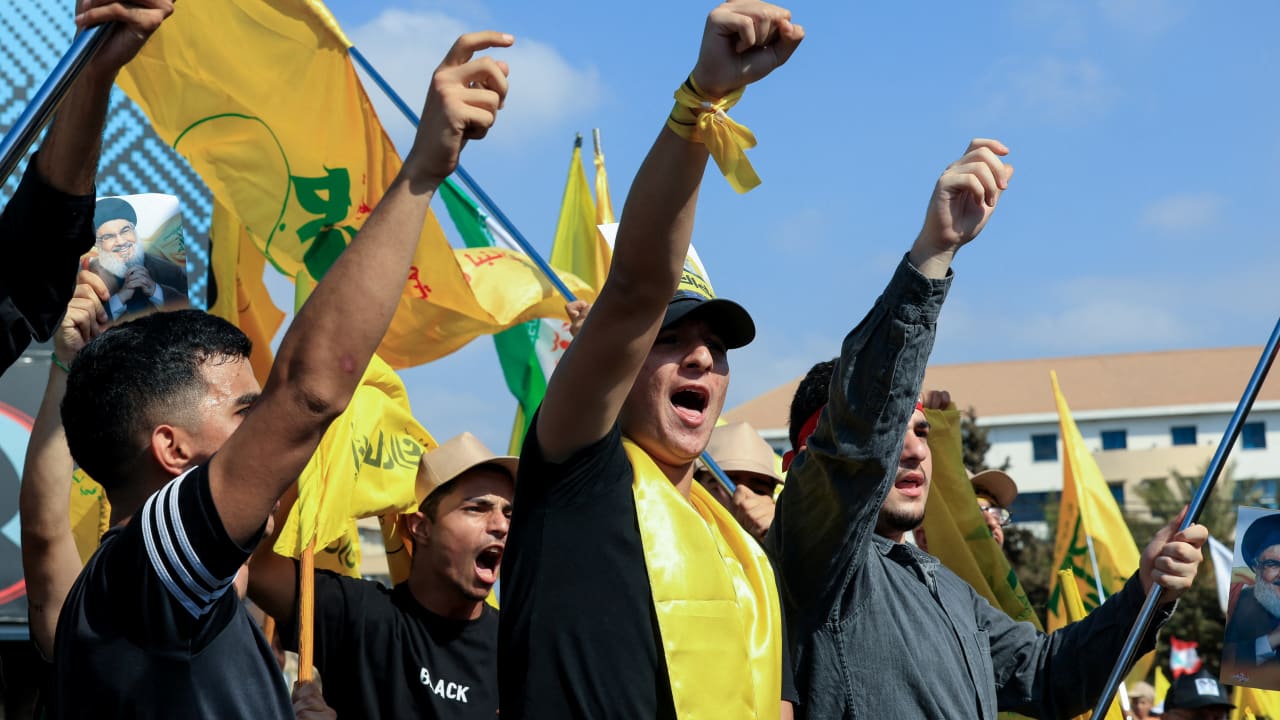
Hezbollah is facing increasing airstrikes as Israel continues to target its operatives in Lebanon. The terrorist group is also cut off from easy rearmament, because Syria is now controlled by a government that opposes it.
As such, Hezbollah may face a rocky road ahead. In its favor, however, is that the Lebanese government still refuses to confront or disarm it.
Hezbollah may have accepted the “resignation” of one of its officials, according to a report over the weekend.
“Lebanon’s Hezbollah accepted the resignation of senior security official Wafiq Safa on Friday, the first time an official of his rank has stepped down,” Reuters reported.
“Safa, who heads Hezbollah’s liaison and coordination unit responsible for working with Lebanese security agencies, survived an Israeli assassination attempt in October 2024,” the report said.
Hezbollah attributed the resignation to “internal restructuring,” Reuters reported, adding that Hezbollah’s “southern commander Hussein Abdullah was appointed to replace Safa.”
The Associated Press reported similar details. Its report said Hezbollah “replaced a top security official who was in charge of coordination with Lebanon’s security agencies after he told the group’s leadership that he wants to step down, two officials with the group who were not authorized to speak publicly on the matter said Friday.”

“Wafiq Safa had headed Hezbollah’s Liaison and Coordination Unit for decades, and it was not immediately clear what his new job within the Iran-backed group is going to be,” the report said, adding that Hezbollah said he was replaced by “Hussein Abdullah, who is not publicly known.”`
Overall, the reports portray Hezbollah as having undergone some internal changes. Some of these affect the liaison and coordination unit. Whether this matters is unclear.
It is also unclear what ramifications it may have. Is Hezbollah concerned that its liaison with the government is not going as planned?
Hezbollah has not been disarmed, which appears to be its main priority at the moment.
Reconstruction in two southern Lebanese villages
The news from Hezbollah was released as Lebanese Prime Minister Nawaf Salam went to southern Lebanon and discussed reconstruction projects in two villages, Yarine and Tayr Harfa. The goal is to repair the destruction from the war.
The government is now trying to move forward with these efforts. Salam sees this as a “national cause.”
Salam “outlined a recovery framework that includes cash assistance, free healthcare services, and guarantees for continued education for displaced students,” China’s official Xinhua News Agency reported. “The government will also focus on rebuilding public infrastructure and state-owned property for better conditions in the villages.”
Salam’s visit lasted two days. He began his trip in Tyre and then went to villages near the border, including Yarine. This village is across from the Israeli village of Arab al-Aramshe.
“Salam received a warm welcome in Yarin,” English-language news site The New Arab reported. “Locals dressed him in an abaya, symbolizing high respect for a guest. ‘I know the pain of Yarin as I know the pain of Zallutiyeh, Al-Bustan, Marwahin, and Al-Dhaira, and as I have seen the pain of your neighbor Tayr Harfa,’ Salam said. ‘These towns have suffered a real catastrophe, and some have endured years of neglect and marginalization... I also know that the attacks are ongoing and that many people live with daily worry, but I know something greater: I know the southerners, in all their diversity, and their attachment to their land. Your resilience is the priority, and the state will stand by you so you can remain and continue [to stay] on your land.’”
Salam said Lebanon still intends to continue with the disarmament of Hezbollah. Like most officials, however, he will not call out Hezbollah.
This has been a challenge with many Lebanese officials, who are willing to talk in general terms about “armed groups” but won’t actually disarm Hezbollah.
Lebanon’s army chief, for instance, was in Washington and Florida last week for key meetings with US Central Command and others. Nevertheless, he also appears to refuse to confront Hezbollah.
Meanwhile, Israel has increased attacks in Lebanon, the Norwegian Refugee Council (NRC) recently reported.
“Israel has carried out at least 50 airstrikes in Lebanon in January 2026 alone, double the number recorded in December, and the highest monthly figure since the ceasefire,” the report said, adding that “the strikes not only create an atmosphere of fear and uncertainty for civilians but also represent a frequent violation of the ceasefire agreed between Israel and Lebanon in November 2024.”
According to Maureen Philippon, NRC’s country director in Lebanon, “We have seen a clear and dangerous surge in the sheer number of Israeli attacks on Lebanon in the first month of the year.”