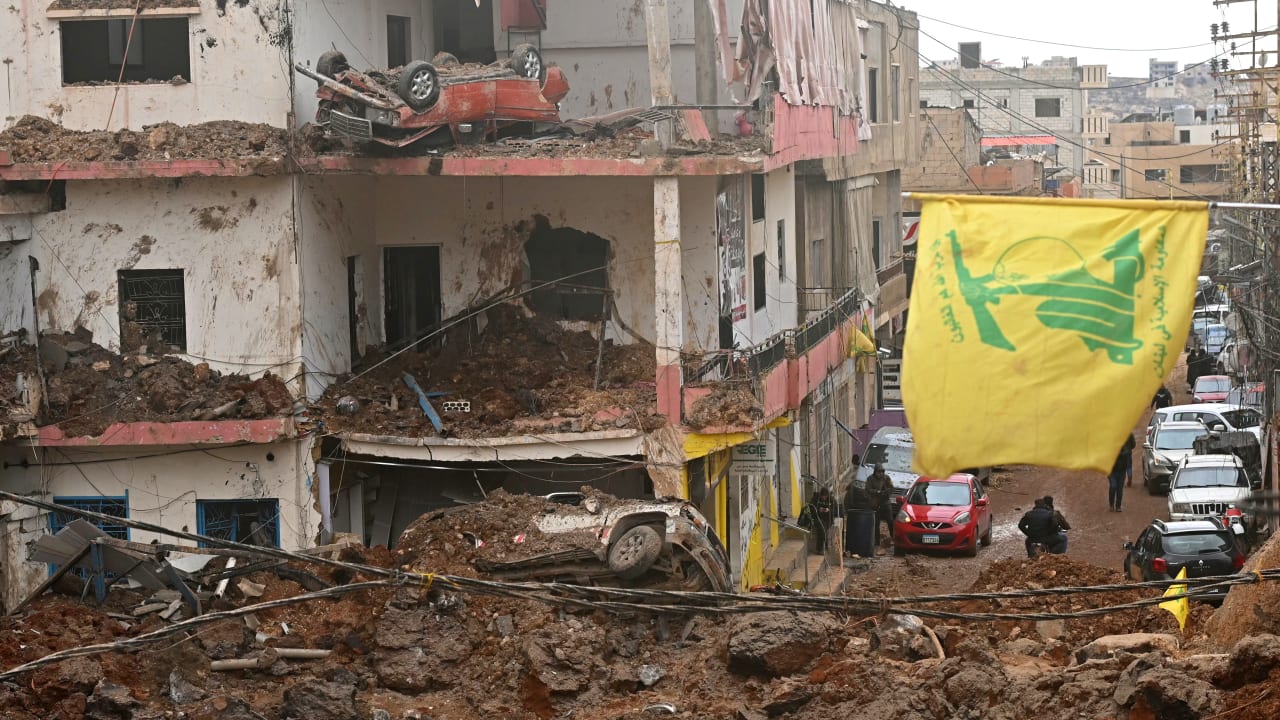
After Lebanese President Joseph Khalil Aoun condemned on Sunday Hezbollah’s “populist campaign” to lure Lebanon into a conflict with Israel, Lt.-Col. (Res.) Sarit Zehavi, the founder and president of the Alma Research and Education Center, told The Jerusalem Post she was unconvinced Beirut’s words would translate to more concrete action.
On Sunday, the same day Aoun denied Hezbollah’s entry into the conflict with six missiles “devoid of impact and effectiveness,” the Lebanese terror group carried out 31 attack waves against Israel, more than 10% of which involved the use of drones.
Sunday’s attacks also saw a Fateh-110 missile launched at central Israel, a kindergarten in Ramla was hit, and around 16 Israelis were wounded by shrapnel in civilian neighborhoods.
Aoun insisted that the six projectiles launched last week did not “achieve, even on the emotional level, a convincing revenge in response to the assassination of the Supreme Leader Khamenei.”
Rather, he claimed that Hezbollah had likely carried out the action to either force Lebanese forces to confront Israel or to champion itself as an alternative to a state unable or unwilling to protect its people.

“Whoever launched those rockets wanted to buy the fall of the Lebanese state, under aggression and chaos, even at the price of destroying dozens of our villages and the fall of tens of thousands of our people. For the sake of the Iranian regime's calculations,” Aoun claimed, adding that “the Lebanese government, on March 2 of this year, took a clear and irrevocable decision stipulating a ban on any military or security activity by Hezbollah. And this is what we want to implement in a clear and decisive manner.”
Expert: 'Little faith' Beirut will deliver on Hezbollah disarmament
Zerhavi shared she had “very little faith” that Beirut would ever “truly deliver” on disarming Hezbollah, suggesting it was more fearful of a civil war than a confrontation with Israel.
“In order to do that (disarm and disable Hezbollah), they will have to clash with it, which they were not willing to do,” she said, though acknowledged that the country had taken positive steps to mitigate Iran’s IRGC presence in the country by now requiring Iranians to acquire a visa.
“The Lebanese government is not doing what it has to do against Hezbollah because it is afraid of a civil war,” she continued. “The elimination of the Islamic Republic in Iran will cut off the oxygen line of weapons, money, training and ideology to Hezbollah, and will assist greatly in motivating the Lebanese government to do what it has to.”
Israeli forces significantly weakened the Iran-backed terror group in 2024, leaving Lebanon in the best position it has been in to take material action, she said. Despite this, Hezbollah has been allowed south of the Litani River in violation of earlier agreements and, since March 2, has carried out a total of 269 attack waves toward Israeli territory.
The latest round of fighting has been costly for Lebanon, with two UN agencies claiming that 667,000 people have been displaced as of Tuesday and a total of 486 people killed.
The current rate of displacement in Lebanon is outpacing levels seen during the 2023-24 war between Hezbollah and Israel, the UN Refugee Agency said on Tuesday.
"Many of the people fleeing were also fleeing back in 2024. We met many who then had their homes completely destroyed, family members killed and so on. So this means that people are not waiting to see what will happen next. They leave immediately," said Karolina Lindholm Billing, UNHCR representative in Lebanon. "Many others are staying with relatives or friends or still searching for accommodation, and we see cars lined along the street with people sleeping in them and also on the sidewalks."
Despite the apparent cost to civilian life, Zehavi doubted reports suggesting Hezbollah was losing its popularity among its Shia supporters in southern Lebanon.
‘We don't see them in the streets protesting. We don't see them demanding to see an alternative. We don't see an alternative. And to those Muslim Shiites of Lebanon, we don't see Lebanon closing the civilian infrastructures of Hezbollah, the organizations, the social organizations, the banks, the schools, the hospitals, all this is not happening. It's just words on social media,” she continued. “[Aoun] won't gain achievements with words on social media.”